

Tag Archives: Revenue Operations

Business analyst reviewing performance dashboards to address the GTM data latency problem and improve decision-making speed

The Data Latency Problem: Why GTM Teams Lose Pipeline to Stale Insights

The GTM data latency problem is not about wrong data, it’s about late data. Most organizations assume poor decisions trace back to inaccurate information. The real culprit is timing: intelligence that arrives after the window to act has already closed.

This timing problem is a hidden risk in Revenue Operations and Go-To-Market systems. Their analytics focus more on deep reporting rather than how quickly data can be delivered. Monthly pipeline reviews inform weekly execution calls. SDR teams receive intent signals after buying windows have cooled. Forecasting models reflect historical snapshots instead of live pipeline movement.

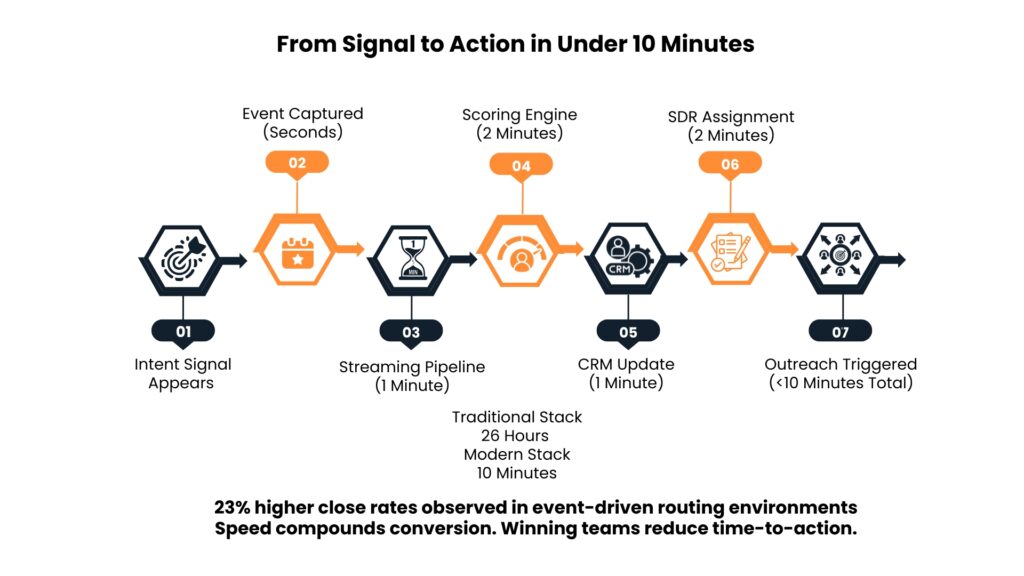
A 2024 RevOps survey found that 57% of critical GTM decisions are made before fresh data is even available. A 2025 benchmark of 68 revenue-focused organizations found that 79% of revenue-critical systems were still fed by batch-based pipelines, with a median end-to-end latency of 26 hours.

In B2B environments where buyers move from anonymous research to vendor shortlists in days, a 26-hour intelligence lag is not a minor inefficiency. It is a structural competitive disadvantage.

Why the GTM Data Latency Problem Is Now a Revenue Liability

Modern B2B buyer behavior moves faster than legacy reporting cycles were built to handle. Buying committees form and evolve rapidly. Budget priorities shift within weeks. Leadership changes open or close pipeline opportunities with no advance notice.

A 2024 study of high-intent accounts found that 54% of accounts signaling strong buying intent converted to meetings within 48 hours, and 78% showed no active signal beyond the 72-hour mark. GTM teams often act on outdated data, one to three days old, which means they target buyers who’ve moved on and rely on signals that have already expired.

Research by HBR shows that firms responding to inbound leads within an hour are seven times more likely to qualify those opportunities than those who take even a little longer. Still, most revenue stacks take 8 to 24 hours to provide insights. This delay can be a real issue. For example, a lead generated on Monday might not reach a sales rep until Wednesday, accumulating about 54 hours of delay. Since the chances of converting a lead fall off sharply after just an hour, that backlog turns into missed opportunities.

You can read more about data prioritization in B2B here.

Four Structural Sources of Data Latency in GTM Stacks
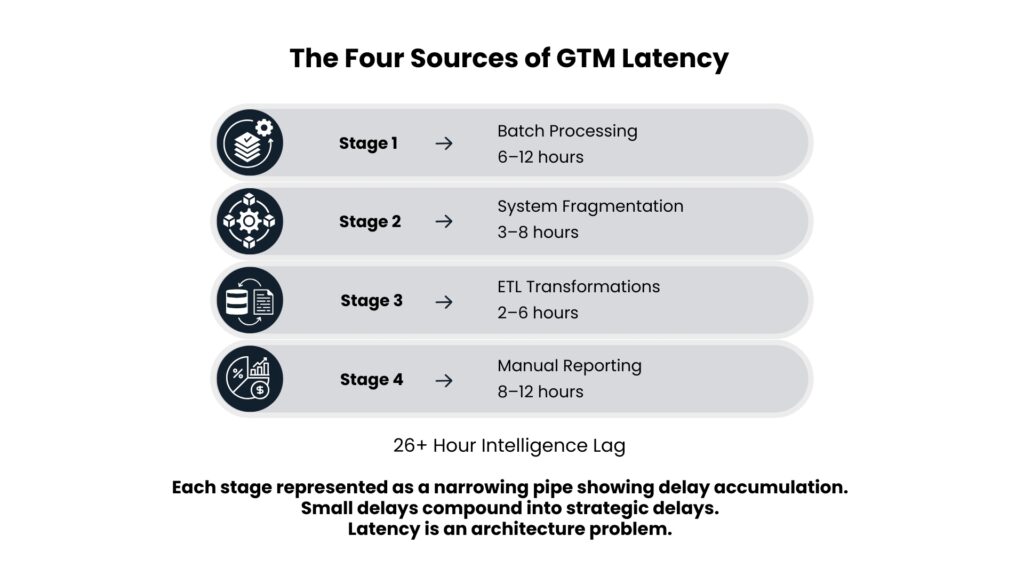
The GTM data latency problem is not a single bottleneck. It compounds across four interconnected layers.

Batch Processing Pipelines

Most enterprise data warehouses still run on batch-oriented ETL cycles. Raw events are grouped and processed on hourly or daily schedules. Even when event collection happens in real time, batch transformation introduces hours of processing lag before any signal reaches an operational system. A 2025 audit found the median end-to-end latency across these systems at 26 hours.

Fragmented System Architecture

On average, businesses use 8 to 12 tools for their revenue stack. When a high-intent signal comes in, it needs to go through web analytics, marketing automation, a data warehouse, enrichment services, a scoring engine, a CRM, and a sales engagement platform. With each step taking 30 to 90 minutes, the urgent lead from the start of the day can become outdated by hours. And it gets worse – integration issues don’t just add time; they multiply delays.

ETL Transformation Delays

Transformation logic introduces additional lag through complex joins between Salesforce, CDPs, enrichment providers, and intent platforms. Late-updating reference tables and territory mappings create a patchwork state where some attributes are current and others are weeks old. This partial staleness is operationally worse than plain latency because it produces misleading intelligence rather than a visible gap.

Manual Reporting Cycles

A significant share of business intelligence still runs through human-generated analysis. Analysts export data, clean it in spreadsheets, and prepare slides for leadership. This cycle often adds 8 to 12 hours on top of system latency. One 2025 case study found that 41% of urgent pipeline and forecasting requests were not completed until two calendar days after the triggering event.

Revenue Consequences of Unresolved Data Latency in GTM Systems

Each of the following consequences traces directly to unresolved data latency in GTM systems.

Missed Buyer Windows

High-intent signals lose conversion value rapidly. A 48-hour delay in routing intent-driven accounts was estimated in one RevOps stack to cost 19% of potential pipeline from that cohort. Organizations technically possess the right intelligence. They operationally fail to act before the opportunity expires.

Structurally Inaccurate Forecasting

A 2025 RevOps benchmark found that models updated once per week had 16 to 22% higher error rates compared to models ingesting data within 12 hours. Models trained on daily snapshots overestimated close rates by an average of 13% because they lagged short-cycle velocity changes. These errors cascade into quota allocation, territory design, and budget decisions built on a pipeline state that no longer exists.

Operational Waste Across GTM Teams

Stale data forces reactive behavior. Sales reps spend hours researching accounts based on last week’s profiles, unaware of executive changes or competitive tool adoptions that occurred 48 hours prior. Customer success teams identify churn risk after intervention windows narrow. The waste is invisible in individual workflows but accumulates into measurable capacity loss across the organization.

Framework: The Intelligence Velocity Matrix

Not all data requires real-time processing. Solving the GTM data latency problem starts with identifying where latency directly degrades revenue outcomes and where batch processing remains sufficient.

A practical model evaluates each data flow across two dimensions: decision frequency and value decay rate.

Tier 1: Real-Time Critical. High frequency plus fast decay. Examples include inbound lead routing, buying intent signals, and product trial engagement. These require sub-15-minute latency and justify event-driven streaming infrastructure.

Tier 2: Near-Real-Time Operational. High frequency plus slower decay. Examples include account-level engagement scoring and contact enrichment. These benefit from 15 to 60-minute refresh cycles through incremental processing or change data capture.

Tier 3: Strategic Analytical. Low frequency, used for planning. Examples include quarterly business reviews and territory design. Daily or weekly batch processing is appropriate here.

This tiering prevents over-engineering and aligns infrastructure cost with revenue impact.

How to Build a Low-Latency GTM Intelligence System

Event-Driven Architectures for Critical Signals

Instead of waiting for those scheduled syncs, event-driven architectures catch signals right when they happen and instantly send them off. So, when a prospect visits a pricing page or hits a product usage milestone, an event record gets sent through something like Apache Kafka. Then, downstream systems can grab that info in seconds, not hours. In one case, a RevOps team used this method to assign enterprise accounts with sudden interest spikes to a dedicated SDR pod within minutes. This led to a 23% higher close rate compared to accounts processed through batch pipelines.

Incremental Processing as a Middle Path

For organizations not quite ready for full streaming, incremental processing offers major upgrades without an extensive revamp. Rather than refreshing whole datasets nightly, systems now update only what’s changed, every 5 to 15 minutes. Plus, platforms like Snowflake, Databricks, and BigQuery make this easy via change data capture and materialized views. So, a firm dealing with 100,000 daily CRM updates could go from that big 24-hour lag to just 15 minutes – all with minor infra tweaks.

Automated Alerting and Decision Triggers

Low latency only matters when paired with automation. Top performers link smarts right into their workflows, sending real-time notifications for intent spikes, kicking off plays when pipelines lag, and routing stuff automatically based on fit. Advanced setups take it up a notch too. They can pause campaigns or switch to retargeting when conversions slow down, and adjust the timing and channels based on actual engagement.
Practical Recommendations for RevOps Leaders

First, audit the current latency and then make those infrastructure changes. Document when data hits source systems, when it gets to GTM platforms, and when decision-makers see it. You’d be surprised how many delays are lurking around that nobody tracked before.

So rank the high-value data flows first. Give each one a score based on decision criticality, market dynamics, and latency tolerance. After that, focus on upgrading streaming or incremental processing for the top two to four data flows. Also, aim to get latency down from 24 hours to less than an hour first. Then, you can target reducing times from one hour to under one minute.

Set clear goals for how fresh your data needs to be. For top performers, key revenue signals should hit action inlets in under 10 minutes, lead scoring updates within 30, and opportunity data sync’d up in an hour. Companies acting ten times slower are working with stale info that could mislead decision-making.

Also, keep an eye on how long it takes for an event to affect sales actions. Treat end-to-end latency as a crucial performance indicator right next to pipeline and conversion rates.

Conclusion: Speed Determines Whether Insights Have Value

In modern GTM systems, accurate information alone is no longer sufficient. Timing determines whether intelligence creates competitive advantage or becomes operational hindsight.

The future of B2B intelligence will not be defined solely by data quality or data volume. Closing the GTM data latency gap will define which organizations convert signals into decisions.

Insights that arrive too late are, in every practical sense, indistinguishable from no insights at all.

Professional reviewing and approving digital records as part of a data trust architecture for reliable business decision-making

Data Trust Architecture: Why Reliable Data Matters More Than More Data

When the VP of Sales questions the pipeline forecast three hours before the board meeting, the problem isn’t data scarcity; it’s data credibility. This is the core challenge that data trust architecture is designed to solve. Modern B2B organizations run CRMs, enrichment platforms, intent providers, attribution tools, and AI-driven scoring engines in parallel. Yet a 2025 survey of 72 revenue-focused companies found that 68% of executives and 59% of RevOps leaders regularly questioned the accuracy of their core dashboards. That is not a volume problem. That is a data trust collapse.

According to OneStream, 72% of companies say bad data costs them at least $500,000, and more than one-third report losses over $1 million. A mid-market B2B firm, with $50 million in yearly income, actually loses around $1.25 million each quarter for every week their strategic decisions are held up because of data issues. The future competitive advantage in B2B intelligence belongs to organizations with the most trusted data systems, not the largest ones.

Why Data Trust Breaks in Revenue Organizations

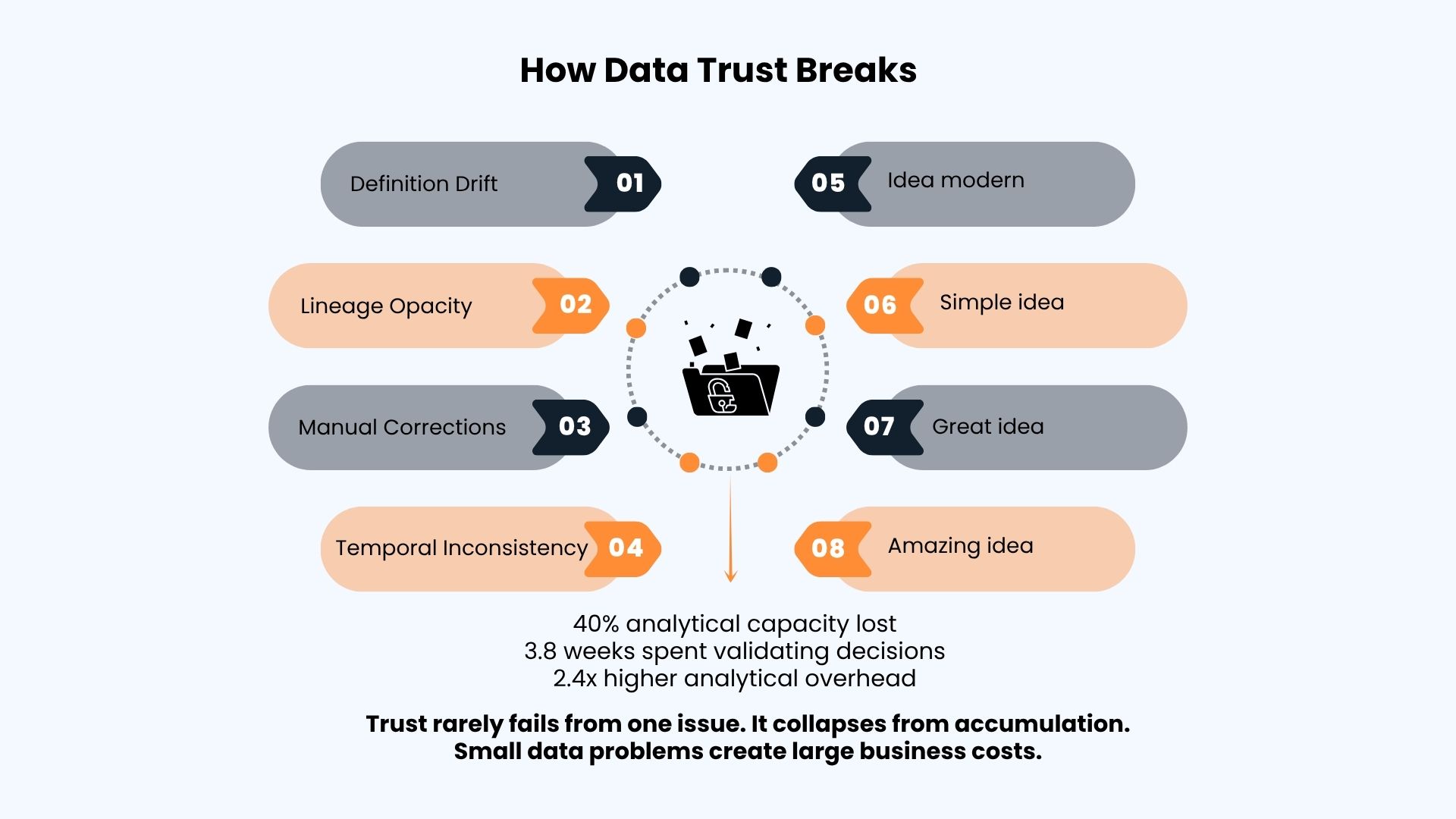
Data trust rarely collapses from a single failure. It erodes through four compounding structural problems.

Definition Drift and Lineage Opacity

Definition drift is the most common fracture point. Marketing counts an “active account” using website intent signals. Sales counts it only after a validated opportunity exists in the pipeline. Finance recognizes it after the first invoice clears. A 2024 analysis of 200 B2B organizations found an average of 4.7 conflicting definitions for core metrics across departments. One SaaS company discovered a 23% discrepancy between marketing and sales pipeline numbers that stalled a market expansion decision for six weeks. RevOps teams in low-definition environments waste an estimated 40% of their analytical capacity reconciling conflicts rather than generating actionable insight.

Lineage opacity compounds the damage. Modern B2B data architectures pass through 7 to 12 transformation layers between source systems and executive dashboards. A 2025 RevOps survey found that only 19% of teams could reliably trace 90% of core revenue metrics back to their source. A telecommunications B2B provider traced an 18% variance in customer lifetime value calculations through five transformation layers to a JOIN operation excluding multi-product customers. The error had misdirected $4.2 million in R&D resources over eight months. Without lineage, debugging is archaeology.

Manual Corrections and Temporal Inconsistency

Undocumented manual corrections are equally destructive. In 68% of B2B organizations studied, finance teams make manual adjustments to revenue data that are never logged in audit-accessible formats. One manufacturing company’s monthly reporting incorporated 127 undocumented Excel adjustments maintained by three analysts. When two departed within six weeks, month-end close extended from four days to nineteen days while the team reverse-engineered the correction logic.

Temporal inconsistency in snapshot data creates a subtler but equally costly problem. When March pipeline forecasts use February 15 data but the comparison baseline uses February 28 data, the 13-day delta introduces noise that masquerades as signal. A private equity firm discovered their month-over-month growth calculations compared snapshots across different billing cycles, causing three portfolio companies to be systematically underfunded.

The Compounding Revenue Cost of Low Data Trust

Low data trust does not just slow decisions. It restructures how organizations operate, creating cascading costs that function as a hidden tax on the entire revenue pipeline.

Analytical duplication alone is substantial. A 2024 RevOps case study found an organization spending 11,000 analyst hours per year reconciling data that should have been settled once. Organizations with low data trust spend 2.4 times more on analytical headcount relative to revenue than high-trust peers.

Tool adoption collapses in low-trust environments. Enterprise analytics implementations average $2.8 million in first-year costs. When users continue relying on legacy spreadsheets, adoption stalls near 40%, tripling the effective cost per active user. A 2025 benchmark of 50 revenue teams found that 63% of SDRs and AEs used spreadsheets as their primary source for account prioritization, not the company-wide BI system.

The speed penalty is measurable. The median B2B company takes 6.2 weeks to agree on big decisions, and it spends 3.8 weeks just verifying data. Companies with low trust in their data take 31% longer to wrap up their plans. On the flip side, rivals who trust their data cut their decision-making time by 60%, gaining first-mover benefits that stack up in every cycle.

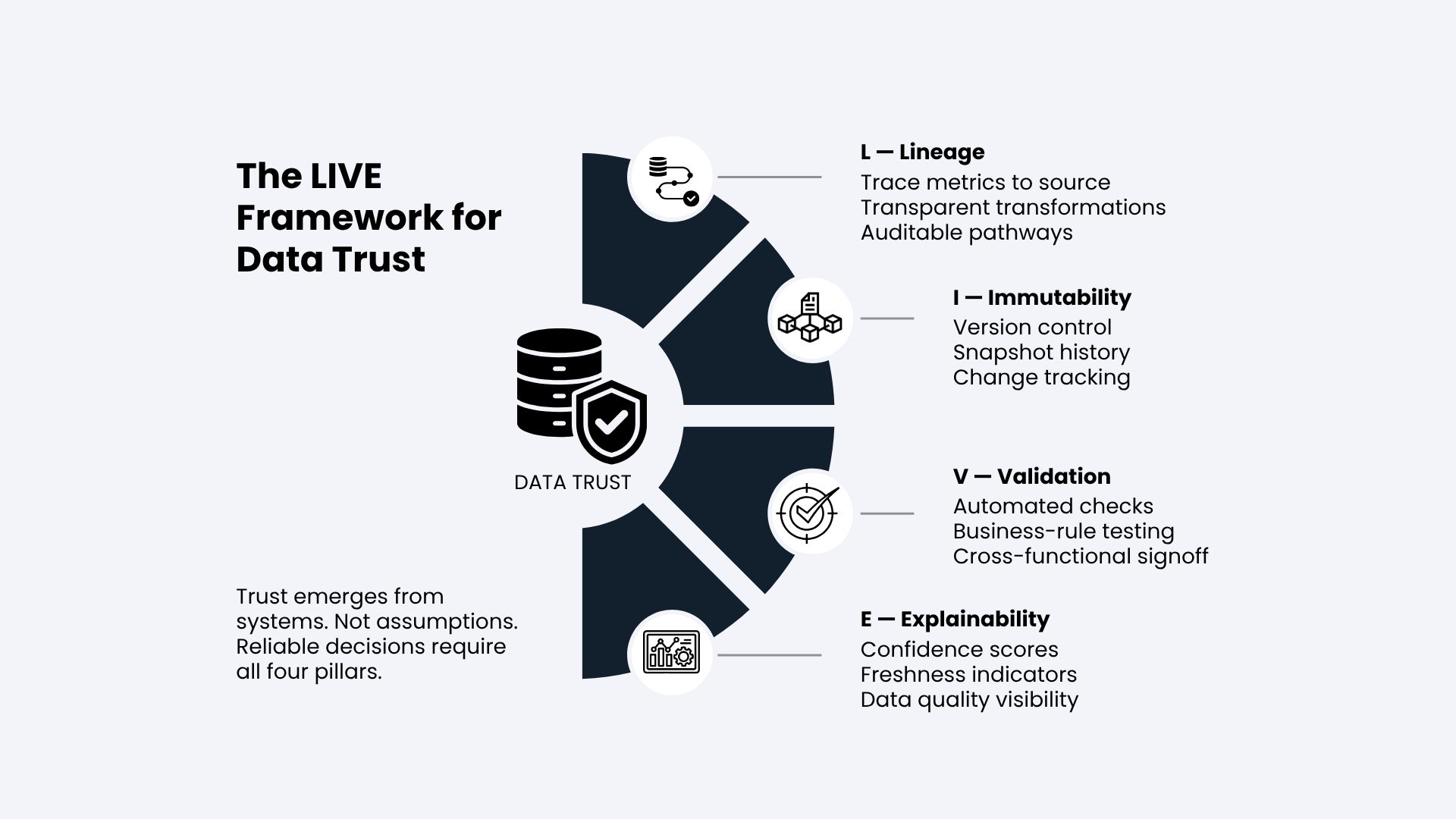
The LIVE Framework: Four Pillars of Data Trust Architecture

Building a reliable data trust architecture requires four foundational capabilities that work together.

Lineage means every metric traces back to its source through documented, auditable pathways visible to business stakeholders, not just data engineers. Column-level lineage implementation at one enterprise software company reduced analyst time spent on “where does this number come from” investigations by 73%.

Making datasets immutable is about treating them like code. This means versioning each transformation, taking snapshots at key decision points, and keeping logs of changes and reasons why those changes happened. Take a B2B logistics firm; after they started versioning their datasets, they reduced their monthly discrepancy solving time from 40 hours to just 7 hours. That’s huge!

For validation, you need checks across different levels. Start with checksums in the source system to make sure the data warehouse is accurate. Add automated business rule tests for logic checks before report publishing. Also, include cross-departmental approval steps where finance and sales teams must sign off on figures together. At a manufacturing company, a similar setup caught a currency conversion mistake in cost calculations that had gone unnoticed for 14 long months. With the new validation process, they spotted it right on day one.

Explainability means showing confidence levels right in dashboards. Including data freshness, completeness scores, and source quality ratings gives stakeholders the context needed to properly interpret the metrics. One SaaS company added confidence scoring and saw executive engagement with analytics dashboards rise 45%, as leaders got more visibility into data limitations.

You can read more about building a composable data architecture here.

A Practical Evaluation Tool: The Data Trust Scorecard

A practical way to audit your data trust architecture is the RevOps Scorecard. RevOps leaders can use a Data Trust Scorecard to measure trust in core revenue metrics. This scorecard rates each metric on four things from 0 to 5.

First, Lineage Transparency: Can we trace the metric to its origin?

Second, Governance and Process: Does paperwork exist for changes and have people been told about them?

Third, Definition Clarity: Has everyone agreed to one definition?

Fourth, Adoption and Reliance: Do stakeholders make calls based on the metric or do they secretly use other spreadsheets?

The Trust Score is the average of those four parts. When used in a 2025 RevOps study, it cut data-checking delays by 28% and boosted analytics adoption by 19%, all within a year and a half.

Practical Recommendations for RevOps Leaders

Audit trust failures directly. Map where stakeholders distrust systems, which dashboards face the most scrutiny, and where manual verification recurs. Trust friction reveals the weak points that accuracy metrics alone cannot surface.

Create a shared metric glossary for the most crucial GTM metrics. Include the definition, source system, key rules, owner, and change history for each one. Show this to everyone, and make it a requirement to review it before getting access to the executive dashboard.

Build cross-functional data governance. Form a working group with representatives from RevOps, sales operations, marketing operations, and finance. Define change-control processes and require that all substantive changes are communicated before they affect operational reporting. Organizations with complete alignment between finance and IT are 5.5 times more likely to report full confidence in their data.

Monitor continuously. Set service-level indicators for key revenue metrics, automate freshness and anomaly checks, and treat data quality like application performance. Catching structural errors in real time prevents downstream sales impact before it registers in the pipeline.

Reliable Data Is the Actual Competitive Advantage

Data volume is no longer the differentiator. Most B2B companies already have way more data than they know what to do with. The big issue isn’t about having enough data; it’s whether the people making decisions trust that data enough to actually use it.

The organizations that thrive are the ones that invest in data trust architecture treat trust as infrastructure, not a by-product. Every measurement needs to be clearly defined and understood by everyone involved. When you treat trust as something concrete and build systems around it, teams start seeing how reliable their data is right in their workflow. This means no more wasting time; like 3.8 weeks per quarter just checking numbers, are needed before moving forward.

The organizations that will lead in the next phase of B2B intelligence are not those collecting the most signals. They are those who have built the infrastructure to verify, govern, and confidently activate the data they already have.

Reliable data is not a luxury. It is the foundation for every strategic advantage that follows.

Business professionals reviewing analytics dashboards and performance metrics to improve data-driven decision making across teams

Data-Driven Decision Making: Closing the Analytics Gap

Revenue operations leaders struggle with data-driven decision making despite massive infrastructure investments. Organizations deploy intent platforms, enrichment APIs, and real-time analytics, yet strategic decision quality remains stagnant.The problem is not data scarcity. It is decision inefficiency.

A 2025 study of 750 business leaders found that 58% say key decisions are based on inaccurate or inconsistent data most of the time. More concerning: 65% believe no one at their organization fully understands all collected data or how to access it. Between 60% and 73% of enterprise data goes unused for analytics, while up to 90% of dashboards eventually become abandoned digital assets.

This is the data decision gap: the disconnect between generating insights and executing decisions that change business outcomes. In go-to-market systems, this gap directly impacts pipeline velocity, conversion rates, and revenue predictability.

What the Data-Driven Decision Gap Actually Means

Data-driven decision making fails when insights don’t translate to action. The data decision gap is the organizational failure to convert analytical outputs into timely, confident business actions. It manifests in three critical patterns.

First, insight availability without decision clarity. A demand generation team identifies that enterprise accounts from financial services convert at 3.2x higher rates than other segments. The insight is clear. The decision is not. Does this mean reallocating all outbound resources? Adjusting pricing? Changing content strategy? Without a decision framework, insights become conversation topics rather than action triggers.

Second, analysis complexity creating decision hesitancy. When sales operations receives a quarterly review tracking 17 metrics across six regions, cognitive overload produces decision avoidance rather than better choices. Research from the Corporate Executive Board found that providing more information decreased purchase confidence by 23%. The same principle applies internally.

Third, time lag between insight generation and decision relevance. Customer success discovers through cohort analysis that accounts without executive engagement in the first 90 days churn at twice the baseline rate. By the time this insight reaches decision-makers and gets operationalized into playbooks, the current cohort has already passed the 90-day window. The insight was accurate but temporally disconnected from its moment of utility.

Organizations optimize for analytical comprehensiveness rather than decision speed and clarity. This is the core failure.

Why the Data Decision Gap Exists

Three structural deficiencies prevent data from translating into decisions.

Lack of interpretation frameworks. Data answers what is happening but not what should be done. When pipeline velocity decreases by 12%, that number alone does not indicate whether the problem stems from lead quality degradation, sales capacity constraints, or deal complexity increases. Without established frameworks that translate metrics into diagnostic categories, each insight triggers a new investigation rather than a predetermined response.

High-performing revenue teams implement decision architectures: pre-defined logic connecting specific data patterns to decision options. For example, if MQL-to-SQL conversion drops below 18% for two consecutive weeks and lead source distribution has not changed, then audit lead scoring criteria and contact SDRs for qualification feedback within 48 hours.

Unclear decision ownership. Data democratization promised better data-driven decision making but created insight accessibility but dissolved decision accountability. A SaaS company analyzed why expansion revenue consistently underperformed despite accurate usage data predicting expansion propensity. The root cause was organizational. Customer success saw expansion signals, but account executives controlled the commercial relationship. Neither team had clear authority to act, so both analyzed repeatedly without executing.

Forbes Council research confirms this pattern: 77% of business leaders say dashboards and charts they receive do not directly inform their decisions. According to Gallup, only 21% of employees strongly agree they have performance metrics within their control.

Over-engineered analysis for under-specified decisions. Revenue teams often pursue analytical sophistication that exceeds decision complexity. Building a machine learning model to predict deal close probability with 87% accuracy sounds valuable until you recognize the business decision is binary: prioritize this deal or do not. If the threshold for prioritization was 70%, the additional 17 points of precision consumed weeks of resources without improving decision quality.

Impact on GTM Performance and Revenue

The decision gap erodes revenue across three dimensions.

Velocity degradation through decision bottlenecks. Revenue intelligence analysis of 200 B2B companies found that organizations in the slowest quartile for internal decision-making had 34% longer sales cycles than the fastest quartile, even when controlling for deal size and industry. The delay was not in customer decision-making. It was in seller decision-making about discount approvals, contract terms, and resource escalation.

Opportunity cost from missed timing windows. Intent signals decay rapidly. Bombora research shows buyer intent signals have a half-life of 7 to 12 days depending on signal strength. Marketing teams that take three weeks to decide on campaign adjustments based on intent data are optimizing for opportunities that have already moved to competitors. The analysis was accurate when generated. It became irrelevant before execution.

Resource misallocation from strategy-execution lag. A technology company identified that inside sales closed deals 40% faster than field sales for accounts under $50K ARR, suggesting a channel strategy shift. Operationalizing that insight required decisions about compensation restructuring, territory reassignment, and customer communication that took two quarters to finalize. During those quarters, the company continued staffing the less efficient channel at full capacity, burning approximately $800K in excess cost of sales.

The Decision-Ready Data Framework

Bridging the gap requires restructuring how organizations prepare data for data-driven decision making, not just analysis. The Decision-Ready Data Framework operates on three principles.

Decision-backward design. Start with the decision, then specify data requirements. Not what insights can we extract, but what decision needs to be made and what is the minimum viable data set to make it confidently. For quota setting, this means prior year attainment by territory, territory-level pipeline coverage ratio, and rep tenure. Excluded: individual deal narratives, competitive intelligence reports, product roadmap details. These might be interesting but do not change the quota decision.

Insight-to-action mapping. Every analytical output should include an explicit decision prompt. Replace “Enterprise segment conversion rate decreased 8% quarter over quarter” with “Enterprise segment conversion rate decreased 8% QoQ, decision required: investigate lead quality with marketing or adjust sales training focus, decision owner: VP Sales, decision deadline: end of week.” This forces clarity on what decision the insight enables, who has authority to make it, and what the decision timeline is.

Confidence thresholds over precision maximization. Establish the confidence level required for each decision category, then stop analyzing when that threshold is met. A demand generation team implemented confidence thresholds for channel budget decisions: 50% confidence to reallocate up to 10% of monthly budget, 70% confidence to reallocate up to 25%, and 85% confidence to eliminate a channel entirely. This created decision speed. The team moved from quarterly optimization requiring 90% statistical significance to monthly optimization accepting lower confidence for lower-stakes decisions.

Operationalizing Data-Driven Decisions

Three operational mechanisms convert framework into practice.

Embedded decision workflows. Insights must enter operational workflows, not standalone reports. A customer success platform integrated churn risk scores directly into weekly account review meetings with pre-populated decision options: escalate to executive sponsor, offer product training, adjust check-in cadence, or monitor. The CS team stopped receiving churn reports and started receiving decision queues.

Decision velocity metrics. Track time-from-insight-to-decision alongside traditional business metrics. A marketing operations team measured insight age: how many days elapsed between identifying an attribution problem and implementing a campaign adjustment. They set a target of less than 14 days for non-structural issues. Tracking decision latency created accountability for bottleneck identification.

Retrospective decision audits. Quarterly, review major decisions against outcomes to calibrate confidence requirements. Did decisions made at 65% confidence produce worse outcomes than those made at 85% confidence? If not, lower the analysis threshold. This prevents analytical over-engineering and builds organizational confidence in faster decision-making.

Practical Steps to Improve Data-Driven Decision Making

Start with the decision, not the data. Before any analysis, ask what decision this will inform and when it needs to be made. If the answer is unclear, the analysis should not proceed.

Assign ownership to every metric. For each KPI on your executive dashboard, there must be a named individual accountable for acting when it moves outside acceptable ranges.

Reduce dashboard complexity. Audit your dashboard portfolio quarterly. Remove what is not driving action. Focus on decision-driving insights, not monitoring metrics.

Automate action where possible. Build workflows that trigger action automatically when predefined conditions are met. Do not wait for humans to interpret signals.

Measure decision impact, not data accuracy. Track pipeline improvements and conversion changes resulting from data-driven decision making. If you are not measuring the result of the decision, you are not doing data-driven business.

Conclusion: Data Must Drive Action, Not Just Analysis

The competitive advantage in modern revenue operations is not data volume or analytical sophistication. It is decision velocity calibrated to business impact. Organizations that treat treat data-driven decision making as a revenue accelerant rather than an analytical end state compress the insight-to-action cycle and translate information advantage into revenue performance.

You can read more here.

The data decision gap closes when revenue leaders ask not what does the data say but what will we do about it, by when, and who decides. That shift from analysis as the goal to decisions as the output transforms data from a reporting function into a revenue driver. In the intelligence era, the distance between knowing and doing is the primary measure of organizational health.

Analysts reviewing multiple records and source materials, illustrating the risks of data risk concentration when organizations rely on too few data sources

The Data Risk Concentration Problem: Why Over-Reliance on Few Data Sources Creates Vulnerability

Data risk concentration is silently crippling B2B revenue teams. Your enrichment vendor has been your sole source of firmographic data for three years. Your intent signals come from a single platform. Your CRM enrichment runs through one API. Then, without warning, that vendor throttles their service, changes pricing, or experiences an outage. Your GTM engine doesn’t slow down; it stops.

According to Gartner’s 2024 Data & Analytics Survey, 68% of B2B organizations source more than 70% of their contact and firmographic data from just one or two providers. When a major B2B SaaS company lost access to their primary enrichment provider for 72 hours in 2023, the result was immediate: $1.2M in pipeline delays and a 34% drop in qualified meeting bookings that quarter. The issue wasn’t poor execution. It was architectural fragility driven by data risk concentration.

What Data Risk Concentration Means for B2B Revenue Teams

Data risk concentration occurs when critical revenue functions depend on a narrow set of data sources. This manifests in three distinct patterns that compound to create systemic vulnerability.

Provider concentration happens when a single vendor supplies the majority of your contact data, technographic intelligence, or intent signals. If that provider experiences quality degradation, coverage gaps in your target market, or service interruptions, your entire go-to-market motion inherits that vulnerability. Research shows that organizations relying on one or two dominant sources often experience higher volatility in data quality and availability, especially when those sources change policies or degrade coverage.

Pipeline concentration emerges when multiple downstream systems like CRM enrichment, marketing automation, sales intelligence platforms, all pull from the same upstream source. A single error propagates across every tool in your stack. When one major provider experienced a data ingestion delay in 2024, thousands of customers simultaneously saw stale job change alerts, outdated contact information, and delayed intent signals across every integrated platform.

Dataset concentration is subtler but equally dangerous. Many organizations use providers that aggregate from overlapping sources. What appears to be diversification, using three different vendors, is actually redundancy when all three scrape the same LinkedIn profiles, parse the same corporate websites, and monitor the same intent networks. According to Forrester’s 2024 B2B Data Ecosystem Report, 73% of organizations using three or more data providers don’t realize those vendors share upstream sources for 40-60% of their data.

The compounding effect makes concentration dangerous. A sales team relying on a single enrichment API for contact validation, the same provider’s Chrome extension for prospecting, and that vendor’s intent data for prioritization has created a three-layer dependency on one data infrastructure. When quality degrades or coverage shifts, every workflow breaks simultaneously.

Why Data Risk Concentration Happens: The Economics of Vendor Consolidation

Data risk concentration isn’t accidental. It’s driven by rational economic and operational incentives that create risk as a byproduct.

Convenience economics favor consolidation. Enterprise data contracts offer volume discounts that make single-vendor relationships 30-40% cheaper than multi-source strategies. One contract, one integration, one invoice. IT teams support this logic: fewer APIs to maintain, simpler security reviews, reduced integration complexity. According to vendor management research, 68% of technology leaders are actively planning to reduce their vendor count by 20%, driven by operational complexity.

Integration debt accelerates the problem. Once your CRM enrichment, sales engagement platform, and marketing automation all connect to the same provider, switching costs compound. Each additional workflow built on that foundation raises the switching threshold. By the time concentration becomes obvious, you’ve built too much on top to easily diversify.

Quality perception bias masks the risk. Teams often consolidate around whichever provider solved their initial data problem most effectively. But data quality is domain-specific. A provider with excellent direct-dial accuracy may have weak technographic coverage or stale funding data. Over-indexing on initial positive experience leads to scope creep without due diligence.

The most dangerous driver is invisible correlation. Teams believe they’re diversified when they’re not. When asked to map source lineage, only 18% of revenue operations leaders could identify which providers used independent collection methodologies versus aggregated resellers. This creates false confidence in diversification that doesn’t exist.

Business Impact: When Data Risk Concentration Causes System Failure

The consequences of data risk concentration materialize across three dimensions: disruption, reliability, and perspective.

Disruption risk is the most visible failure mode. A mid-market cybersecurity vendor relying exclusively on one enrichment provider lost API access during a billing system migration in 2024. For six days, their lead routing broke, form submissions went unenriched, and their SDR team operated blind. The calculated impact: 412 leads stuck in processing, 67 qualified opportunities delayed past SLA, and an estimated $840K in pipeline pushed to the following quarter.

Reduced data reliability follows from lack of cross-validation. When you have only one source, you have no way to verify its accuracy. One enterprise sales organization discovered their primary data vendor had 62% contact accuracy in their core mid-market technology segment but only 31% accuracy in healthcare, their fastest-growing vertical. Because all prospecting, enrichment, and intent workflows used that single source, they’d been systematically deprioritizing their highest-potential accounts for eight months. The opportunity cost: $3.2M in addressable pipeline they never activated.

Limited perspective risk is the most insidious because it doesn’t look like failure, it looks like your data. A revenue operations leader at a marketing automation company discovered this when they layered a second intent provider for comparison. The overlap was only 34%. Both providers showed statistically significant intent signals but for almost entirely different account sets. Neither was wrong, but relying on just one meant missing two-thirds of the addressable in-market opportunity. When they activated the previously invisible segment, pipeline velocity increased 28% and win rates improved 12%.

The Data Source Diversification Framework

Building resilient data architecture requires a structured approach to identifying, assessing, and mitigating concentration risk.

Layer 1: Dependency Mapping

Document every revenue-critical workflow and its data dependencies. For lead enrichment, account prioritization, contact discovery, intent monitoring, and technographic intelligence, trace back to originating sources. Create a dependency matrix showing which vendor supplies each data point for each workflow. If one provider appears in 60% or more of cells, you have critical concentration.

Layer 2: Source Lineage Analysis

Not all diversification is real diversification. Ask vendors directly: What percentage of your data is self-collected versus licensed from aggregators? Which specific sources contribute to your datasets? Providers using independent methodologies: proprietary web scraping, direct partnerships, behavioral tracking offer true diversification. Resellers create the illusion of backup without reducing correlation risk.

Layer 3: Use-Case Matching

Different workflows have different tolerance for risk. High-stakes precision workflows require maximum accuracy even at the expense of coverage. High-volume discovery workflows tolerate lower individual record accuracy in exchange for comprehensive coverage. Time-sensitive activation workflows require real-time freshness. Route each use case to the source best architected for its specific requirements.

Layer 4: Validation and Redundancy

Implement tiered sourcing by designating primary and fallback providers for essential workflows. Deploy variance monitoring to detect degradation before it impacts outcomes. When two independent providers historically agree on 75% of firmographic data but agreement suddenly drops to 62%, investigate whether one source has introduced errors. Variance is your early warning system for quality problems that would be invisible with a single source.

Practical Steps to Mitigate Data Vendor Dependency Risk

Mitigating data risk concentration starts with visibility.

Audit your data dependencies

Map every data source by type, vendor, and criticality. Identify single points of failure where one vendor supplies 100% of a critical data type.

Implement multi-source for Tier 1 data

For firmographics, intent signals, and contact data that drive pipeline decisions, maintain at least two sources. The cost of the second source is insurance against the cost of the first failing.

Build cross-validation into workflows

Don’t just collect multiple sources, compare them. Flag discrepancies. Investigate root causes. Track metrics like contact-level accuracy, account-level completeness, intent signal precision, and data freshness against your actual business outcomes.

Monitor vendor health continuously

Vendor performance degrades over time. Track API reliability, data freshness, and accuracy trends. Create data quality scorecards that measure provider performance against real-world results, not vendor-supplied claims.

Plan for fallback

Document what happens when each source fails. Establish contingency protocols before you need them. When disruption occurs, execute a plan rather than improvising under pressure.
You can read more about it here.

Conclusion: Resilience Requires Diversification

Data risk concentration is a structural vulnerability embedded in how most revenue organizations architect their data infrastructure. The shift to data-driven go-to-market strategies has created new dependencies that traditional risk management doesn’t capture. Your uptime isn’t just your own systems anymore. It’s also your data providers’ uptime.

Building resilient data architecture means accepting that perfect information doesn’t exist and single sources of truth are single points of failure. The goal isn’t eliminating all dependency, it’s ensuring no single dependency can create systemic collapse. In a market where data quality directly determines pipeline quality, concentration risk is revenue risk.

The organizations building durable competitive advantages aren’t those with the most data or the most expensive providers. They’re the ones who’ve architected redundancy, monitored variance, and built workflows that degrade gracefully rather than fail catastrophically when data sources shift. Because in revenue operations, the question isn’t “Whether your data will fail?”, it’s, “Whether your business can keep running when it does?”

Business professional analyzing multiple dashboards and analytics screens to transform raw information into actionable data context for GTM intelligence

Data Context: Transform Raw Data Into GTM Intelligence

You have 50,000 contacts in your CRM. You process millions of behavioral events in your data warehouse. There are 247 active leads on your dashboard. But your salespeople still can’t tell when customers are ready to purchase. Your marketing campaigns seem generic. And your forecasts are still a shot in the dark.

The problem isn’t data volume, it’s data context. Without context, even accurate data produces no results.

Industry statistics show that up to 80% of all enterprise data is never leveraged because it lacks any kind of context. People just aren’t able to apply this data into meaningful action. That’s the problem with data context, data that is accurate yet unable to produce results simply because it’s not contextualized within the business process and decision-making.

GTM is one area where this challenge makes an immediate impact.

What Data Context Means for GTM Teams

Data context consists of three interconnected layers that transform raw information into intelligence: Why is this data important? To whom does the data apply? And how should this impact on their decision-making process?

The business relevance layer connects the data to your unique GTM strategy. The significance of someone holding the director’s title varies in different organizations. A fundraise event will only have implications for expansion only if your product helps enterprises scale. Without such context, firmographic details such as industry and company size lack precision for segmenting customers.

The role context layer defines where a person fits in the buying decision process. Is the individual an influencer, decision-maker, or end-user? What is the significance of the same title in small firms versus large corporations? A VP of marketing role holds entirely different responsibilities when compared between a Series A startup and Fortune 500 company.

Usage context determines when and how data should trigger action. A product usage spike indicates expansion readiness only if it follows adoption of key features. A job change matters only if the new role has budget authority. Intent signals without buying stage context lead to misguided outreach.

As one analysis explains, without semantic definitions mapping business terms to precise data, teams improvise. They see a customers table and assume every row is a customer. These assumptions are wrong often enough to make systems unreliable.

Where Data Context Breaks Down in RevOps

The data context gap appears in four predictable areas across revenue operations.

Generic datasets provide standardized fields and broad coverage but not business-specific relevance. A typical B2B database delivers company size, industry, and job titles without growth stage, technology stack, or buying intent. According to analysis of intent data evolution, first-wave intent failed precisely because it lacked persona-level precision needed to identify actual buying group members. Sales received lists of hot accounts with no context on who to call or what their role-specific pain points were.

Lack of segmentation means treating all contacts within a title cohort as identical. Marketing targets all Marketing Managers without filtering by industry, company size, or intent. The result is diluted messaging and lower engagement.

Absence of linking prevents understanding relationships between data points. A funding announcement without hiring data does not indicate expansion capacity. A job change without company growth context does not signal authority. In most cases, there is intent data on one platform, technographic data in another, and the CRM history on yet another. In this case, because there is no connection between all these points, you may be seeing someone visiting the pricing page when they have just created a support ticket.

Over-reliance on raw fields leads teams to depend on individual attributes instead of derived insights. Using job title alone misses the value of combining role, influence level, and buying stage into a composite signal.

How Missing Data Context Impacts GTM Performance

Missing context cascades through every revenue function.

Poor targeting results from treating all accounts within firmographic bands as equal. Without growth stage, technology fit, and intent context, marketing campaigns reach companies that cannot buy. Sales teams prioritize accounts that will not convert. Campaigns targeting all Marketing Managers without context include low-fit segments, producing diluted messaging and lower conversion rates.

Weak prioritization means all leads receive equal treatment. High-value accounts get ignored while low-potential prospects consume resources. Without scoring based on intent plus fit, pipeline quality suffers. One analysis notes that without access to complete context, execution breaks down. A hyper-growth customer showing early churn signals needs proactive outreach before they start evaluating alternatives. None of these plays work effectively without deep, unified context about the account.

Ineffective decision-making follows from incomplete intelligence. A lead score based solely on engagement volume misses whether the engaged contact is a decision-maker. A territory plan based solely on company count misses growth trajectory. Leaders might allocate more budget to the region with the most leads, not realizing another region has leads with much higher contextual fit.

Operational inefficiency emerges when large datasets are processed without context. Low signal quality means wasted effort and increased customer acquisition costs. Scaling raw data without context leads to more noise, not more insight.

A Framework for Building Data Context in Your Stack

Building effective data context requires a four-layer approach:

Layer 1: Raw Data includes contacts, accounts, activities, and signals. It has high volume but low inherent meaning.

Layer 2: Enrichment adds firmographics, technographics, and intent signals to increase data depth. According to 6sense analysis, data enrichment solves the context problem by filling gaps and adding context that turns skeletal records into complete, actionable profiles.

Layer 3: Context transforms data into ICP alignment, account tiers, buying stage, and role relevance through scoring models, segmentation frameworks, and relationship mapping. This is where most teams stop at enrichment but high performers invest in true context because enrichment adds data while context adds meaning.

Layer 4: Decision connects data to actions, workflows, and campaigns through lead routing, outreach triggers, and prioritization queues.

According to the evolution of intent data, the fundamental shift is how data is used. Intent data is now the engine of signal-based revenue operations. When a high-value signal is detected, modern systems can trigger a nurture sequence, send an instant notification to the BDR, and populate an ad audience.

Making Data Actionable in GTM Systems

Adding context is necessary but insufficient. Context must be integrated into workflows to drive action.

Align with business goals before adding context. Every dataset should answer how this impacts pipeline. As one Chief Data Officer learned, data initiatives fail when they exist in isolation. The approach changed when they stopped treating data as a separate function and started embedding it directly into business strategy.

Integrate into workflows so context triggers action. Ensure data feeds into CRM actions, campaign triggers, and sales prioritization. Context viewed in reports is unused. Context embedded in CRM records, alert workflows, and campaign segmentation drives action.

Facilitate interpretation on a large scale with semantic layers to determine meaning. Avoid unnecessary analysis by offering explicit signals and pre-classified data types. Ensure consistency with standardized logic for all applications, including artificial intelligence, business intelligence, and analytics.
You can read more, here.

Strike a balance between coverage and relevance. Data quantity does not guarantee quality decision-making. Prioritize meaningful data over sheer numbers.

Data Context Implementation: RevOps Best Practices

Audit data usage. Identify which data fields actually influence decisions. Most organizations discover they are enriching for volume rather than decision-critical attributes.

Define context models explicitly. Create clear frameworks for ICP, segmentation, and prioritization. Build a semantic layer that defines what key terms mean for your business. Active lead, qualified account, and expansion opportunity must have precise, shared definitions.

Layer intent on top of fit. Firmographic fit tells you who could buy. Intent context tells you who is ready to buy now. Without both, prioritization remains guesswork.

Reduce raw data dependency. Shift from field-level analysis to derived insights. Create scores, categories, and segments instead of depending on individual attributes.

Standardize context across teams. Ensure consistent definitions and unified usage. When different teams operate from different contexts, marketing builds campaigns around generic personas while sales discovers actual decision-makers in conversations.

Measure context effectiveness. Track conversion improvements, targeting accuracy, and pipeline quality to validate that context is driving business outcomes.

Conclusion: Data Context Transforms Raw Data Into Revenue

Raw data is potential. Context is activation.

The organizations that scale successfully are not those with the most data but those that add the most relevant context, transforming fragments into insights, records into relationships, and signals into pipeline.

In modern GTM systems, data collection is easy and enrichment is scalable. But context remains the differentiator. Organizations that solve the data context problem move from noise to signal, from activity to efficiency, from data to revenue.

The question is not whether you have enough data. The question is whether you understand what it means. Because without context, you do not have intelligence. You have noise.

Professional analyzing unstable data dashboards highlighting the data observability gap in monitoring data systems

The Data Observability Gap: Why Teams Don’t Know When Their Data Is Breaking

Dashboards are green, pipelines are working, and alerts are silent. But at the same time, you’re spending valuable time chasing down non-existent accounts, your SDRs’ days are wasted reaching out to bad leads, and your forecast accuracy rate has gone down by 41%. This is a case of invisible data corruption. It happens quietly and costs businesses an estimated $12.9 million per year. Data corruption is one of the main reasons why almost 42% of enterprises stated that more than half of their AI initiatives were postponed or failed, according to a survey conducted in 2025 among 401 data leaders.

Most organizations monitor infrastructure religiously. They track CPU usage, memory consumption, and API response times. But they do not monitor their data, the actual asset driving decisions. This is the data observability gap, and for revenue operations teams managing seven and eight-figure pipelines, it represents an invisible tax on every strategic choice.

What Data Observability Measures (And Why the Gap Exists)

Data observability extends beyond traditional system monitoring. It answers not “Is the system running?” but “Is the system producing reliable outputs?”

The distinction matters. A CRM sync might complete successfully while dropping 15% of contact updates. An enrichment job processes on schedule but only covers 60% of records due to API limits. Intent signals arrive with 72-hour delays. No errors trigger. No alerts fire. The damage compounds silently.

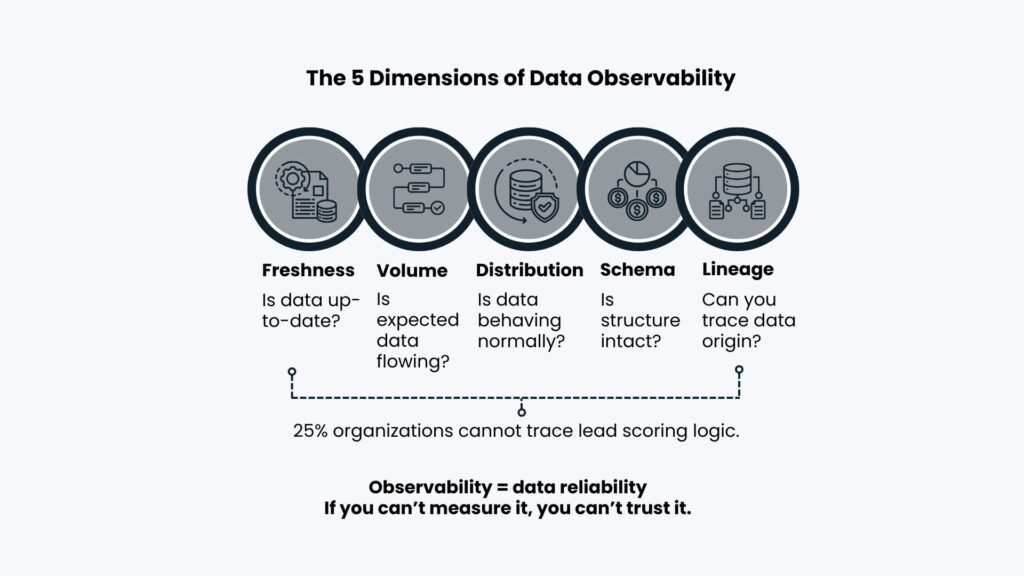
The Five Critical Dimensions of Data Observability Gap

Freshness measures how recent data is and whether updates arrive on time. In B2B, an intent signal loses value rapidly. If latency jumps from 5 minutes to 5 hours, the data has failed even if the pipeline succeeded.

Volume tracks whether expected amounts of data flow through systems. A sudden spike or flatline typically indicates broken tracking pixels or failed API integrations. A daily enrichment job that processes 40% fewer records than baseline has failed, regardless of technical completion status.

Distribution catches problems that do not violate rules but distort reality. If 35% of your pipeline typically comes from enterprise accounts and suddenly shifts to 55%, you face either a market breakthrough or a segmentation failure. When email open rates jump 40% overnight, you probably have a tracking implementation break, not an engagement miracle.

Schema monitors structural integrity. When the “Industry” field starts receiving job titles, your schema has drifted. When a data provider shifts existing values from a “size” field to “legacy_size” without notification, your segmentation rules execute against empty fields. No errors appear. Your ICP targeting just stops working.

Lineage provides the audit trail from source to dashboard. When conversion rates look wrong, lineage allows you to trace back through transformations to find exactly where logic failed. According to SiriusDecisions research, 25% of B2B organizations cannot trace how their lead scores are calculated, making silent failures nearly impossible to diagnose.

Four Data Observability Failures Hiding in Revenue Pipelines

Revenue teams operate with broken data longer than they realize because observability gaps manifest in ways that evade standard monitoring. Each of the following failure modes is a direct symptom of the data observability gap.

Silent schema drift occurs when upstream systems change structures without notification. A data provider modifies their taxonomy, now categorizing directors as “management” instead of “leadership.” Your lead scoring model continues executing perfectly. Results become meaningless. Detection happens quarters later when reviewing win rates by segment.

Gradual decay masquerading as variance presents as normal fluctuation. Email bounce rates creep from 3% to 11% over eight months. Each week feels within range. No single day trips an alert. But the cumulative impact; thousands of unreachable prospects, declining sender reputation, contaminated lists, represents material revenue leakage with no definitive break moment.

Transformation logic failures emerge when business rules and data reality diverge. Marketing automation shows 450 MQLs this quarter. CRM reports 520. Your data warehouse calculates 475. Each system is internally consistent. Each team defends their number. Revenue forecasts built on any of them are equally wrong, but no error appears in any log.

Cross-system inconsistency creates multiple versions of truth. One enterprise SaaS company discovered their entire Q3 demand generation budget targeted accounts using an enrichment feed that had not updated industry classifications in 14 months. Their “high-growth fintech” segment was actually legacy financial services companies that had since pivoted or been acquired.

The Revenue Cost of the Data Observability Gap

The business cost of the data observability gap concentrates in three areas.

Pipeline inefficiency manifests when teams operate on degraded data. If 20% of contact information is outdated and systems cannot flag which 20%, reps either waste time on dead ends or spend resources re-verifying everything. Salesforce’s 2023 State of Sales report found that reps spend 72% of their week on non-selling activities, with data quality issues consuming the largest share. For a 50-person sales team, a 10% reduction in selling time from bad data represents roughly $2.1 million in lost productivity annually.

Misallocated GTM spend occurs when targeting relies on corrupted signals. Intent data with 48-hour latency gets treated as real-time, causing marketing to engage prospects after buying windows close. Firmographic data with 35% accuracy drives ABM campaigns to wrong personas.

Delayed problem detection compounds every other failure. The leader of revenue operations in a Series C firm found that they were using inaccurate information to make important business decisions due to an error in their pipeline reports, which had been going on for five months without the team’s knowledge. Deals that got synced from Salesforce to the warehouse were somehow getting filtered out of the report depending on where they stood in the pipeline process.

How to Close the Data Observability Gap: 5 Operational Steps

Implementation requires structured measurement across the data lifecycle.

Define data health metrics explicitly. Do not rely on implicit assumptions. Set tolerable fill rates, freshness levels, and accuracy standards for mission-critical resources. A contact record fit for newsletter segmentation might not suffice for sales campaigns. Measure data quality on factors that count: completeness of the fields needed for engagement, freshness of enrichments (job title updated within 90 days), credibility of signals (intent scores with proven accuracy >70%).

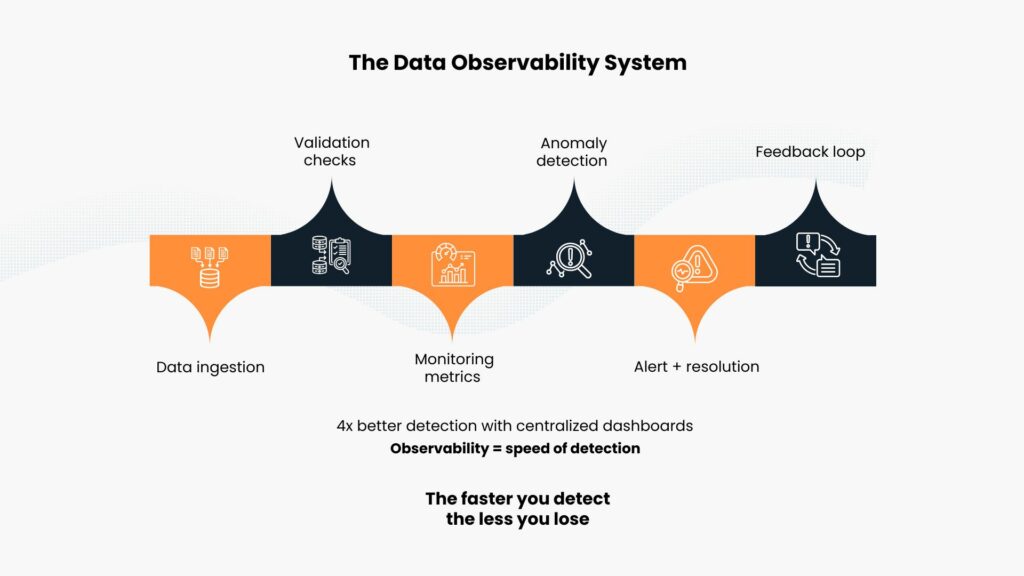
Implement automated anomaly detection. Track expected distributions and trigger alerts when patterns shift. If firmographic coverage typically holds at 90% and drops to 65%, high-value accounts are being excluded from campaigns. Manual checks do not scale. Deploy statistical or machine learning-based detection for volume, freshness, and distribution anomalies.

Create centralized visibility dashboards. These are not engineering dashboards showing server metrics. Such metrics include:

“Freshness of contact information for Q1 target customers: 78% refreshed within 30 days” or
“Latency of intent signal: Median 8 hours, 95th percentile 26 hours.”

Firms having unified dashboards measuring data health have a fourfold higher ability to detect problems than those that depend on reactive reports from users.

Assign clear ownership with defined protocols. Revenue operations typically owns CRM data integrity, sales owns account and opportunity data, marketing owns campaign and engagement data. Each owner needs authority to reject bad data. When anomaly detection flags a 25% drop in daily contact imports, documented protocols should specify who gets alerted, investigation SLAs, and rollback procedures.

Integrate observability into workflows. Before campaigns launch, reporting, and before scaling, validate data readiness, data integrity and data reliability respectively. Track mean time to detection (MTTD) and mean time to resolution (MTTR) for data incidents. Improving these metrics is the goal of observability.

The foundation of revenue growth strategy is having a unified RevOps data infrastructure.

Why Closing the Data Observability Gap Is a Strategic Advantage

The data observability gap is not about systems going down, it is about broken data continuing to drive decisions undetected.

Fixing pipeline inefficiency is impossible if you can’t see that 30% of contact data is stale. Optimizing conversion is impossible when you don’t even know your lead scoring broke six weeks ago. And if you can’t quantify the revenue impact of current failures, you’ll never justify data quality investments.

For revenue leaders, the observability gap represents a fundamental strategic vulnerability: flying blind while believing you can see. Based on industry standards, data problems may affect between 20-30% of all operational data pipelines at any given moment, yet without causing any failure points. These problems go unnoticed for a long time, which means that decisions are being made based on inaccurate data.

Data maturity’s next step is not about having more data, using more tools, or creating additional dashboards. The focus should be on improving data visibility. Because targeting depends on accurate data, prioritization depends on timely data, and conversion depends on relevant data.

Organizations implementing comprehensive observability see measurable improvements. Full-stack observability reduces outage costs by 37% and mean time to recovery by 50%. Research shows 51% of organizations report achieving a 2-3x ROI on their observability spend.

Closing the data observability gap is the next step in data maturity and the most underdiscussed competitive advantage in modern GTM.

Professional managing big data systems illustrating data ownership accountability challenges in organizations

The Data Ownership Problem: Why No One Is Accountable for Data Quality

Your CRM shows a deal at 90% confidence. The forecast meeting confirms it. Two weeks later, the deal is dead. When you investigate, you discover the contact left the prospect company three months ago. The champion never existed. The 90% number was hope, wearing a spreadsheet. This is what happens when data ownership accountability doesn’t exist. No one is responsible for verifying the data quality that your revenue forecast relies on.

According to IBM’s Institute for Business Value, 43% of chief operations officers consider data quality as their primary concern, with more than one-quarter estimating losses of over $5 million annually. Gartner pegs the average at $12.9 million annually. But why does this issue continue to exist when nobody owns the data?

If data management is everyone’s responsibility, then it will be nobody’s priority. Marketing owns lead generation. Sales owns CRM updates. RevOps owns systems. External vendors own enrichment. Each team influences data quality, but no single team controls it end to end. The result is a GTM engine built on shifting sand.

What Data Ownership Accountability Actually Means

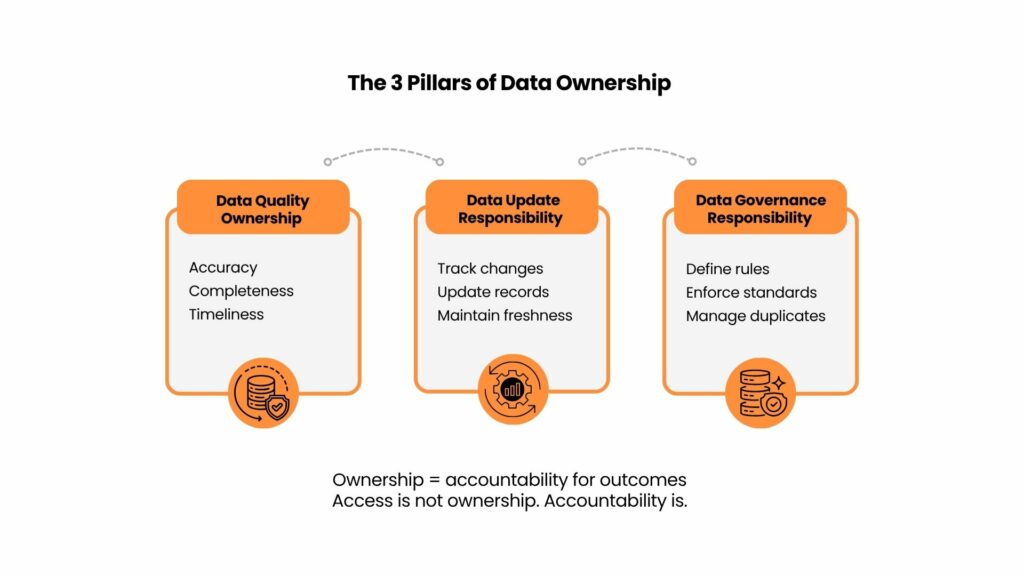
Data ownership accountability is frequently mistaken for data access. Data access does not necessarily imply data ownership. It implies accountability along three key axes.

Data quality ownership requires accountability for data accuracy, completeness, and timely updates for specified data types. If address information is incorrect, an individual can be held accountable for correcting them. This includes defining what “good data” actually means and maintaining standards for formatting, validation, and mandatory fields.

Data update responsibility means someone ensures records remain current. When a contact changes jobs or a company shifts technology stacks, ownership dictates who detects that change and updates the system. Without this, data becomes stale even if initially accurate.

Data governance responsibility means someone defines and enforces the rules. Standards for entry, modification, duplication resolution, and compliance require accountable stewards. DemandLab notes that no single group owns revenue data, but “what is owned is the primary responsibility at each phase of the revenue cycle.”

The underlying concept is straightforward. Ownership of data implies accountability for results, not merely processes. When the quality of data is compromised, the owner determines who is accountable, what necessary actions to take, and how to measure performance.

Why Data Ownership and Accountability Fail in B2B

The accountability gap emerges from predictable structural failures. Without clear data ownership accountability, these problems compound across every revenue function.

Cross-team dependencies create the primary problem. B2B data flows across multiple functions. Marketing generates leads. Sales qualifies them. Customer Success manages relationships. When data quality requires coordination across silos with competing incentives, no single team prioritizes it. Research from Integrate and Demand Metric found that over 60% of teams report poor data disrupts lead handoffs and slows sales productivity.

Unclear role definitions compound the issue. The majority of companies lack clear ownership of contact vs. account data, who is responsible for validation of the enrichment process, and who is accountable for duplicate management. How can we know whose record in the CRM, MAPs, and data warehouse is accurate if there is disagreement among them? Without clarity, the issue never gets sorted out.

Lack of governance structures means accountability is assumed rather than assigned. Many teams rely on informal processes, manual fixes, and reactive cleanup efforts. There are no defined standards, validation rules, or enforcement mechanisms. One industry study found that 84% of organizations struggle with inaccurate or duplicate data precisely because they lack formal quality measures.

Vendor dependency creates a false sense of security. Organizations often assume the data vendor ensures quality. In reality, vendors optimize for coverage, not precision. Accuracy varies by segment and geography. Data degrades after delivery. Without internal ownership, vendor data becomes unverified input that teams trust until it fails. A data procurement framework is a must.

The GTM Cost of Unowned Data

The absence of ownership creates compounding inefficiencies across every revenue function.

Inconsistent data quality means standards vary across teams. Enrichment is applied inconsistently. Validation is sporadic. This leads to unpredictable performance and three versions of truth. The sales department claims revenue is X. The finance department believes it is Y. The operations department has its own figure.

Unsolved errors mount up silently because no one is answerable for fixing them. Problems are deprioritized. Duplicate records can reach 10% to 30% of customer databases in organizations without data quality initiatives. Each duplicate means wasted outreach, confused reporting, and damaged customer experience.

Operational inefficiencies become normalized. Salesforce estimates that reps spend up to 27% of their time dealing with data issues instead of selling. Teams spend hours manually reconciling conflicting data. Sales reps begin “shadow researching,” ignoring the CRM and going to LinkedIn to manually verify every prospect. This is a massive waste of high-value labor that could be avoided with clear ownership.

Broken prioritization and targeting affect ICP alignment, lead scoring accuracy, and intent signal reliability. If data inputs are inconsistent, prioritization models produce misleading outputs. Intent signals point to churned contacts. Enrichment delivers 92% accuracy but only 61% becomes usable.

The IBM research found that data quality issues often go unnoticed because their impact appears downstream as lost revenue, not at the point of failure. Pipeline leaks. Conversion rates weaken. Sales cycles lengthen. The impact is not isolated. It affects the entire revenue system.

A Framework for Data Ownership Accountability

Building data ownership accountability requires a structured approach to assigning and enforcing ownership.

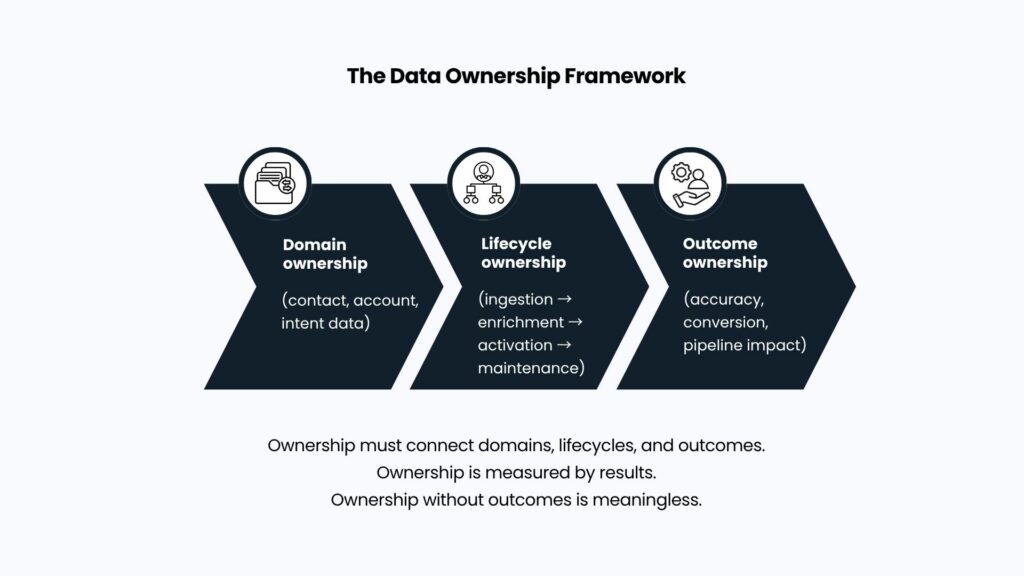
Domain ownership defines what is owned. Assign ownership by data domain: contact data, account data, enrichment data, intent signals. Each domain should have a clear owner. For example, RevOps owns contact enrichment and is accountable for 82% connect rates. Demand Gen owns intent signals and is measured on 35% progression lift. The data team owns firmographics with a 92% ICP match target.

Lifecycle ownership defines when it is owned. There must be ownership at each level: ingestion (data input and acquisition), enrichment (enhancement and verification), activation (usage within campaigns and routing), and maintenance (upgrades and cleaning). Ownership can be assigned to different groups for each step, but transition protocols should be clear.

Outcome ownership defines why it is owned. Ownership is validated through results, not activity. Define ownership based on outcomes such as data accuracy rates, contactability metrics, ICP fit consistency, and campaign performance impact. Most organizations assign ownership at the process level. High-performing organizations assign ownership at the outcome level.

Operationalizing Data Ownership

Moving from theory to practice requires embedding ownership into daily workflows and performance systems.

Data SLAs (service level agreements) define expected quality levels. For example, you must maintain contact data with greater than 90% deliverability, enrich data within defined intervals, and meet accuracy thresholds. SLAs make quality measurable and non-negotiable.

Quality benchmarks provide objective targets. Monitor the metrics of bounce rate, duplication rate, enrichment match rate, and ICP alignment. The fundamental criteria include accuracy, which should be 98% or more, completeness at 95% or more, consistency of 97% or more, timeliness of 99% within 24 hours, and uniqueness at 99% or more.

Performance tracking ties data quality metrics to team KPIs, operational reviews, and performance evaluations. Regular scorecards show each domain’s quality metrics against SLAs. When quality drops below thresholds, automated alerts trigger owner intervention. Include data integrity in performance reviews and reward the “data citizens” who actively improve the system.

Workflow integration ensures ownership is maintained during execution. Embed validation into CRM processes through required fields and validation rules. Build automated checks into enrichment pipelines. Use campaign readiness filters to prevent unowned data from reaching execution. Before any outreach deploys, validation confirms that required fields meet quality thresholds. Data ownership accountability must be embedded into daily workflows, not treated as a one-time project.

As one data governance framework emphasizes, “without accountability, measures become shelfware. Each critical data element should have both a data steward responsible for data quality rules and a system owner accountable for implementation.”

Practical Recommendations for RevOps Leaders

Start with a clear gap analysis. Map current ownership structures, which likely reveals that no one truly owns critical data domains. Calculate the quality cost using the $2.7 million annual benchmark for mid-market companies. Identify your top three pain points, typically bounce rates, duplicates, and stale intent signals.

Define ownership explicitly. Identify the owners of each data domain, the accountable parties at each phase of the lifecycle, and the criteria for measuring success. Apply a RACI model to assign ownership roles: accountable party, responsible party, and consumer (utilizes the data).

Prioritize those data domains that will make the biggest difference. Contact accuracy, relevance of roles, account-level data, and intent signals will make the largest contribution to the bottom line and will produce the quickest ROI from ownership.

Align ownership with revenue outcomes. Measure data quality based on pipeline contribution, conversion rates, and sales efficiency rather than just technical accuracy metrics. This ensures ownership drives business results.

Decrease dependence on vendors. Verify vendor information internally. Do not delegate responsibility. Establish continuous feedback cycles that utilize performance metrics like bounce rate and connect rate to detect problems with data and update validation criteria.

Conclusion: Data Quality Improves When Ownership is Clear

Typically, most B2B companies are concerned with getting better data, enriching it, and enhancing the technology. However, none of this works without proper ownership. This is not a technological challenge, but rather an organizational one.

What is needed is a paradigm shift to data ownership accountability; from shared responsibility to clear ownership, from process metrics to outcome measurement. And infrastructure only performs when someone is accountable for maintaining it.

You need to ask not whether you can afford data ownership, but whether you can afford to continue without it. With each passing day that this ambiguity continues, your data deteriorates, your decision-making skills deteriorate, and money flows out of your hands. Because ultimately, it is ownership that improves your data.

Professional reviewing archived records and reports illustrating data validation B2B processes for accuracy and reliability

B2B Data Validation Systems: How to Test, Verify, and Trust Your Data Before Activation

Data validation B2B systems determine whether your go-to-market campaigns succeed or fail before they launch. Consider this example: An exemplary mid-market SaaS business took 6 months to develop an Account-Based Marketing/ABM initiative targeted at 5,000 high-intent accounts. They sourced and enriched their contact databases with technographic insight and executed the respective strategies. 3 months post implementation, the pipeline contribution was only 2% of planned projections.

There was no messaging or timing issue. A post-mortem review revealed that 34% of email addresses were invalid, 28% of titles were out-of-date, and 19% of companies had been wrongly categorized. Essentially, the team created a large-scale deployment of unvalidated data resulting in optimization on top of an already broken foundation.

This example happens each week throughout B2B organizations. Gartner states that poor data quality costs businesses approximately $12.9 million per year. According to Salesforce, the average sales rep loses up to 27% of their time working with bad data instead of selling. This is not just a few inefficient processes; this is a systemic revenue leak due to a lack of trust in data operations.

What Data Validation Actually Means

Data validation is a dynamic process that continuously verifies that one single query is fulfilled: Is this data credible enough to be used right now?

In most cases, businesses mistake data procurement for data credibility, as they acquire a mailing list, update their database accordingly, and think everything is ready. However, there are three fundamental areas where this logic falls apart.

Contact-level accuracy ensures that the contact is indeed present in that very role and can be reached in data validation B2B workflows. Does the email resolve? Does the number connect to the intended individual? Is the title current? Even small inaccuracies here directly impact connect rates and outreach efficiency.

Company attribute validation confirms that firmographic and technographic data reflects current reality. Is the headcount accurate? Is the technology stack still in use? Has the company been acquired? B2B data decays at approximately 30% annually due to job changes, company transitions, and technology migrations.

Segmentation logic verification ensures that the rules used to prioritize and route data produce intended outcomes. Are high-value accounts correctly identified? Does the scoring model match actual conversion patterns? This layer determines whether data is strategically usable, not just technically correct.

The distinction matters. Most teams validate fields. High-performing teams validate decisions.

The Three Validation Checkpoints That Drive Performance

Validation must occur at multiple stages of the data lifecycle, each catching different failure modes.

Pre-ingestion validation occurs before data enters your CRM or marketing automation platform. This checkpoint prevents contaminated data from polluting your systems. It includes email syntax verification, domain existence checks, duplicate detection, and basic deliverability assessment. According to research conducted by Forrester in 2023, businesses using pre-ingestion validation experienced a saving of 67% on data remediation costs compared to those using post-integration validation.

Post-enrichment validation ensures that enrichment operations have enhanced, rather than compromised, the quality of the data. A 2026 accuracy study of eight website visitor identification platforms found dramatic quality variation. The highest-scoring platform achieved 82% correct identification of known visitors, while the lowest returned entirely wrong individuals from unrelated companies. The study attributed quality gaps to underlying identification methods. Deterministic matching produced significantly fewer false positives than probabilistic methods that infer identity from behavioral patterns.

This means testing a sample of enriched records against known ground truth before trusting the entire dataset. Cross-verification of firmographic fields, role validation against organizational structure, and technographic consistency checks are essential at this stage.

Validation at the campaign level is the last hurdle before deployment. Ensure that your targeted list is of high quality before starting an outreach campaign. Run tests on the deliverability of your emails to a small number of contacts. Check that the phone numbers work.Confirm that company attributes match targeting criteria. Skipping this step leads to silent execution failures where campaigns run and data looks fine, but performance drops without clear attribution.

Common B2B Data Validation Failures and Their Revenue Impact

Most data validation B2B failures follow predictable patterns, each with compounding costs.

Skipping validation entirely is the most common and most expensive failure. Teams assume that purchased data is validated by the vendor. According to a survey conducted by Integrate, almost 50% of marketers take more than ten hours each month for data cleansing. However, this effort can be greatly minimized through validation procedures.

Over-reliance on vendor claims creates hidden risks. A vendor’s claimed accuracy rate is a marketing statement, not a guarantee. “95% accuracy” is often measured at the field level, averaged across datasets, and not reflective of your target segment. Without independent validation, these metrics are misleading at best.

The absence of systematic checks leads to ad hoc validation. In the absence of automated data validation processes, data quality deteriorates without anyone’s knowledge until an audit takes place manually. Close to 75% of marketing professionals believe that at least 10% of their leads have erroneous information. Over 60% of companies find data quality issues interfering with lead transitions. The impact is quantifiable. When validation fails, SDRs lose an average of 545 hours per year dealing with bad data. For a team of 10 SDRs, you are effectively paying for two full-time employees to spend their entire year navigating data errors instead of selling.

Building a Practical Validation Framework

Effective data validation B2B systems combine statistical rigor with operational efficiency.

Stratified sampling methods guarantee validation coverage without having to go through 100 percent manual verification. If the number of contacts is less than 1,000, then apply the method of stratified sampling for validation at 15 percent on criteria such as data origin, seniority level of the contact, company size category, and recency of acquisition. If error rates in any segment exceed 10%, expand sampling or reject the data entirely.

Multi-source verification cross-references critical attributes against independent data sources. No source of information can be considered entirely accurate. Validating contact data through several vendors makes the process of validation much more robust, validating firmographic data against publicly and privately sourced data strengthens it, and validating signals of intent with behavior data enhances it.

Automated validation rules enable continuous validation at scale. Manual validation does not scale. Key automation examples include flagging records with conflicting firmographic data, identifying outdated job titles based on tenure thresholds, detecting anomalies in enrichment fields, and scoring records based on confidence levels. Modern CRM platforms now enable real-time checks on save, on import, and via scheduled bulk jobs.

Embedding Data Validation B2B into GTM Workflows

Data validation B2B workflows fail when disconnected from execution. They must embed directly into daily operations.

CRM level validation checks for the validity of each data entry before accepting it and discards incomplete or low-confidence records. It also calculates the confidence score of each record.

Campaign readiness filters apply before activation. Exclude any contact not verified in the last 30 days. Set minimum confidence score requirements. Verify ICP alignment criteria and contactability thresholds. This single filter eliminates the majority of decay-related failures.

Continuous validation loops maintain data freshness between campaigns. Key feedback signals include bounce rates, connect rates, reply rates, and conversion performance. Incorporate the feedback from these signals into the validation process to adjust the rules, re-evaluate the trust score, and select better data.

Practical Data Validation B2B Recommendations for Revenue Teams

Begin with an initial assessment. Take a sample of 10,000 records among the vendors and manually verify 500 accounts to measure your initial trust score.

Build core framework elements within 30 days. Implement 12 automated checks covering email deliverability, firmographic accuracy, and intent signal validity. Apply stratified 2% sampling per segment and cross-reference against three vendors minimum.

Integrate validation into workflows within 90 days. Use plugins to auto-quarantine imported records. Conduct weekly campaigns using 1,000 record tests. Produce scorecards each week for revenue leadership that display validation coverage trends.

Test the validity of validation itself by examining measures such as quarantine ratio, validation coverage, false positive ratio, and time-to-detection.

Conclusion: B2B Data Validation Trust Must Be Engineered

Most B2B organizations do not have a data problem: they collect, enrich, and activate it. They have a data trust problem. But they do not verify it.

Without validation, even accurate data becomes unreliable in execution. We must transform data gathering into data verification, trust in vendors into trust in systems, and static quality into ongoing validation.

Almost half of all RevOps practitioners say that poor data quality leads to inefficient pipeline management. Almost half believe that data discrepancies happen often or always within their organizations. These companies launch unverified data and pay for it indefinitely.

Competitive advantage in data validation B2B doesn’t come from having more data, it comes from having data you can trust. Validation is not a cost center. It is the foundation of predictable revenue and the difference between a guess and a qualified opportunity.

Glowing blue network map showing interconnected data points and cloud storage, illustrating a modern, scalable RevOps data infrastructure.

RevOps Data Infrastructure: Building the Single Source of Truth

While your sales VP reports $2.3 million in pipeline, your marketing director presents $2.8 million and your finance team forecasts only $1.9 million. Three different versions of the truth. Three teams pointing fingers. Zero confidence in any number. This is what happens without proper RevOps data infrastructure.

Your business is losing millions as a result of this RevOps data crisis. Recent Salesforce research indicate that sales representatives only spend 28% of their time selling. Finding accurate contact details, resolving inconsistent account records, and manually updating systems where automation should exist take up the remaining time. According to research, data fragmentation costs businesses between 15 and 20 percent of their potential revenue. This amounts to an annual loss of $7.5 to $10 million for a $50 million firm. Building proper RevOps data infrastructure eliminates this waste.

When every team maintains different numbers, trust erodes. Executives question every forecast. Sales reps ignore CRM data. Marketing campaigns target outdated contacts. Customer success teams lack visibility into early warning signs.

Single Source of Truth: RevOps Data Infrastructure Foundation

Single source of truth doesn’t mean forcing everyone onto one tool or making all teams use identical dashboards. Those approaches fail because they ignore how different functions need different views of the same underlying data.

Real single source of truth means ensuring data flows bidirectionally between systems automatically. When a sales rep updates an opportunity in Salesforce, marketing automation platforms reflect that change instantly; meanwhile, when marketing scores a lead based on engagement, sales sees updated prioritization in real-time, and when customer success logs a support ticket, account health scores adjust across all systems.

This requires maintaining consistent definitions across teams. What qualifies as a Marketing Qualified Lead? When does an opportunity enter “Negotiation” stage? What constitutes an active account versus dormant? Organizations with unified data strategies establish these definitions early and enforce them through technical architecture, not policy documents gathering dust.

The foundation is having one canonical record for each account and contact accessible everywhere. Account hierarchy matters. Parent-subsidiary relationships. Territory assignments. These key data elements need to be based on a single source of truth, with all other systems reading from these sources instead of duplicating each other with multiple versions.

Most RevOps data infrastructure uses a hub-and-spoke model. Your CRM acts as the hub. Data enrichment platforms, marketing automation tools, sales engagement tools, and analytics systems are the spokes. Data flows into the hub from all sources. The hub cleanses it. Standardizes it. Returns it to operational systems.

The Five Data Types RevOps Must Unify

All of the metrics mentioned below can be measured independently, through multiple technologies (marketing automation platforms; website analytics systems; sales engagement software) and they all indicate a different kind of engagement type. Unified engagement scoring combines these signals into comprehensive account-level metrics showing overall interest and activity patterns over time.

Customer and Account Data

Customer and account data forms the foundation. Firmographics (e.g. account size), technographics (e.g. individual software applications), and the overall account history will provide your team with context when interacting with accounts. Key fields in an account include firmographics, such as parent-child accounts; technographics based on rep ownership at individual accounts geographically and/or demographically; and historical engagement information that will help with future conversations at the account. Enrichment platforms continuously append missing firmographic and technographic data, ensuring profiles remain complete as accounts evolve.

Contact and People Data

Contact and people data identifies who influences decisions. The individuals in the buying committee as well as those who will influence or decide upon a purchase will determine how you go about reaching out to you. The role of each individual, at what level, who they work for, and how accurate their contact details are can help you to effectively target all potential contacts. Systems must be in place to track these contacts, since 30% of B2B contacts change roles every year. When a champion moves companies, sales needs immediate notification to maintain relationships and potentially follow them to new opportunities.

Engagement Statistics

Engagement statistics determine the level of engagement between accounts and your brand. The following are just a few examples of metrics that you can use to track how much interest an account has shown in your business or brand: email open/clicks; website visits; content downloads; number of meetings attended; requests for demos.

Intent Data

Intent data reveals research signals and buying stage indicators. Third-party intent providers track when accounts research solutions in your category across B2B publications and review sites. First-party behavior tracking captures on-site signals. Surge timing matters. When multiple decision-makers from an account suddenly increase research activity, timing and relevance improve.

Revenue Data

Revenue data drives forecasting and planning. Opportunities, pipeline stages, close dates, deal values, and forecasts must reconcile across sales, finance, and executive dashboards. CRM systems, configure-price-quote tools, and finance platforms each maintain revenue records. Inconsistencies here create the “three versions of truth” problem. Stage definitions, probability assignments, and forecast categories need standardization enforced through workflow automation.

Building Your RevOps Data Infrastructure Hub

Leading organizations adopt centralized data enrichment approaches rather than point-to-point integrations that create unmaintainable complexity. A central hub receives data from all sources, enriches and standardizes information, then distributes clean data back to operational systems.

Account intelligence platforms serve this role by providing single points for firmographic and technographic append. When fresh records are added into your CRM, the enrichment APIs will cover any deficiencies, including the following fields: employee count, annual revenue, industry classification, technology stack, and funding stage.

Companies such as Packed Data Services provide the essential central enrichment functions by adding info about firmographics, technographics and aggregating intent signals from various sources and assigning a unified score to each account. They combine account intelligence, intent signals and AI-driven lead prioritization to provide customers with a complete view of their accounts in real-time and in tandem with each other between sales and marketing tools, thereby minimizing the integration difficulties that have traditionally created a point-to-point linking model.

Actionable Intelligence and Real-Time Scaling

Intent signal aggregation centralizes scoring across multiple intent sources. Third-party providers each track different publication networks and research behaviors. Centralized platforms normalize these signals into unified intent scores showing which accounts are actively researching solutions. Combined with fit and engagement data, account scoring engines produce single prioritization scores guiding both sales and marketing efforts.

Real-time alerting notifies teams when accounts hit threshold scores or show buying signals. When an enterprise account’s intent score surges, engagement increases, and technographic signals indicate budget approval, automated workflows alert assigned sales reps and trigger personalized outreach sequences.

With an API-first architecture you can connect any tool within your architecture, including pre-built connectors such as those used for Salesforce, HubSpot, Marketo, Outreach, etc., which will speed up your implementation process; however, if you have any custom systems or tools that are specific to your workflow, there are APIs available that integrate those tools into your API stack.

The 90-Day RevOps Data Infrastructure Roadmap

Days 1-30

Focus on audit and definition. Map all current data sources and flows. Records that refer to accounts, contacts, opportunities, and engagement data are kept in various systems. A thorough study of the data flow between systems at the present time and the identification of manual operations that cause bottlenecks in the workflow should be done. Definitions of fields should be recorded and a data dictionary should be compiled. The question “What is a Marketing Qualified Lead?” can be asked. What are the different stages of the opportunity process? Recognize discrepancies, multiple records, and contradictory information. Define KPIs and success metrics aligned with revenue outcomes.

Days 31-60

Shift to connection and cleansing. Integrate data enrichment platforms with CRM. Establish automated workflows where new accounts trigger enrichment jobs filling missing fields. Fill in the missing data fields by enriching the existing database. Carry out a bulk enrichment of current account and contact records with the prioritization of high-value segments. Establish bi-directional dataflows. Make sure that modifications in the operational systems get synchronized with the central hub and then get distributed to other connected platforms.

Days 61-90

Activate and optimize. Train teams on new unified data access. Show sales reps how to access complete account intelligence. Demonstrate to marketing teams how intent signals inform campaign targeting. Build dashboards using enriched data. Replace old reports with new views leveraging complete firmographic, technographic, and intent information. Set up governance and data quality protocols. Agree on who data stewards will be and what their roles and responsibilities will be. Assess the influence on sales and marketing productivity. Monitor the time saved from data searching. Work out the rise in connect rates and meeting bookings.

Those companies that manage to finish this phase generally experience quicker pipeline velocity, better cross, team alignment, and more accurate forecasting. Companies disclose 40 percent rises in sales efficiency that have been energised by clean data foundations.

Conclusion

RevOps is no longer an operational function. The foundation of revenue growth strategy is having a unified RevOps data infrastructure. Organizations that use disparate datasets will fail in their attempt to grow, their ability to forecast accurately, and their ability to personalize engagement with customers. When organizations create a RevOps data infrastructure, they benefit from an accelerated decision-making process, improved conversion rates, more accurate forecasting, and better alignment between marketing, sales, and finance functions. The development of scalable, dependable growth engines requires a single source of truth as the cornerstone.