

Tag Archives: GTM data strategy

Professional reviewing and approving digital records as part of a data trust architecture for reliable business decision-making

Data Trust Architecture: Why Reliable Data Matters More Than More Data

When the VP of Sales questions the pipeline forecast three hours before the board meeting, the problem isn’t data scarcity; it’s data credibility. This is the core challenge that data trust architecture is designed to solve. Modern B2B organizations run CRMs, enrichment platforms, intent providers, attribution tools, and AI-driven scoring engines in parallel. Yet a 2025 survey of 72 revenue-focused companies found that 68% of executives and 59% of RevOps leaders regularly questioned the accuracy of their core dashboards. That is not a volume problem. That is a data trust collapse.

According to OneStream, 72% of companies say bad data costs them at least $500,000, and more than one-third report losses over $1 million. A mid-market B2B firm, with $50 million in yearly income, actually loses around $1.25 million each quarter for every week their strategic decisions are held up because of data issues. The future competitive advantage in B2B intelligence belongs to organizations with the most trusted data systems, not the largest ones.

Why Data Trust Breaks in Revenue Organizations

Data trust rarely collapses from a single failure. It erodes through four compounding structural problems.
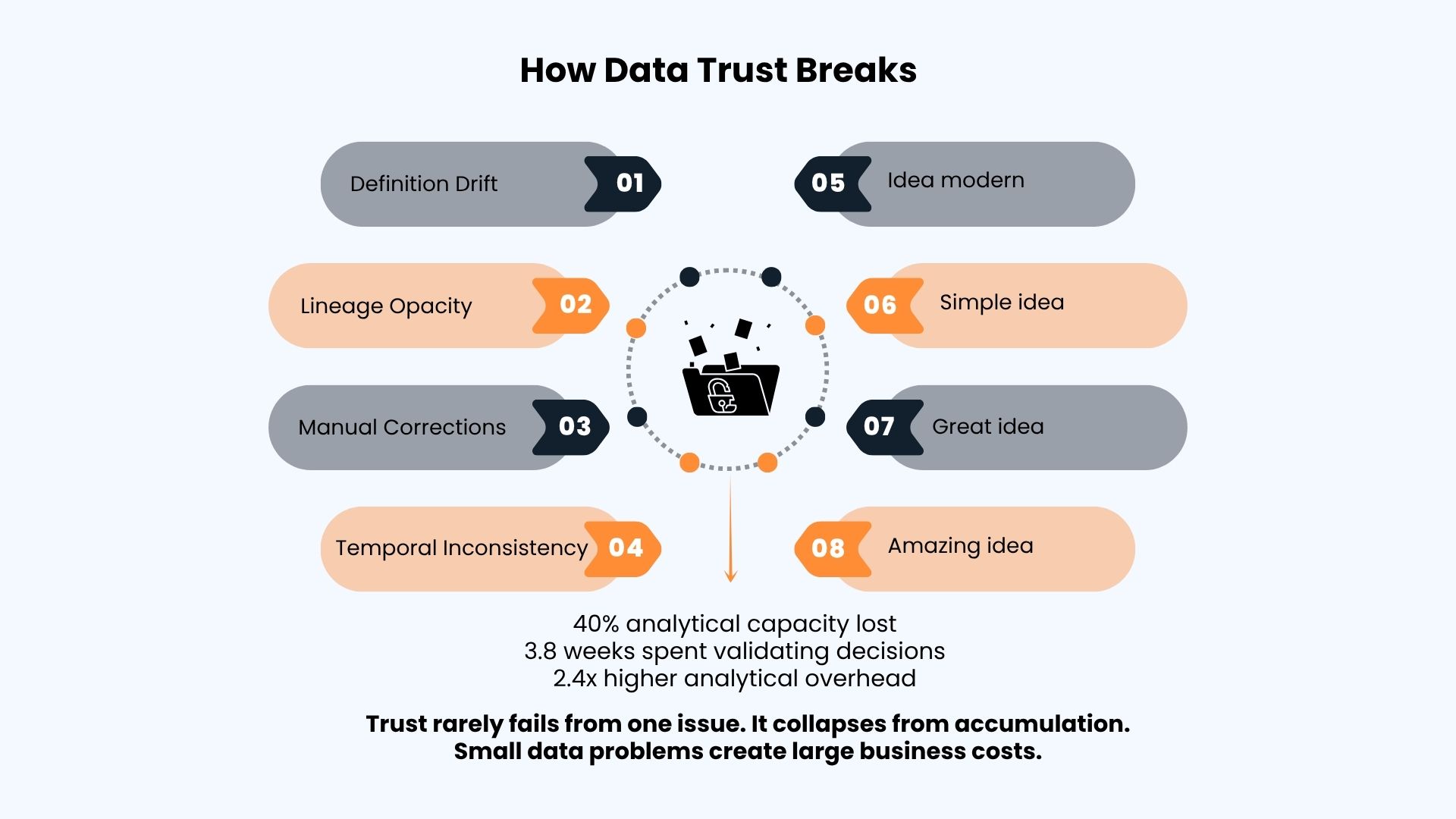
Definition Drift and Lineage Opacity

Definition drift is the most common fracture point. Marketing counts an “active account” using website intent signals. Sales counts it only after a validated opportunity exists in the pipeline. Finance recognizes it after the first invoice clears. A 2024 analysis of 200 B2B organizations found an average of 4.7 conflicting definitions for core metrics across departments. One SaaS company discovered a 23% discrepancy between marketing and sales pipeline numbers that stalled a market expansion decision for six weeks. RevOps teams in low-definition environments waste an estimated 40% of their analytical capacity reconciling conflicts rather than generating actionable insight.

Lineage opacity compounds the damage. Modern B2B data architectures pass through 7 to 12 transformation layers between source systems and executive dashboards. A 2025 RevOps survey found that only 19% of teams could reliably trace 90% of core revenue metrics back to their source. A telecommunications B2B provider traced an 18% variance in customer lifetime value calculations through five transformation layers to a JOIN operation excluding multi-product customers. The error had misdirected $4.2 million in R&D resources over eight months. Without lineage, debugging is archaeology.

Manual Corrections and Temporal Inconsistency

Undocumented manual corrections are equally destructive. In 68% of B2B organizations studied, finance teams make manual adjustments to revenue data that are never logged in audit-accessible formats. One manufacturing company’s monthly reporting incorporated 127 undocumented Excel adjustments maintained by three analysts. When two departed within six weeks, month-end close extended from four days to nineteen days while the team reverse-engineered the correction logic.

Temporal inconsistency in snapshot data creates a subtler but equally costly problem. When March pipeline forecasts use February 15 data but the comparison baseline uses February 28 data, the 13-day delta introduces noise that masquerades as signal. A private equity firm discovered their month-over-month growth calculations compared snapshots across different billing cycles, causing three portfolio companies to be systematically underfunded.

The Compounding Revenue Cost of Low Data Trust

Low data trust does not just slow decisions. It restructures how organizations operate, creating cascading costs that function as a hidden tax on the entire revenue pipeline.

Analytical duplication alone is substantial. A 2024 RevOps case study found an organization spending 11,000 analyst hours per year reconciling data that should have been settled once. Organizations with low data trust spend 2.4 times more on analytical headcount relative to revenue than high-trust peers.

Tool adoption collapses in low-trust environments. Enterprise analytics implementations average $2.8 million in first-year costs. When users continue relying on legacy spreadsheets, adoption stalls near 40%, tripling the effective cost per active user. A 2025 benchmark of 50 revenue teams found that 63% of SDRs and AEs used spreadsheets as their primary source for account prioritization, not the company-wide BI system.

The speed penalty is measurable. The median B2B company takes 6.2 weeks to agree on big decisions, and it spends 3.8 weeks just verifying data. Companies with low trust in their data take 31% longer to wrap up their plans. On the flip side, rivals who trust their data cut their decision-making time by 60%, gaining first-mover benefits that stack up in every cycle.

The LIVE Framework: Four Pillars of Data Trust Architecture

Building a reliable data trust architecture requires four foundational capabilities that work together.
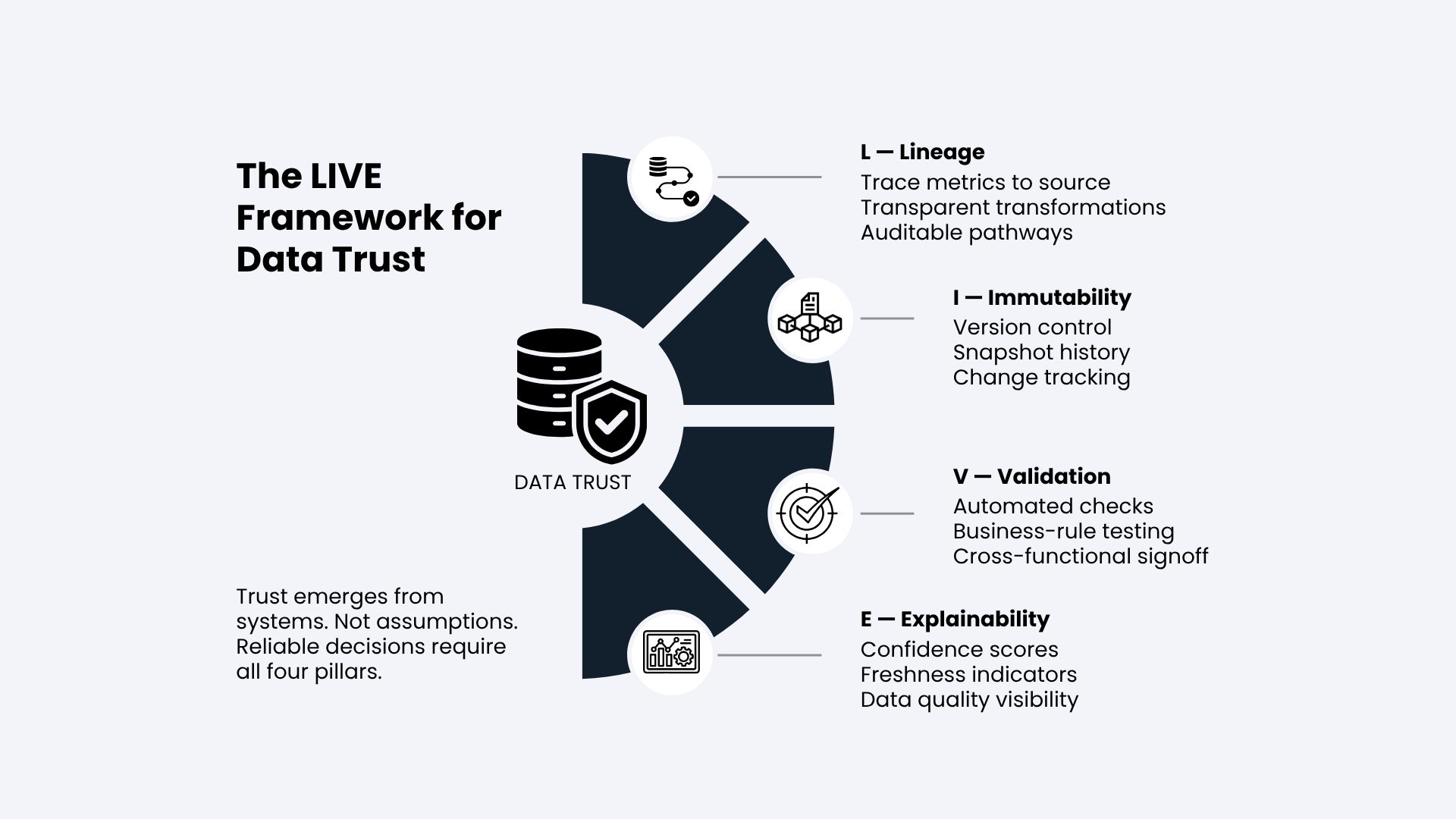
Lineage means every metric traces back to its source through documented, auditable pathways visible to business stakeholders, not just data engineers. Column-level lineage implementation at one enterprise software company reduced analyst time spent on “where does this number come from” investigations by 73%.

Making datasets immutable is about treating them like code. This means versioning each transformation, taking snapshots at key decision points, and keeping logs of changes and reasons why those changes happened. Take a B2B logistics firm; after they started versioning their datasets, they reduced their monthly discrepancy solving time from 40 hours to just 7 hours. That’s huge!

For validation, you need checks across different levels. Start with checksums in the source system to make sure the data warehouse is accurate. Add automated business rule tests for logic checks before report publishing. Also, include cross-departmental approval steps where finance and sales teams must sign off on figures together. At a manufacturing company, a similar setup caught a currency conversion mistake in cost calculations that had gone unnoticed for 14 long months. With the new validation process, they spotted it right on day one.

Explainability means showing confidence levels right in dashboards. Including data freshness, completeness scores, and source quality ratings gives stakeholders the context needed to properly interpret the metrics. One SaaS company added confidence scoring and saw executive engagement with analytics dashboards rise 45%, as leaders got more visibility into data limitations.

You can read more about building a composable data architecture here.

A Practical Evaluation Tool: The Data Trust Scorecard

A practical way to audit your data trust architecture is the RevOps Scorecard. RevOps leaders can use a Data Trust Scorecard to measure trust in core revenue metrics. This scorecard rates each metric on four things from 0 to 5.

First, Lineage Transparency: Can we trace the metric to its origin?

Second, Governance and Process: Does paperwork exist for changes and have people been told about them?

Third, Definition Clarity: Has everyone agreed to one definition?

Fourth, Adoption and Reliance: Do stakeholders make calls based on the metric or do they secretly use other spreadsheets?

The Trust Score is the average of those four parts. When used in a 2025 RevOps study, it cut data-checking delays by 28% and boosted analytics adoption by 19%, all within a year and a half.

Practical Recommendations for RevOps Leaders

Audit trust failures directly. Map where stakeholders distrust systems, which dashboards face the most scrutiny, and where manual verification recurs. Trust friction reveals the weak points that accuracy metrics alone cannot surface.

Create a shared metric glossary for the most crucial GTM metrics. Include the definition, source system, key rules, owner, and change history for each one. Show this to everyone, and make it a requirement to review it before getting access to the executive dashboard.

Build cross-functional data governance. Form a working group with representatives from RevOps, sales operations, marketing operations, and finance. Define change-control processes and require that all substantive changes are communicated before they affect operational reporting. Organizations with complete alignment between finance and IT are 5.5 times more likely to report full confidence in their data.

Monitor continuously. Set service-level indicators for key revenue metrics, automate freshness and anomaly checks, and treat data quality like application performance. Catching structural errors in real time prevents downstream sales impact before it registers in the pipeline.

Reliable Data Is the Actual Competitive Advantage

Data volume is no longer the differentiator. Most B2B companies already have way more data than they know what to do with. The big issue isn’t about having enough data; it’s whether the people making decisions trust that data enough to actually use it.

The organizations that thrive are the ones that invest in data trust architecture treat trust as infrastructure, not a by-product. Every measurement needs to be clearly defined and understood by everyone involved. When you treat trust as something concrete and build systems around it, teams start seeing how reliable their data is right in their workflow. This means no more wasting time; like 3.8 weeks per quarter just checking numbers, are needed before moving forward.

The organizations that will lead in the next phase of B2B intelligence are not those collecting the most signals. They are those who have built the infrastructure to verify, govern, and confidently activate the data they already have.

Reliable data is not a luxury. It is the foundation for every strategic advantage that follows.

Clock interface symbolizing buyer journey data timing issues when revenue intelligence reaches teams too early or too late in the sales process

The Data Timing Misalignment Problem: When Revenue Intelligence Arrives at the Wrong Stage of the Buyer Journey

A SaaS firm spent $180,000 annually on premium intent data, and still watched their conversion rate stall at 1.2%, less than a third of their 3.5% target. The data was accurate. The problem was buyer journey data timing. By the time SDRs received and acted on intent signals, 73% of tracked accounts had already moved past the stage where that data was relevant. This is the data timing misalignment problem: not inaccuracy, not data decay, but a structural failure to synchronize intelligence with where buyers actually are in their decision cycle.

This represents a fundamental but underappreciated dimension of data quality: temporal alignment. According to SiriusDecisions, 67% of the buyer’s journey is completed before prospects engage with sales, yet most data systems still operate on static, stage-agnostic models. Research shows that 60% of B2B buyers report receiving outreach irrelevant to their current project stage. In markets where data decays at 3% monthly, the utility of an insight is inextricably linked to its position in the decision cycle.

Understanding Buyer Journey Data Timing: Beyond Freshness and Accuracy

Data timing misalignment occurs when three critical timelines fail to synchronize: data availability, buyer readiness stage, and GTM execution capacity. This is distinct from data decay. A contact’s email changing is a freshness problem. Receiving intent signals for mid-funnel content when your team only has early-stage nurture sequences is a timing problem.

The distinction matters because the solutions differ fundamentally. Data decay requires faster refresh cycles. Timing misalignment demands stage-aware data models, dynamic segmentation engines, and lifecycle-synchronized execution systems.

Consider the typical B2B data flow. A company demonstrates intent by attending a webinar in Week 1. Your data provider captures this signal and delivers it in Week 2. Marketing automation processes it in Week 3, scoring the lead and routing it to sales. The SDR makes first contact in Week 4. By then, according to Forrester research, 68% of accounts exhibiting intent signals have already engaged with 3 to 5 vendors and formed preliminary preferences.

The data was never wrong. It was temporally orphaned, disconnected from the actual decision timeline it was meant to inform.

You can read more here.

3 Ways B2B Intent Data Timing Misalignment Breaks GTM Execution

Each vector of buyer journey data timing failure affects GTM output differently.

Early-stage data applied to late-stage decisions

Organizations apply broad, awareness-stage data to accounts already deep in evaluation. A company downloads a whitepaper on marketing automation basics, a classic early-stage signal. This data point enters a nurture stream. Three months later, that same company is comparing vendors, reading implementation case studies, and discussing contract terms. Yet they continue receiving educational content about why automation matters.

In a 2023 analysis of 847 B2B software buyers by Gartner, 44% reported receiving irrelevant early-stage content from vendors they were actively evaluating for purchase. Vendors possessed their intent data but failed to map it correctly to journey stage.

Signal latency in rapid cycles

B2B buying cycles are getting shorter. The time required for SaaS assessments went down from an average of 6.1 months in 2021 to 3.8 months in 2024, according to ChartMogul. However, several databases still rely on batch processing once a week, month, or quarter.

When a $250K deal moves from interest to decision in 45 days, a data system with 7-day processing latency misses 15% of the total cycle. For high-velocity segments, particularly PLG-influenced deals where users can evaluate and purchase in under 30 days, even 48-hour data delivery creates temporal blindness during critical decision windows.

Static datasets in dynamic execution environments

Most B2B databases are structured as snapshots: firmographic attributes, technographic installs, historical engagement. These snapshots feed into campaign logic designed for progression. The mismatch creates systemic timing errors.

An account flagged as using Salesforce might be accurate, but without temporal context (installed 6 years ago versus 6 months ago), the data cannot inform stage-appropriate outreach. New implementations signal expansion or replacement cycles. Legacy installs might indicate satisfaction and low switching intent. The same data point, without temporal dimensionality, produces opposite strategic implications.

The Revenue Cost of Data Timing Misalignment: 3 Key Metrics

Revenue intelligence timing gaps manifest across three key metrics.

Outreach irrelevance rate

When messaging does not match journey stage, response rates collapse. Industry benchmarks show 2.3% response rates for stage-aligned outreach versus 0.4% for misaligned attempts, an 83% efficiency loss. For a team sending 50,000 emails quarterly, misalignment eliminates approximately 950 potential conversations.

Opportunity velocity drag

Temporal misalignment extends sales cycles by introducing friction. When data suggests an account is early-stage but they are actually late-stage, sales follows the wrong playbook, requiring additional calls to diagnose actual needs. Conversely, rushing accounts that need education damages trust. Both scenarios add 12 to 18 days to average deal cycles, per analysis of 1,200+ B2B transactions by InsightSquared.

Resource allocation inefficiency

Perhaps most costly, timing misalignment directs effort to accounts at incompatible stages. Analysis of SDR activity across 40 B2B companies by The Bridge Group found that 34% of outreach volume targeted accounts either too early (not yet evaluating) or too late (already in procurement with competitors). This represents approximately $47,000 in wasted SDR capacity per team member annually.

A Practical Framework for Buyer Journey Data Timing Alignment

Solving buyer journey data timing misalignment requires rebuilding data models around temporal logic. The framework operates across four journey stages with distinct data requirements.

Problem identification stage

Buyer need: Understanding industry benchmarks, validating pain points.

Relevant data types: Category trends, peer benchmarks, problem prevalence.

Misalignment risk: Sending product features or pricing when buyers seek educational content.

Solution exploration stage

Buyer need: Evaluating approaches, understanding options.

Relevant data types: Technology comparisons, implementation case studies, ROI ranges.

Misalignment risk: Sending competitor-specific comparisons before buyer defines requirements.

Vendor selection phase

Requirement of the buyer: Comparative analysis of selected vendors, negotiations.

Type of information: Competitive advantage, pricing schemes, implementation periods.

Risk of misalignment: Providing information to late-stage buyers.

Purchase decision phase

Requirement of the buyer: Closing deals, answering final queries.

Type of information: Customer testimonials, SLA commitments, implementation support.

Risk of misalignment: Providing information that creates doubts.

Research on B2B buying emphasizes that the journey is not linear. Buyers may loop between stages, and data systems must support this non-linear reality. A buyer who enters the vendor selection may need to backfill earlier stages of context.

Time-Aware Data Architecture: The Infrastructure Fix for Timing Misalignment

Three structural layers enable temporal precision.

Temporal attributes

Every data point requires a timestamp triplet: capture date, relevance window, and decay function. A job change captured today has a 90-day peak relevance window when outreach capitalizes on role transition momentum, then decays at 15% monthly. A technology installation has a 6-month relevance window post-implementation, then enters a 2-year dormancy until the next evaluation cycle.

This transforms static fields into temporal signals. Instead of “Uses Marketo: Yes,” the data point becomes “Marketo installed Q2 2024, now 8 months in deployment, entering optimization phase, replacement evaluation unlikely for 16 months.”

Stage-progression indicators

Instead of assuming stages based on a score that is calculated over time, establish clear progression markers linked to certain points in the customer’s buying process: awareness markers (content consumption, research questions), evaluation markers (product comparison, feature assessment), decision markers (price discussion, broader stakeholder involvement), and procurement markers (contract review, security questionnaires).

Every marker has timestamps associated with them, which will help direct the account through appropriate processes in real time.

Execution synchronization

Data delivery must sync with campaign capacity and sales availability. A timing-aware system does not just capture intent. It holds or releases it based on GTM readiness. If your best-performing AE is unavailable for 10 days, late-stage hot accounts queue for her return rather than routing to less suitable reps.

RevOps Fixes for Buyer Journey Data Timing: 5 Actionable Steps

Focus on time rather than quantity

A company that provides 50 million contacts that are refreshed each month is going to fall behind a company that provides 10 million contacts that are refreshed each week if your sales cycle is shorter than one month.

Implement stage-triggered data requests

Rather than purchasing comprehensive datasets upfront, establish on-demand enrichment triggered by stage progression. When an account enters evaluation, trigger deep technographic analysis and competitive intelligence gathering. This concentrates data spend on accounts at stages where that data drives decisions.

Build temporal decay into scoring models

Most scoring models treat engagement equally regardless of recency. A whitepaper download from 6 months ago scores identically to yesterday. Implement exponential decay: recent signals weight heavily, older signals diminish. A formula like Score = Base Value × 0.9^(Days Elapsed/30) reduces signal value by 10% monthly, ensuring scores reflect current-stage relevance.

Create temporal feedback loops

Track conversion rates by data age at first touch. If accounts contacted within 3 days of intent signal convert at 8% but those contacted after 10 days convert at 2%, your system has a timing problem. Use this data to negotiate SLAs with data providers or redesign internal routing logic.

Audit signal-to-action latency

Measure exactly how many hours pass between a prospect’s action and your rep’s response. Aim for under 90 minutes for high-intent triggers. Research from Bombora shows buyer intent signals have a half-life of 7 to 12 days depending on signal strength. Marketing teams that take three weeks to decide on campaign adjustments based on intent data are optimizing for opportunities that have already moved to competitors.

Conclusion: Buyer Journey Data Timing Is the Next GTM Advantage

The B2B data industry has solved for scale and largely solved for accuracy. The frontier now is temporal intelligence, ensuring data arrives not just correct and complete, but synchronized to the moment when it can actually influence decisions.

This requires a fundamental re-conception of data infrastructure. Not as repositories of facts, but as temporal delivery systems calibrated to buying cycle rhythms. Organizations that master buyer journey data timing extract 3-4x more value from existing assets other than competitors still operating on static, stage-agnostic models.

The question for revenue leaders is not whether your data is accurate. It is whether your data knows what time it is in your buyer’s journey, and whether your systems can act accordingly. Because in modern GTM environments, data is only valuable when it arrives at the right moment. And the organizations that master timing convert signals into pipeline consistently.

Analysts reviewing multiple records and source materials, illustrating the risks of data risk concentration when organizations rely on too few data sources

The Data Risk Concentration Problem: Why Over-Reliance on Few Data Sources Creates Vulnerability

Data risk concentration is silently crippling B2B revenue teams. Your enrichment vendor has been your sole source of firmographic data for three years. Your intent signals come from a single platform. Your CRM enrichment runs through one API. Then, without warning, that vendor throttles their service, changes pricing, or experiences an outage. Your GTM engine doesn’t slow down; it stops.

According to Gartner’s 2024 Data & Analytics Survey, 68% of B2B organizations source more than 70% of their contact and firmographic data from just one or two providers. When a major B2B SaaS company lost access to their primary enrichment provider for 72 hours in 2023, the result was immediate: $1.2M in pipeline delays and a 34% drop in qualified meeting bookings that quarter. The issue wasn’t poor execution. It was architectural fragility driven by data risk concentration.

What Data Risk Concentration Means for B2B Revenue Teams

Data risk concentration occurs when critical revenue functions depend on a narrow set of data sources. This manifests in three distinct patterns that compound to create systemic vulnerability.

Provider concentration happens when a single vendor supplies the majority of your contact data, technographic intelligence, or intent signals. If that provider experiences quality degradation, coverage gaps in your target market, or service interruptions, your entire go-to-market motion inherits that vulnerability. Research shows that organizations relying on one or two dominant sources often experience higher volatility in data quality and availability, especially when those sources change policies or degrade coverage.

Pipeline concentration emerges when multiple downstream systems like CRM enrichment, marketing automation, sales intelligence platforms, all pull from the same upstream source. A single error propagates across every tool in your stack. When one major provider experienced a data ingestion delay in 2024, thousands of customers simultaneously saw stale job change alerts, outdated contact information, and delayed intent signals across every integrated platform.

Dataset concentration is subtler but equally dangerous. Many organizations use providers that aggregate from overlapping sources. What appears to be diversification, using three different vendors, is actually redundancy when all three scrape the same LinkedIn profiles, parse the same corporate websites, and monitor the same intent networks. According to Forrester’s 2024 B2B Data Ecosystem Report, 73% of organizations using three or more data providers don’t realize those vendors share upstream sources for 40-60% of their data.

The compounding effect makes concentration dangerous. A sales team relying on a single enrichment API for contact validation, the same provider’s Chrome extension for prospecting, and that vendor’s intent data for prioritization has created a three-layer dependency on one data infrastructure. When quality degrades or coverage shifts, every workflow breaks simultaneously.

Why Data Risk Concentration Happens: The Economics of Vendor Consolidation

Data risk concentration isn’t accidental. It’s driven by rational economic and operational incentives that create risk as a byproduct.

Convenience economics favor consolidation. Enterprise data contracts offer volume discounts that make single-vendor relationships 30-40% cheaper than multi-source strategies. One contract, one integration, one invoice. IT teams support this logic: fewer APIs to maintain, simpler security reviews, reduced integration complexity. According to vendor management research, 68% of technology leaders are actively planning to reduce their vendor count by 20%, driven by operational complexity.

Integration debt accelerates the problem. Once your CRM enrichment, sales engagement platform, and marketing automation all connect to the same provider, switching costs compound. Each additional workflow built on that foundation raises the switching threshold. By the time concentration becomes obvious, you’ve built too much on top to easily diversify.

Quality perception bias masks the risk. Teams often consolidate around whichever provider solved their initial data problem most effectively. But data quality is domain-specific. A provider with excellent direct-dial accuracy may have weak technographic coverage or stale funding data. Over-indexing on initial positive experience leads to scope creep without due diligence.

The most dangerous driver is invisible correlation. Teams believe they’re diversified when they’re not. When asked to map source lineage, only 18% of revenue operations leaders could identify which providers used independent collection methodologies versus aggregated resellers. This creates false confidence in diversification that doesn’t exist.

Business Impact: When Data Risk Concentration Causes System Failure

The consequences of data risk concentration materialize across three dimensions: disruption, reliability, and perspective.

Disruption risk is the most visible failure mode. A mid-market cybersecurity vendor relying exclusively on one enrichment provider lost API access during a billing system migration in 2024. For six days, their lead routing broke, form submissions went unenriched, and their SDR team operated blind. The calculated impact: 412 leads stuck in processing, 67 qualified opportunities delayed past SLA, and an estimated $840K in pipeline pushed to the following quarter.

Reduced data reliability follows from lack of cross-validation. When you have only one source, you have no way to verify its accuracy. One enterprise sales organization discovered their primary data vendor had 62% contact accuracy in their core mid-market technology segment but only 31% accuracy in healthcare, their fastest-growing vertical. Because all prospecting, enrichment, and intent workflows used that single source, they’d been systematically deprioritizing their highest-potential accounts for eight months. The opportunity cost: $3.2M in addressable pipeline they never activated.

Limited perspective risk is the most insidious because it doesn’t look like failure, it looks like your data. A revenue operations leader at a marketing automation company discovered this when they layered a second intent provider for comparison. The overlap was only 34%. Both providers showed statistically significant intent signals but for almost entirely different account sets. Neither was wrong, but relying on just one meant missing two-thirds of the addressable in-market opportunity. When they activated the previously invisible segment, pipeline velocity increased 28% and win rates improved 12%.

The Data Source Diversification Framework

Building resilient data architecture requires a structured approach to identifying, assessing, and mitigating concentration risk.

Layer 1: Dependency Mapping

Document every revenue-critical workflow and its data dependencies. For lead enrichment, account prioritization, contact discovery, intent monitoring, and technographic intelligence, trace back to originating sources. Create a dependency matrix showing which vendor supplies each data point for each workflow. If one provider appears in 60% or more of cells, you have critical concentration.

Layer 2: Source Lineage Analysis

Not all diversification is real diversification. Ask vendors directly: What percentage of your data is self-collected versus licensed from aggregators? Which specific sources contribute to your datasets? Providers using independent methodologies: proprietary web scraping, direct partnerships, behavioral tracking offer true diversification. Resellers create the illusion of backup without reducing correlation risk.

Layer 3: Use-Case Matching

Different workflows have different tolerance for risk. High-stakes precision workflows require maximum accuracy even at the expense of coverage. High-volume discovery workflows tolerate lower individual record accuracy in exchange for comprehensive coverage. Time-sensitive activation workflows require real-time freshness. Route each use case to the source best architected for its specific requirements.

Layer 4: Validation and Redundancy

Implement tiered sourcing by designating primary and fallback providers for essential workflows. Deploy variance monitoring to detect degradation before it impacts outcomes. When two independent providers historically agree on 75% of firmographic data but agreement suddenly drops to 62%, investigate whether one source has introduced errors. Variance is your early warning system for quality problems that would be invisible with a single source.

Practical Steps to Mitigate Data Vendor Dependency Risk

Mitigating data risk concentration starts with visibility.

Audit your data dependencies

Map every data source by type, vendor, and criticality. Identify single points of failure where one vendor supplies 100% of a critical data type.

Implement multi-source for Tier 1 data

For firmographics, intent signals, and contact data that drive pipeline decisions, maintain at least two sources. The cost of the second source is insurance against the cost of the first failing.

Build cross-validation into workflows

Don’t just collect multiple sources, compare them. Flag discrepancies. Investigate root causes. Track metrics like contact-level accuracy, account-level completeness, intent signal precision, and data freshness against your actual business outcomes.

Monitor vendor health continuously

Vendor performance degrades over time. Track API reliability, data freshness, and accuracy trends. Create data quality scorecards that measure provider performance against real-world results, not vendor-supplied claims.

Plan for fallback

Document what happens when each source fails. Establish contingency protocols before you need them. When disruption occurs, execute a plan rather than improvising under pressure.
You can read more about it here.

Conclusion: Resilience Requires Diversification

Data risk concentration is a structural vulnerability embedded in how most revenue organizations architect their data infrastructure. The shift to data-driven go-to-market strategies has created new dependencies that traditional risk management doesn’t capture. Your uptime isn’t just your own systems anymore. It’s also your data providers’ uptime.

Building resilient data architecture means accepting that perfect information doesn’t exist and single sources of truth are single points of failure. The goal isn’t eliminating all dependency, it’s ensuring no single dependency can create systemic collapse. In a market where data quality directly determines pipeline quality, concentration risk is revenue risk.

The organizations building durable competitive advantages aren’t those with the most data or the most expensive providers. They’re the ones who’ve architected redundancy, monitored variance, and built workflows that degrade gracefully rather than fail catastrophically when data sources shift. Because in revenue operations, the question isn’t “Whether your data will fail?”, it’s, “Whether your business can keep running when it does?”

Professional analyzing unstable data dashboards highlighting the data observability gap in monitoring data systems

The Data Observability Gap: Why Teams Don’t Know When Their Data Is Breaking

Dashboards are green, pipelines are working, and alerts are silent. But at the same time, you’re spending valuable time chasing down non-existent accounts, your SDRs’ days are wasted reaching out to bad leads, and your forecast accuracy rate has gone down by 41%. This is a case of invisible data corruption. It happens quietly and costs businesses an estimated $12.9 million per year. Data corruption is one of the main reasons why almost 42% of enterprises stated that more than half of their AI initiatives were postponed or failed, according to a survey conducted in 2025 among 401 data leaders.

Most organizations monitor infrastructure religiously. They track CPU usage, memory consumption, and API response times. But they do not monitor their data, the actual asset driving decisions. This is the data observability gap, and for revenue operations teams managing seven and eight-figure pipelines, it represents an invisible tax on every strategic choice.

What Data Observability Measures (And Why the Gap Exists)

Data observability extends beyond traditional system monitoring. It answers not “Is the system running?” but “Is the system producing reliable outputs?”

The distinction matters. A CRM sync might complete successfully while dropping 15% of contact updates. An enrichment job processes on schedule but only covers 60% of records due to API limits. Intent signals arrive with 72-hour delays. No errors trigger. No alerts fire. The damage compounds silently.

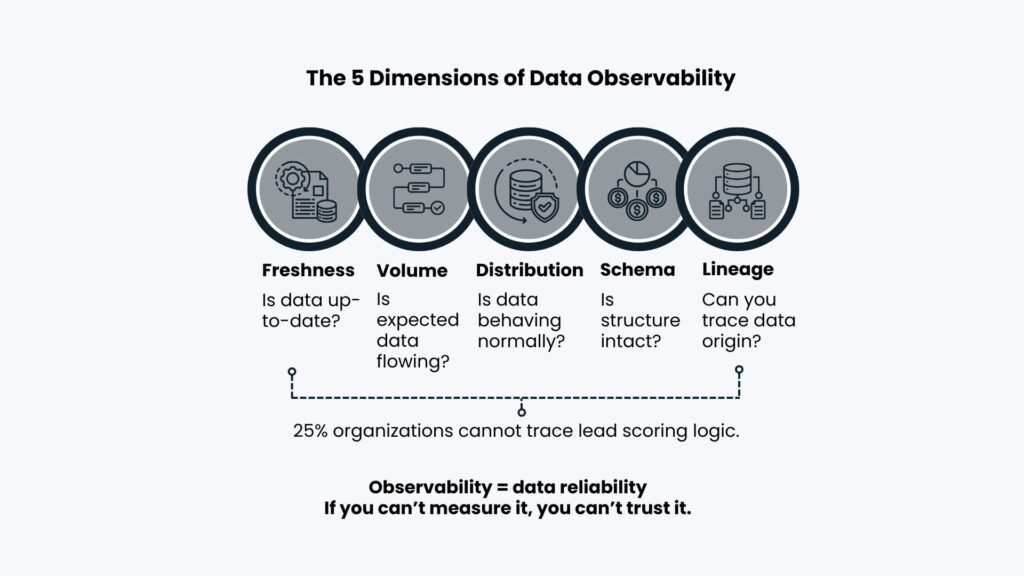
The Five Critical Dimensions of Data Observability Gap

Freshness measures how recent data is and whether updates arrive on time. In B2B, an intent signal loses value rapidly. If latency jumps from 5 minutes to 5 hours, the data has failed even if the pipeline succeeded.

Volume tracks whether expected amounts of data flow through systems. A sudden spike or flatline typically indicates broken tracking pixels or failed API integrations. A daily enrichment job that processes 40% fewer records than baseline has failed, regardless of technical completion status.

Distribution catches problems that do not violate rules but distort reality. If 35% of your pipeline typically comes from enterprise accounts and suddenly shifts to 55%, you face either a market breakthrough or a segmentation failure. When email open rates jump 40% overnight, you probably have a tracking implementation break, not an engagement miracle.

Schema monitors structural integrity. When the “Industry” field starts receiving job titles, your schema has drifted. When a data provider shifts existing values from a “size” field to “legacy_size” without notification, your segmentation rules execute against empty fields. No errors appear. Your ICP targeting just stops working.

Lineage provides the audit trail from source to dashboard. When conversion rates look wrong, lineage allows you to trace back through transformations to find exactly where logic failed. According to SiriusDecisions research, 25% of B2B organizations cannot trace how their lead scores are calculated, making silent failures nearly impossible to diagnose.

Four Data Observability Failures Hiding in Revenue Pipelines

Revenue teams operate with broken data longer than they realize because observability gaps manifest in ways that evade standard monitoring. Each of the following failure modes is a direct symptom of the data observability gap.

Silent schema drift occurs when upstream systems change structures without notification. A data provider modifies their taxonomy, now categorizing directors as “management” instead of “leadership.” Your lead scoring model continues executing perfectly. Results become meaningless. Detection happens quarters later when reviewing win rates by segment.

Gradual decay masquerading as variance presents as normal fluctuation. Email bounce rates creep from 3% to 11% over eight months. Each week feels within range. No single day trips an alert. But the cumulative impact; thousands of unreachable prospects, declining sender reputation, contaminated lists, represents material revenue leakage with no definitive break moment.

Transformation logic failures emerge when business rules and data reality diverge. Marketing automation shows 450 MQLs this quarter. CRM reports 520. Your data warehouse calculates 475. Each system is internally consistent. Each team defends their number. Revenue forecasts built on any of them are equally wrong, but no error appears in any log.

Cross-system inconsistency creates multiple versions of truth. One enterprise SaaS company discovered their entire Q3 demand generation budget targeted accounts using an enrichment feed that had not updated industry classifications in 14 months. Their “high-growth fintech” segment was actually legacy financial services companies that had since pivoted or been acquired.

The Revenue Cost of the Data Observability Gap

The business cost of the data observability gap concentrates in three areas.

Pipeline inefficiency manifests when teams operate on degraded data. If 20% of contact information is outdated and systems cannot flag which 20%, reps either waste time on dead ends or spend resources re-verifying everything. Salesforce’s 2023 State of Sales report found that reps spend 72% of their week on non-selling activities, with data quality issues consuming the largest share. For a 50-person sales team, a 10% reduction in selling time from bad data represents roughly $2.1 million in lost productivity annually.

Misallocated GTM spend occurs when targeting relies on corrupted signals. Intent data with 48-hour latency gets treated as real-time, causing marketing to engage prospects after buying windows close. Firmographic data with 35% accuracy drives ABM campaigns to wrong personas.

Delayed problem detection compounds every other failure. The leader of revenue operations in a Series C firm found that they were using inaccurate information to make important business decisions due to an error in their pipeline reports, which had been going on for five months without the team’s knowledge. Deals that got synced from Salesforce to the warehouse were somehow getting filtered out of the report depending on where they stood in the pipeline process.

How to Close the Data Observability Gap: 5 Operational Steps

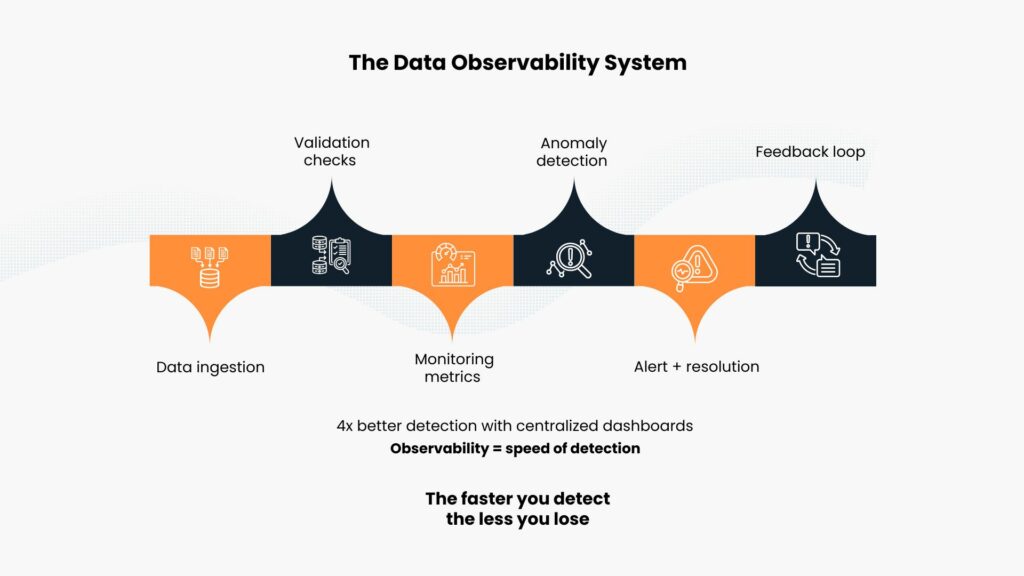
Implementation requires structured measurement across the data lifecycle.

Define data health metrics explicitly. Do not rely on implicit assumptions. Set tolerable fill rates, freshness levels, and accuracy standards for mission-critical resources. A contact record fit for newsletter segmentation might not suffice for sales campaigns. Measure data quality on factors that count: completeness of the fields needed for engagement, freshness of enrichments (job title updated within 90 days), credibility of signals (intent scores with proven accuracy >70%).

Implement automated anomaly detection. Track expected distributions and trigger alerts when patterns shift. If firmographic coverage typically holds at 90% and drops to 65%, high-value accounts are being excluded from campaigns. Manual checks do not scale. Deploy statistical or machine learning-based detection for volume, freshness, and distribution anomalies.

Create centralized visibility dashboards. These are not engineering dashboards showing server metrics. Such metrics include:

“Freshness of contact information for Q1 target customers: 78% refreshed within 30 days” or
“Latency of intent signal: Median 8 hours, 95th percentile 26 hours.”

Firms having unified dashboards measuring data health have a fourfold higher ability to detect problems than those that depend on reactive reports from users.

Assign clear ownership with defined protocols. Revenue operations typically owns CRM data integrity, sales owns account and opportunity data, marketing owns campaign and engagement data. Each owner needs authority to reject bad data. When anomaly detection flags a 25% drop in daily contact imports, documented protocols should specify who gets alerted, investigation SLAs, and rollback procedures.

Integrate observability into workflows. Before campaigns launch, reporting, and before scaling, validate data readiness, data integrity and data reliability respectively. Track mean time to detection (MTTD) and mean time to resolution (MTTR) for data incidents. Improving these metrics is the goal of observability.

The foundation of revenue growth strategy is having a unified RevOps data infrastructure.

Why Closing the Data Observability Gap Is a Strategic Advantage

The data observability gap is not about systems going down, it is about broken data continuing to drive decisions undetected.

Fixing pipeline inefficiency is impossible if you can’t see that 30% of contact data is stale. Optimizing conversion is impossible when you don’t even know your lead scoring broke six weeks ago. And if you can’t quantify the revenue impact of current failures, you’ll never justify data quality investments.

For revenue leaders, the observability gap represents a fundamental strategic vulnerability: flying blind while believing you can see. Based on industry standards, data problems may affect between 20-30% of all operational data pipelines at any given moment, yet without causing any failure points. These problems go unnoticed for a long time, which means that decisions are being made based on inaccurate data.

Data maturity’s next step is not about having more data, using more tools, or creating additional dashboards. The focus should be on improving data visibility. Because targeting depends on accurate data, prioritization depends on timely data, and conversion depends on relevant data.

Organizations implementing comprehensive observability see measurable improvements. Full-stack observability reduces outage costs by 37% and mean time to recovery by 50%. Research shows 51% of organizations report achieving a 2-3x ROI on their observability spend.

Closing the data observability gap is the next step in data maturity and the most underdiscussed competitive advantage in modern GTM.