

Tag Archives: data quality

Analysts reviewing multiple records and source materials, illustrating the risks of data risk concentration when organizations rely on too few data sources

The Data Risk Concentration Problem: Why Over-Reliance on Few Data Sources Creates Vulnerability

Data risk concentration is silently crippling B2B revenue teams. Your enrichment vendor has been your sole source of firmographic data for three years. Your intent signals come from a single platform. Your CRM enrichment runs through one API. Then, without warning, that vendor throttles their service, changes pricing, or experiences an outage. Your GTM engine doesn’t slow down; it stops.

According to Gartner’s 2024 Data & Analytics Survey, 68% of B2B organizations source more than 70% of their contact and firmographic data from just one or two providers. When a major B2B SaaS company lost access to their primary enrichment provider for 72 hours in 2023, the result was immediate: $1.2M in pipeline delays and a 34% drop in qualified meeting bookings that quarter. The issue wasn’t poor execution. It was architectural fragility driven by data risk concentration.

What Data Risk Concentration Means for B2B Revenue Teams

Data risk concentration occurs when critical revenue functions depend on a narrow set of data sources. This manifests in three distinct patterns that compound to create systemic vulnerability.

Provider concentration happens when a single vendor supplies the majority of your contact data, technographic intelligence, or intent signals. If that provider experiences quality degradation, coverage gaps in your target market, or service interruptions, your entire go-to-market motion inherits that vulnerability. Research shows that organizations relying on one or two dominant sources often experience higher volatility in data quality and availability, especially when those sources change policies or degrade coverage.

Pipeline concentration emerges when multiple downstream systems like CRM enrichment, marketing automation, sales intelligence platforms, all pull from the same upstream source. A single error propagates across every tool in your stack. When one major provider experienced a data ingestion delay in 2024, thousands of customers simultaneously saw stale job change alerts, outdated contact information, and delayed intent signals across every integrated platform.

Dataset concentration is subtler but equally dangerous. Many organizations use providers that aggregate from overlapping sources. What appears to be diversification, using three different vendors, is actually redundancy when all three scrape the same LinkedIn profiles, parse the same corporate websites, and monitor the same intent networks. According to Forrester’s 2024 B2B Data Ecosystem Report, 73% of organizations using three or more data providers don’t realize those vendors share upstream sources for 40-60% of their data.

The compounding effect makes concentration dangerous. A sales team relying on a single enrichment API for contact validation, the same provider’s Chrome extension for prospecting, and that vendor’s intent data for prioritization has created a three-layer dependency on one data infrastructure. When quality degrades or coverage shifts, every workflow breaks simultaneously.

Why Data Risk Concentration Happens: The Economics of Vendor Consolidation

Data risk concentration isn’t accidental. It’s driven by rational economic and operational incentives that create risk as a byproduct.

Convenience economics favor consolidation. Enterprise data contracts offer volume discounts that make single-vendor relationships 30-40% cheaper than multi-source strategies. One contract, one integration, one invoice. IT teams support this logic: fewer APIs to maintain, simpler security reviews, reduced integration complexity. According to vendor management research, 68% of technology leaders are actively planning to reduce their vendor count by 20%, driven by operational complexity.

Integration debt accelerates the problem. Once your CRM enrichment, sales engagement platform, and marketing automation all connect to the same provider, switching costs compound. Each additional workflow built on that foundation raises the switching threshold. By the time concentration becomes obvious, you’ve built too much on top to easily diversify.

Quality perception bias masks the risk. Teams often consolidate around whichever provider solved their initial data problem most effectively. But data quality is domain-specific. A provider with excellent direct-dial accuracy may have weak technographic coverage or stale funding data. Over-indexing on initial positive experience leads to scope creep without due diligence.

The most dangerous driver is invisible correlation. Teams believe they’re diversified when they’re not. When asked to map source lineage, only 18% of revenue operations leaders could identify which providers used independent collection methodologies versus aggregated resellers. This creates false confidence in diversification that doesn’t exist.

Business Impact: When Data Risk Concentration Causes System Failure

The consequences of data risk concentration materialize across three dimensions: disruption, reliability, and perspective.

Disruption risk is the most visible failure mode. A mid-market cybersecurity vendor relying exclusively on one enrichment provider lost API access during a billing system migration in 2024. For six days, their lead routing broke, form submissions went unenriched, and their SDR team operated blind. The calculated impact: 412 leads stuck in processing, 67 qualified opportunities delayed past SLA, and an estimated $840K in pipeline pushed to the following quarter.

Reduced data reliability follows from lack of cross-validation. When you have only one source, you have no way to verify its accuracy. One enterprise sales organization discovered their primary data vendor had 62% contact accuracy in their core mid-market technology segment but only 31% accuracy in healthcare, their fastest-growing vertical. Because all prospecting, enrichment, and intent workflows used that single source, they’d been systematically deprioritizing their highest-potential accounts for eight months. The opportunity cost: $3.2M in addressable pipeline they never activated.

Limited perspective risk is the most insidious because it doesn’t look like failure, it looks like your data. A revenue operations leader at a marketing automation company discovered this when they layered a second intent provider for comparison. The overlap was only 34%. Both providers showed statistically significant intent signals but for almost entirely different account sets. Neither was wrong, but relying on just one meant missing two-thirds of the addressable in-market opportunity. When they activated the previously invisible segment, pipeline velocity increased 28% and win rates improved 12%.

The Data Source Diversification Framework

Building resilient data architecture requires a structured approach to identifying, assessing, and mitigating concentration risk.

Layer 1: Dependency Mapping

Document every revenue-critical workflow and its data dependencies. For lead enrichment, account prioritization, contact discovery, intent monitoring, and technographic intelligence, trace back to originating sources. Create a dependency matrix showing which vendor supplies each data point for each workflow. If one provider appears in 60% or more of cells, you have critical concentration.

Layer 2: Source Lineage Analysis

Not all diversification is real diversification. Ask vendors directly: What percentage of your data is self-collected versus licensed from aggregators? Which specific sources contribute to your datasets? Providers using independent methodologies: proprietary web scraping, direct partnerships, behavioral tracking offer true diversification. Resellers create the illusion of backup without reducing correlation risk.

Layer 3: Use-Case Matching

Different workflows have different tolerance for risk. High-stakes precision workflows require maximum accuracy even at the expense of coverage. High-volume discovery workflows tolerate lower individual record accuracy in exchange for comprehensive coverage. Time-sensitive activation workflows require real-time freshness. Route each use case to the source best architected for its specific requirements.

Layer 4: Validation and Redundancy

Implement tiered sourcing by designating primary and fallback providers for essential workflows. Deploy variance monitoring to detect degradation before it impacts outcomes. When two independent providers historically agree on 75% of firmographic data but agreement suddenly drops to 62%, investigate whether one source has introduced errors. Variance is your early warning system for quality problems that would be invisible with a single source.

Practical Steps to Mitigate Data Vendor Dependency Risk

Mitigating data risk concentration starts with visibility.

Audit your data dependencies

Map every data source by type, vendor, and criticality. Identify single points of failure where one vendor supplies 100% of a critical data type.

Implement multi-source for Tier 1 data

For firmographics, intent signals, and contact data that drive pipeline decisions, maintain at least two sources. The cost of the second source is insurance against the cost of the first failing.

Build cross-validation into workflows

Don’t just collect multiple sources, compare them. Flag discrepancies. Investigate root causes. Track metrics like contact-level accuracy, account-level completeness, intent signal precision, and data freshness against your actual business outcomes.

Monitor vendor health continuously

Vendor performance degrades over time. Track API reliability, data freshness, and accuracy trends. Create data quality scorecards that measure provider performance against real-world results, not vendor-supplied claims.

Plan for fallback

Document what happens when each source fails. Establish contingency protocols before you need them. When disruption occurs, execute a plan rather than improvising under pressure.
You can read more about it here.

Conclusion: Resilience Requires Diversification

Data risk concentration is a structural vulnerability embedded in how most revenue organizations architect their data infrastructure. The shift to data-driven go-to-market strategies has created new dependencies that traditional risk management doesn’t capture. Your uptime isn’t just your own systems anymore. It’s also your data providers’ uptime.

Building resilient data architecture means accepting that perfect information doesn’t exist and single sources of truth are single points of failure. The goal isn’t eliminating all dependency, it’s ensuring no single dependency can create systemic collapse. In a market where data quality directly determines pipeline quality, concentration risk is revenue risk.

The organizations building durable competitive advantages aren’t those with the most data or the most expensive providers. They’re the ones who’ve architected redundancy, monitored variance, and built workflows that degrade gracefully rather than fail catastrophically when data sources shift. Because in revenue operations, the question isn’t “Whether your data will fail?”, it’s, “Whether your business can keep running when it does?”

Professional managing big data systems illustrating data ownership accountability challenges in organizations

The Data Ownership Problem: Why No One Is Accountable for Data Quality

Your CRM shows a deal at 90% confidence. The forecast meeting confirms it. Two weeks later, the deal is dead. When you investigate, you discover the contact left the prospect company three months ago. The champion never existed. The 90% number was hope, wearing a spreadsheet. This is what happens when data ownership accountability doesn’t exist. No one is responsible for verifying the data quality that your revenue forecast relies on.

According to IBM’s Institute for Business Value, 43% of chief operations officers consider data quality as their primary concern, with more than one-quarter estimating losses of over $5 million annually. Gartner pegs the average at $12.9 million annually. But why does this issue continue to exist when nobody owns the data?

If data management is everyone’s responsibility, then it will be nobody’s priority. Marketing owns lead generation. Sales owns CRM updates. RevOps owns systems. External vendors own enrichment. Each team influences data quality, but no single team controls it end to end. The result is a GTM engine built on shifting sand.

What Data Ownership Accountability Actually Means

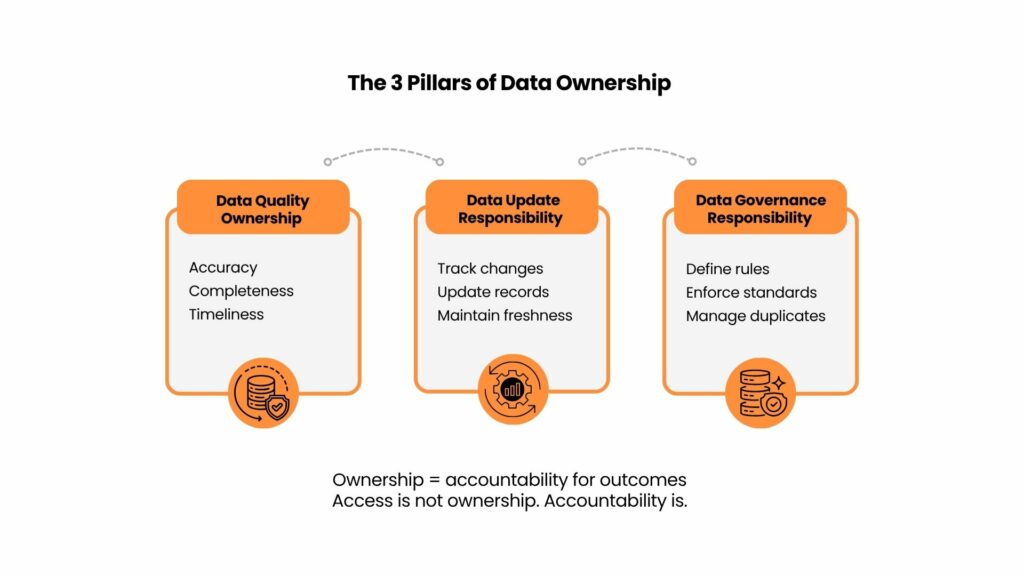
Data ownership accountability is frequently mistaken for data access. Data access does not necessarily imply data ownership. It implies accountability along three key axes.

Data quality ownership requires accountability for data accuracy, completeness, and timely updates for specified data types. If address information is incorrect, an individual can be held accountable for correcting them. This includes defining what “good data” actually means and maintaining standards for formatting, validation, and mandatory fields.

Data update responsibility means someone ensures records remain current. When a contact changes jobs or a company shifts technology stacks, ownership dictates who detects that change and updates the system. Without this, data becomes stale even if initially accurate.

Data governance responsibility means someone defines and enforces the rules. Standards for entry, modification, duplication resolution, and compliance require accountable stewards. DemandLab notes that no single group owns revenue data, but “what is owned is the primary responsibility at each phase of the revenue cycle.”

The underlying concept is straightforward. Ownership of data implies accountability for results, not merely processes. When the quality of data is compromised, the owner determines who is accountable, what necessary actions to take, and how to measure performance.

Why Data Ownership and Accountability Fail in B2B

The accountability gap emerges from predictable structural failures. Without clear data ownership accountability, these problems compound across every revenue function.

Cross-team dependencies create the primary problem. B2B data flows across multiple functions. Marketing generates leads. Sales qualifies them. Customer Success manages relationships. When data quality requires coordination across silos with competing incentives, no single team prioritizes it. Research from Integrate and Demand Metric found that over 60% of teams report poor data disrupts lead handoffs and slows sales productivity.

Unclear role definitions compound the issue. The majority of companies lack clear ownership of contact vs. account data, who is responsible for validation of the enrichment process, and who is accountable for duplicate management. How can we know whose record in the CRM, MAPs, and data warehouse is accurate if there is disagreement among them? Without clarity, the issue never gets sorted out.

Lack of governance structures means accountability is assumed rather than assigned. Many teams rely on informal processes, manual fixes, and reactive cleanup efforts. There are no defined standards, validation rules, or enforcement mechanisms. One industry study found that 84% of organizations struggle with inaccurate or duplicate data precisely because they lack formal quality measures.

Vendor dependency creates a false sense of security. Organizations often assume the data vendor ensures quality. In reality, vendors optimize for coverage, not precision. Accuracy varies by segment and geography. Data degrades after delivery. Without internal ownership, vendor data becomes unverified input that teams trust until it fails. A data procurement framework is a must.

The GTM Cost of Unowned Data

The absence of ownership creates compounding inefficiencies across every revenue function.

Inconsistent data quality means standards vary across teams. Enrichment is applied inconsistently. Validation is sporadic. This leads to unpredictable performance and three versions of truth. The sales department claims revenue is X. The finance department believes it is Y. The operations department has its own figure.

Unsolved errors mount up silently because no one is answerable for fixing them. Problems are deprioritized. Duplicate records can reach 10% to 30% of customer databases in organizations without data quality initiatives. Each duplicate means wasted outreach, confused reporting, and damaged customer experience.

Operational inefficiencies become normalized. Salesforce estimates that reps spend up to 27% of their time dealing with data issues instead of selling. Teams spend hours manually reconciling conflicting data. Sales reps begin “shadow researching,” ignoring the CRM and going to LinkedIn to manually verify every prospect. This is a massive waste of high-value labor that could be avoided with clear ownership.

Broken prioritization and targeting affect ICP alignment, lead scoring accuracy, and intent signal reliability. If data inputs are inconsistent, prioritization models produce misleading outputs. Intent signals point to churned contacts. Enrichment delivers 92% accuracy but only 61% becomes usable.

The IBM research found that data quality issues often go unnoticed because their impact appears downstream as lost revenue, not at the point of failure. Pipeline leaks. Conversion rates weaken. Sales cycles lengthen. The impact is not isolated. It affects the entire revenue system.

A Framework for Data Ownership Accountability

Building data ownership accountability requires a structured approach to assigning and enforcing ownership.

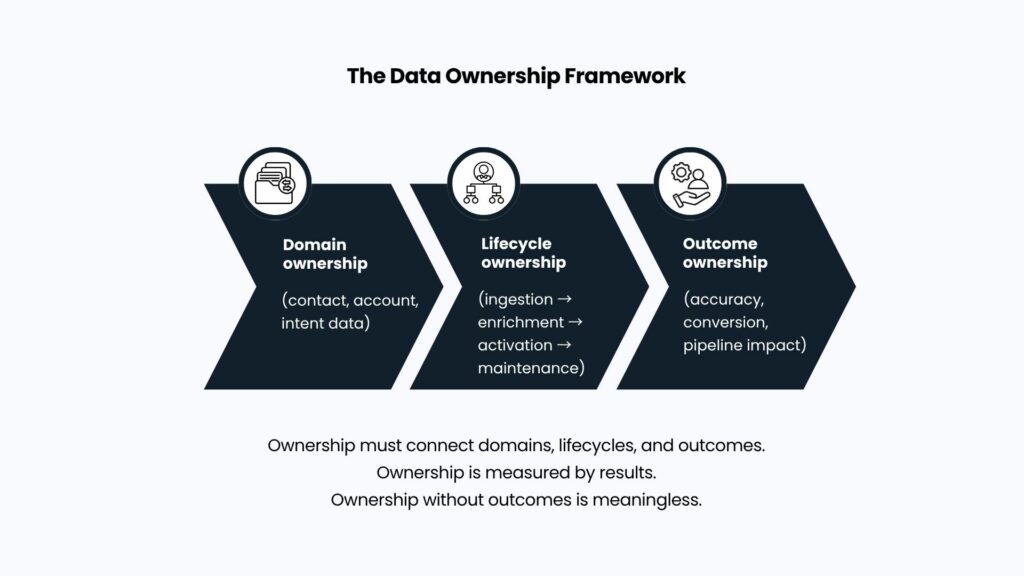
Domain ownership defines what is owned. Assign ownership by data domain: contact data, account data, enrichment data, intent signals. Each domain should have a clear owner. For example, RevOps owns contact enrichment and is accountable for 82% connect rates. Demand Gen owns intent signals and is measured on 35% progression lift. The data team owns firmographics with a 92% ICP match target.

Lifecycle ownership defines when it is owned. There must be ownership at each level: ingestion (data input and acquisition), enrichment (enhancement and verification), activation (usage within campaigns and routing), and maintenance (upgrades and cleaning). Ownership can be assigned to different groups for each step, but transition protocols should be clear.

Outcome ownership defines why it is owned. Ownership is validated through results, not activity. Define ownership based on outcomes such as data accuracy rates, contactability metrics, ICP fit consistency, and campaign performance impact. Most organizations assign ownership at the process level. High-performing organizations assign ownership at the outcome level.

Operationalizing Data Ownership

Moving from theory to practice requires embedding ownership into daily workflows and performance systems.

Data SLAs (service level agreements) define expected quality levels. For example, you must maintain contact data with greater than 90% deliverability, enrich data within defined intervals, and meet accuracy thresholds. SLAs make quality measurable and non-negotiable.

Quality benchmarks provide objective targets. Monitor the metrics of bounce rate, duplication rate, enrichment match rate, and ICP alignment. The fundamental criteria include accuracy, which should be 98% or more, completeness at 95% or more, consistency of 97% or more, timeliness of 99% within 24 hours, and uniqueness at 99% or more.

Performance tracking ties data quality metrics to team KPIs, operational reviews, and performance evaluations. Regular scorecards show each domain’s quality metrics against SLAs. When quality drops below thresholds, automated alerts trigger owner intervention. Include data integrity in performance reviews and reward the “data citizens” who actively improve the system.

Workflow integration ensures ownership is maintained during execution. Embed validation into CRM processes through required fields and validation rules. Build automated checks into enrichment pipelines. Use campaign readiness filters to prevent unowned data from reaching execution. Before any outreach deploys, validation confirms that required fields meet quality thresholds. Data ownership accountability must be embedded into daily workflows, not treated as a one-time project.

As one data governance framework emphasizes, “without accountability, measures become shelfware. Each critical data element should have both a data steward responsible for data quality rules and a system owner accountable for implementation.”

Practical Recommendations for RevOps Leaders

Start with a clear gap analysis. Map current ownership structures, which likely reveals that no one truly owns critical data domains. Calculate the quality cost using the $2.7 million annual benchmark for mid-market companies. Identify your top three pain points, typically bounce rates, duplicates, and stale intent signals.

Define ownership explicitly. Identify the owners of each data domain, the accountable parties at each phase of the lifecycle, and the criteria for measuring success. Apply a RACI model to assign ownership roles: accountable party, responsible party, and consumer (utilizes the data).

Prioritize those data domains that will make the biggest difference. Contact accuracy, relevance of roles, account-level data, and intent signals will make the largest contribution to the bottom line and will produce the quickest ROI from ownership.

Align ownership with revenue outcomes. Measure data quality based on pipeline contribution, conversion rates, and sales efficiency rather than just technical accuracy metrics. This ensures ownership drives business results.

Decrease dependence on vendors. Verify vendor information internally. Do not delegate responsibility. Establish continuous feedback cycles that utilize performance metrics like bounce rate and connect rate to detect problems with data and update validation criteria.

Conclusion: Data Quality Improves When Ownership is Clear

Typically, most B2B companies are concerned with getting better data, enriching it, and enhancing the technology. However, none of this works without proper ownership. This is not a technological challenge, but rather an organizational one.

What is needed is a paradigm shift to data ownership accountability; from shared responsibility to clear ownership, from process metrics to outcome measurement. And infrastructure only performs when someone is accountable for maintaining it.

You need to ask not whether you can afford data ownership, but whether you can afford to continue without it. With each passing day that this ambiguity continues, your data deteriorates, your decision-making skills deteriorate, and money flows out of your hands. Because ultimately, it is ownership that improves your data.

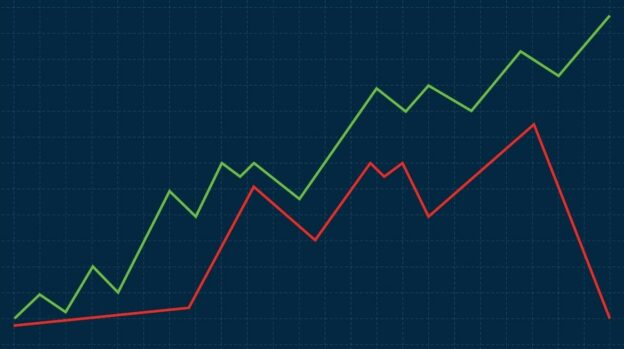
Line graph comparison showing fluctuations in B2B intent data accuracy and signal inflation trends

B2B Intent Data Accuracy: Stop Signal Inflation

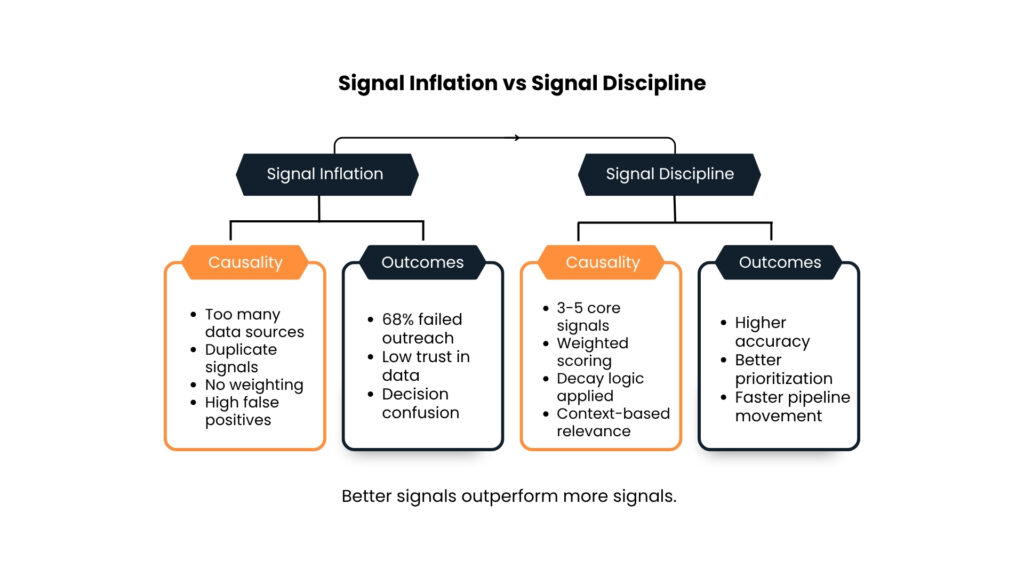
Your sales team tracks intent data from six providers. Your CRM pulls buyer signals from twelve sources. You spent $150,000 on data subscriptions this year. Yet when your SDRs reach out to high-intent accounts, 68% of conversations go nowhere. You are experiencing signal inflation, the paradox where B2B intent data from multiple sources dilutes predictive accuracy instead of improving it.

Forrester’s Q1 2025 Intent Data Providers Wave found that 50% of companies leveraging B2B intent data report too many false positives. Forrester’s comprehensive evaluation of B2B intent data providers revealed that signal quality, not volume, determines effectiveness, with leading vendors focusing on precision over broad coverage.

When half your hot accounts turn out to be researchers or competitors, the problem is not a lack of data. It’s too much undifferentiated noise drowning genuine signals in B2B intent data.

When More B2B Intent Data Becomes the Problem

The B2B intent data market exploded over the past five years, creating unprecedented signal noise. With 70-100% of B2B marketing and sales teams now using third-party intent data, according to 2024 industry surveys, the same signals trigger alerts for hundreds of vendors simultaneously. When a prospect shows content consumption activity, they receive 36 or more vendor outreaches within two weeks, per Demand Gen Report’s 2024 Buyer Behavior Survey. The feeding frenzy creates the exact opposite of competitive advantage.

Recent predictive modeling research confirms that simple models using 10 carefully selected data series often outperform complex models ingesting hundreds of variables. The lesson translates directly to B2B sales intelligence: disciplined signal selection beats indiscriminate accumulation. As global data volume approaches 175 zettabytes, the challenge is no longer a shortage of information. It is the explosion of noise.

Four Mechanisms Driving B2B Intent Data Inflation

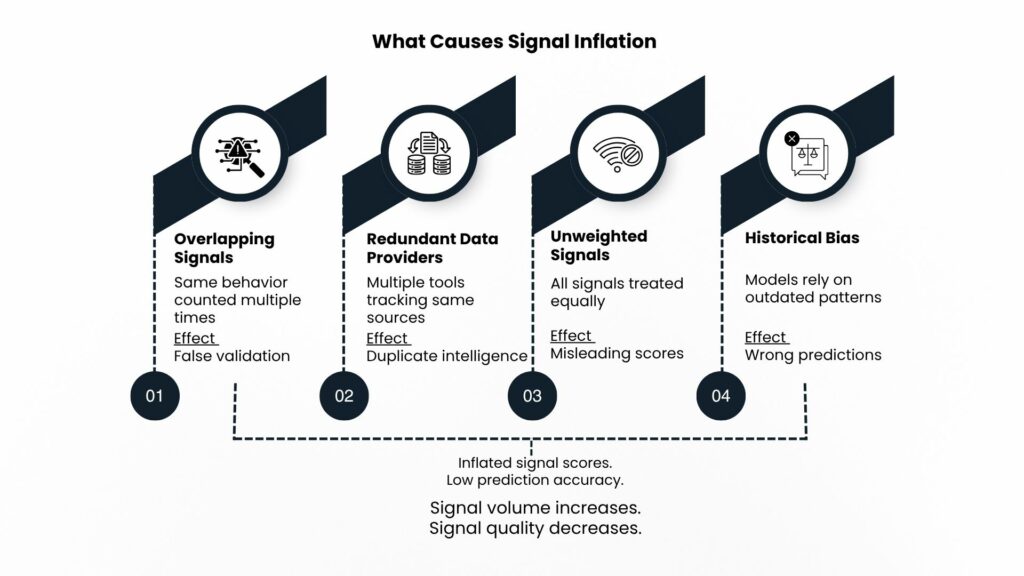
Signal inflation in B2B intent data stems from four predictable mechanisms that compound inaccuracy.

Overlapping Indicators

A prospect downloads a whitepaper tracked by one intent provider. That same download gets counted by a second provider monitoring the same publisher. Three signals from three vendors describe one behavioral event. Teams mistake redundant data for validation when they are seeing echo chamber effects. When these signals enter models without adjustment, the system overestimates buyer intent and inflates account scores.

Redundant Data Providers

Most third-party intent platforms source signals from overlapping pools: bidstream data, B2B publisher cooperatives, and the same handful of review sites. When providers claim to track trillions of intent signals, they are often tracking many of the same signals repackaged with different scoring. Subscribing to multiple vendors without de-duplication creates weighted repetition, not additional intelligence.

Unweighted Signals

A CFO visiting your pricing page three times in a week receives the same intent score as an intern downloading an educational whitepaper. Without weighting that accounts for role, recency, and engagement depth, raw signal volume creates false confidence. At Packed Data, this is exactly why the approach centers on a minimum viable signal framework: identifying the three to five core triggers that actually correlate with revenue rather than treating all activity as equally meaningful.

Historical Bias in Models

Many predictive scoring systems train on past closed deals, creating self-reinforcing cycles. If historical data shows that accounts with high content consumption converted well, the model keeps surfacing similar accounts, even as buyer behavior evolves. NetLine’s 2024 B2B content consumption report found that 25% of intent surges led to no meaningful buying activity within six months. One in four high-confidence signals produces nothing. That is not prediction. It is expensive guesswork dressed up with dashboards.

What Over-Signaling Actually Costs You

Poor B2B intent data quality creates cascading costs across sales operations.

False Positives

Over-signaled models surface hundreds of leads showing intent without actual buying power or technical fit. According to research on B2B intent data effectiveness, 87% of B2B teams deal with unreliable intent signals, and only 26% of those signals turn into real opportunities. SDRs chase accounts that were never in-market. Pipeline quality collapses. Credibility erodes with both buyers and the sales team itself.

Model Overfitting

When too many variables enter predictive scoring without proper regularization, models fit noise rather than genuine patterns. They achieve impressive accuracy on historical data while failing on new prospects. One SaaS organization reduced its active signals from 60 to 12 and saw scoring accuracy rise from 55% to 88%. The fewer, better-chosen signals produced a model that actually worked in the field.

Rep Distrust and Decision Paralysis

When sales teams watch high-scoring accounts go cold repeatedly, they stop trusting the intelligence system. Manual overrides reach 50% at organizations where signal quality has degraded, per Gartner research. The expensive data infrastructure becomes shelfware. At the executive level, contradictory recommendations from competing providers create a fog of war. Teams hold meetings to debate which prediction to trust. Forrester estimates decision paralysis from signal overload reduces pipeline velocity by 20%.

Building B2B Intent Data Discipline

Signal Hierarchy Frameworks

Build a hierarchy that weights indicators by predictive power. Packed Data organizes signals into three tiers.

Tier-1 covers high-signal intent and technographic data: the strongest indicators of buying readiness.

Tier-2 covers supporting firmographic context.

Tier-3 covers general behavioral signals used for background awareness only. Direct engagement, such as demo requests and pricing page visits, outweighs passive signals. This hierarchy must be explicit and consistently applied.

Decay Weighting

A technographic shift from six months ago is cold. A website visit from four hours ago is not. Effective implementations apply exponential decay: recent signals carry maximum weight, last week’s signals contribute partial influence, and anything beyond 60 days drops from active scoring entirely. Packed Data’s real-time enrichment model is built around this principle, ensuring stale data points do not artificially inflate account priority scores.

Contextual Relevance Scoring

A high-intent signal from a company with the wrong technology stack is a distraction. By integrating ICP analytics directly into the scoring model, signals are amplified only when they occur within a high-fit context. Multiple technical roles engaging integration documentation suggests active evaluation. General business content consumption suggests early awareness. These are not equivalent, and your model should not treat them as though they are.

Human-in-the-Loop Validation

Automated models catch scale. Humans catch context. Regular feedback loops where sales reps flag poor leads allow models to learn the difference between a real signal and noise specific to your industry. Hybrid approaches combining AI predictions with expert validation consistently outperform either pure automation or purely manual analysis. A rep’s ability to downvote a lead teaches the system what generic intent actually looks like in your market.

What Signal Discipline Delivers

Higher trust in intelligence: When scores consistently align with outcomes, sales teams use them. Win rates on accounts targeted through disciplined intelligence are double those from generic outbound prospecting. Trust becomes self-reinforcing as successful conversions refine models.

Fewer false alerts: Teams using intent data strategically achieve 2.5x improvement in engagement rates compared to baseline campaigns. Buyers receive outreach only when strong signal convergence suggests genuine buying activity.

Cleaner prioritization: Organizations with disciplined signal frameworks report higher pipeline-to-close conversion rates, faster deal velocity, and larger average deal sizes. One fintech organization applying signal discipline with Packed Data’s weighted intent and technographic data saw ARR increase by $5.1 million and customer acquisition cost drop by 27%.

Sharper Intent Signals, Better Predictions

The competitive advantage in B2B sales intelligence is not who accumulates the most signals. It is who filters most effectively, weights most accurately, and maintains the discipline to ignore the majority of data in pursuit of the minority that actually predicts outcomes.

At Packed Data, the philosophy is that data for the sake of data is a liability. The goal is insight density: pre-filtered account intelligence and real-time company insights designed to simplify decision-making. CRM integrations built on this model surface the signal that matters, ensuring AI-driven prioritization rests on high-fidelity data rather than inflated noise.

Audit your current signal stack. Identify which sources overlap. Build a decay model. Establish a signal hierarchy. The organizations that sharpen their signals will outpredict and outperform those still collecting everything and trusting nothing.

Professional analyzing dashboard on laptop illustrating data lifecycle management from data collection to business insights

Data Lifecycle Management: From Acquisition to ROI

Your CFO approves a $500,000 investment in a B2B intelligence platform. Marketing celebrates 50,000 new prospect records. Sales expects a pipeline surge. Twelve months later, campaigns disappoint, conversion rates stagnate, and ROI tells an uncomfortable story: that expensive data delivered minimal value.

The problem isn’t the data itself. It’s a fundamental misunderstanding of data lifecycle management; how data creates and destroys value across its entire lifespan. Most organizations track acquisition costs carefully but ignore everything after: validation overhead, activation delays, maintenance burden, and decay penalties. The result is bloated data estates, spiraling costs, and strategic insights buried under low-value information.

This is why data lifecycle management matters. Data’s value fluctuates dramatically from creation through retirement, yet most companies measure ROI at only one point. Mastering data lifecycle management is becoming a defining capability for leaders who want efficiency, growth, and real competitive advantage.

Why Data Lifecycle Management Matters: Value Changes Over Time

The traditional view treats data as a permanent asset. Once acquired, it is always valuable. That assumption is wrong.

B2B contact details can become outdated at yearly rates that vary between 22.5% and 70%. As much as 70.8% of business contacts change within a year: some people get new job titles, others change their phone numbers, and still others switch their email addresses. That pristine database purchased this quarter is largely obsolete by next year. Your balance sheet reflects no depreciation. Your pipeline does.

A buyer intent signal is highly valuable the moment it is triggered. Its value drops sharply with every hour it sits unacted upon. Conversely, historical firmographic data may have low immediate activation value but high strategic value for long-term ICP analytics. If you are not measuring value relative to time and stage, you are not managing an asset. According to IBM research, poor data quality costs organizations to lose an average of 12% of revenue due to inaccurate, incomplete, or outdated business information. and has cost U.S. businesses an estimated $3.1 trillion each year.

The Five Stages of Data Lifecycle Management

Data lifecycle management involves five distinct stages, each with unique costs and value creation patterns.

Acquisition

Data gets into your company through purchases, being internally generated, or third, party enrichment. The costs are upfront: vendor fees, integration work, storage, compliance. The value at this stage is potential, not realized. Acquisition accounts for only 15-20% of total lifecycle costs, yet this is what gets the most attention.

Collection is excessive and uncontrolled. Organizations gather far more data than they ever activate, assuming future value will justify the cost. Without clear use cases, acquisition becomes accumulation. High-performing organizations invest in targeted account intelligence instead, acquiring data aligned with specific business outcomes.

Validation

Raw data hardly ever is ready for use. Validation alters it by cleaning, deduplication, standardization, and enrichment. This phase increases the level of quality, thus the cost, and it is estimated to be around 20-30% of the total amount of money spent on the lifecycle.

An entity that puts its money into validation at the beginning of the process will gain a 30% accuracy improvement and lower maintenance costs downstream to a great extent. Validate early or pay continuously. Contact data that is 95% accurate at acquisition but left unchecked will decay to 70% accuracy within twelve months, requiring perpetual maintenance that far exceeds the upfront validation cost.

At Packed Data, validation is built into the process from the start, ensuring that when a sales rep picks up a lead, the account intelligence is genuinely actionable.

Activation

Activation is where data justifies its existence. It fuels a model, informs a decision, personalizes a campaign, or surfaces an expansion opportunity. Without activation, every prior investment is sunk cost.

According to research, companies only put to use 20-30% of the data they have obtained during the first 6 months. The remaining data is inactive, losing value and at the same time causing storage and other associated costs. The solution is to start with the purpose of data: clarify the expected business results first and then, buy the data that could most effectively help achieve those results.

Decay

All data decays. B2B data degrades at roughly 2.1% monthly, with technology sector contacts experiencing up to 50% job title changes annually. On average, sales representatives waste 27.3% of their time pursuing leads that do not convert.

Marketing campaigns suffer bounce rates that damage sender reputation even for valid contacts. If your data decays 30% annually with no refresh strategy, you are losing 30% of associated pipeline.

Organizations that manage decay effectively monitor firmographic changes, technology adoption signals, funding events, and leadership transitions in real time. Packed Data’s real-time company insights platform updates records automatically as business environments evolve, transforming static databases into living intelligence streams.

Retirement

The most neglected stage. Keeping data longer than its useful life costs you in various ways: storage capacity is used up, the security risk of each retained record is increased, the complexity of compliance requirements is multiplied, and analysts have to spend their time on very low, value noise. Retaining data out of fear generates more risk than it reduces. An organization that systematically retires data has achieved a 25-40% reduction in storage costs besides better data hygiene and easier governance.

Hidden Costs of Poor Data Lifecycle Management

Traditional ROI calculations miss substantial costs embedded across lifecycle stages, systematically underestimating total ownership costs and overestimating net value.

Over-Collection: The “more data is better” instinct leads to massive datasets with low utilization. Roughly 85% of data estates contain at least 30% unnecessary data. Collecting signals you have no plan to activate creates a storage tax that erodes the ROI of your useful data.

Under-Utilization: The most expensive data is the data you own but never activate. Research estimates 60% of datasets in typical B2B organizations remain unused. You pay full acquisition and maintenance costs for assets generating zero returns.

Maintenance Overhead: Data maintenance accounts for 30, 40% of the total lifecycle costs, but it seldom gets included in the initial investment proposals. For instance, a data purchase of $50, 000 may necessitate an annual maintenance expenditure of $75, 000, thus, the actual cost over three years is much closer to $275, 000.

Late Retirement: Data that has been scheduled for deletion is still lingering in backups, data lakes, and overlooked spreadsheets. An audit of a SaaS company revealed that 40% of its data was over two years old. Getting rid of it helped the company save $800, 000 in infrastructure costs and allowed the team to focus on leveraging Packed Data intent signals that brought in $2.4 million in new ARR.

Modeling the Data Lifecycle Economy

Cost Curves vs. Value Curves

Acquisition costs spike initially. Maintenance costs accumulate steadily over time. Value curves behave differently: many assets deliver minimal value during early processing, peak during activation when data is current and aligned with business priorities, then decline as decay progresses.

The critical insight: optimal lifecycle length occurs when cumulative value peaks, often far sooner than organizations assume. Contact data might deliver maximum value in months 3-18. Intent signals lose value within weeks if not immediately activated. Extending data lifespan through aggressive maintenance often destroys value, spending more to preserve decaying assets than those assets generate.

Identifying Negative-ROI Assets and Prioritizing High-Yield Domains

A negative-ROI asset is any dataset where total costs exceed total value created. Audit your data estate. Flag any dataset with usage below 10% quarterly and a value-to-cost ratio below 0.5. These are candidates for retirement.

High-yield data domains share four traits: clear linkage to business outcomes, rapid activation capability, extended useful lifespan, and manageable maintenance requirements. For B2B sales and marketing, research points to consistent winners:

ICP analytics identifying prospects matching successful customer patterns deliver 3-5x improvement in conversion rates.

Buyer intent signals indicating active solution evaluation compress sales cycles by 30-40%.

Technographic data revealing specific technology gaps improves engagement by 25-35%.

Contact enrichment providing decision-maker identification accelerates deal velocity by 20-30%.

    These are the domains where Packed Data concentrates its intelligence, combining AI-driven lead prioritization with real-time buyer intent signals to maximize the window of peak data value.

    Strategic Outcomes of Data Lifecycle Management

    Strategic data lifecycle management delivers three measurable outcomes.

    Leaner Data Estates

    By eliminating negative-ROI assets and retiring data promptly, organizations reduce total data volumes by 40-60% while improving average quality and business relevance. Storage costs decrease. Security risk diminishes. Analytical performance improves as algorithms process cleaner, smaller datasets.

    Lower Operational Cost

    Organizations implementing lifecycle management report 30-50% reductions in total data-related costs. These savings do not come from reduced capability. They come from eliminating waste: unused acquisitions, late retirements, and maintenance overhead on low-value assets. Marketing teams achieve better campaign performance. Sales representatives spend time on qualified opportunities. Analytics teams deliver insights faster.

    Higher Insight Density

    Lifecycle management raises the proportion of actionable intelligence over the total amount of data. Getting rid of the noise reveals the signal. Predictive models yield higher accuracy. The quality of decisions improves. If each and every potential client contact is backed up by thorough, up, to, date intelligence, then the rate of responses will be multiplied by 2 to 3 times, the duration of sales cycles will be reduced by 30 to 40%, and the rate of closing deals will go up by 25 to 35% by focusing better, not by more effort.

    From Accumulation to Strategy

    At present, the main concern is not really the quantity of data that you have. Rather, it is the value that your data produces which must be more than the cost of the entire data life.

    Implementing data lifecycle management starts with a simple 90-day audit plan. Take stock of all the data sets and mark them according to the stage of their life cycle. Model your cost and value curves. Retire low-ROI assets. Enrich and activate high-yield intelligence. Review quarterly. The leaders who treat data as a financial asset with a clear shelf life will outperform those still asking, “how much data do we have?”

    Data is not an asset you own indefinitely. It is an asset you manage continuously. The companies that outperform in the years ahead will master data lifecycle management, measuring value creation and loss across data’s entire life.