


Tag Archives: data architecture

Professional analyzing dashboards and system data illustrating challenges in data scalability architecture as data volumes increase

The Data Scalability Problem: Why Data Systems Fail as Volume Increases

Most data systems don’t fail at launch. They fail when they succeed; a fundamental data scalability architecture problem.

The CRM enrichment process that works seamlessly on 10,000 records fails on 100,000 records. The marketing automation system working perfectly with 200 leads every week fails once there is a campaign generating 2,000 leads. The system remains the same but its volume changes.

Based on Gartner’s findings from 2023, 47% of all data systems suffer from reduced functionality at a mere 3x the scale of their initial capacity. When it comes to RevOps, it results in inaccurate pipeline analysis, outdated intent scores, and SDRs reporting that contact information is lacking. The problem is not necessarily downtime; the issue is a slow degradation of trust in the accuracy of your data.

Understanding Data Scalability Architecture: Three Core Dimensions
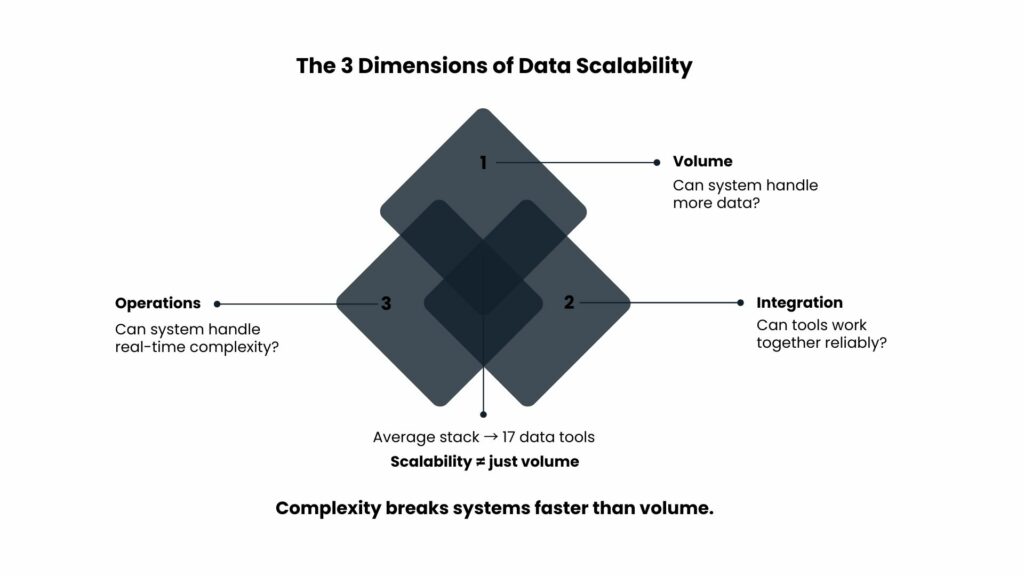
Data scalability architecture encompasses three distinct dimensions that organizations often conflate when planning for growth.

Volume scalability focuses on pure throughput. Are you able to support 50,000 API enrichment requests per day compared to 5,000? But volume scalability alone doesn’t account for complexity. A system that handles 100,000 basic contacts may fail once you need to merge 10,000 records using multiple data sources, implementing deduplication and resolving conflicts with third-party APIs.

The need for integration of scalability increases as your infrastructure grows. Connecting three platforms such as Salesforce, HubSpot, and one enrichment tool can work just fine. Once you throw in Outreach, Gong, ZoomInfo, Clearbit, and a data warehouse, you have built an ecosystem of interdependencies, where a failure of one service affects all the others. On average, a B2B business uses 17 data tools, according to the ChiefMartec 2024 research.

Operational scalability is defined by the capability of your system to retain reliability amid varied usage patterns. For a startup, batch enrichment may be performed on a weekly basis. As for the growth phase, real-time enrichment is necessary on account of form submissions, chats, and integrations that must happen in parallel. According to Databricks’ research, 62% of failures in data pipelines result from such interactions, not volume.

Where Scalability Failures Manifest

Degradation of processing usually starts slowly but reaches a point where the increase becomes dramatic. If a data enrichment pipeline takes two minutes initially, doubling the number of records makes it take five minutes. Increasing by an additional twenty percent causes processing times to balloon up to forty-five minutes and leads to timeouts, job failures, and partial data sets. This is due to the nature of most processing systems having certain tipping points: queries becoming inefficient, rate limiting of APIs, memory exhaustion, and network limits.

Let’s consider a practical example. A Series B SaaS company that ran nightly enrichment pipelines extracting company data from three different providers, combining them, and then updating Salesforce found its enrichment process took forty minutes for five thousand accounts but three hours for fifteen thousand accounts. At 25,000 accounts, it failed entirely. Not because servers crashed, but because sequential API calls, conflict resolution logic, and Salesforce update operations couldn’t complete before the next batch started. The system wasn’t designed for scale. It was designed to work. This failure illustrates why data scalability architecture must be designed upfront, not retrofitted after systems break.

System overload creates downstream effects beyond slow processing. When enrichment services lag, sales teams start manually researching accounts, creating duplicate records, inconsistent data formatting, and bypassing validation rules. Salesforce reports from 2023 indicate that 34% of CRM data quality issues originate from workarounds created when automated systems fail to perform.

Integration failures multiply as systems scale because they operate on different assumptions. Your CRM expects responses within 10 seconds. Your enrichment provider’s SLA allows 30 seconds. At low volume, average response time stays under threshold. At scale, the provider’s 95th percentile response time exceeds your timeout, causing intermittent failures that are difficult to diagnose and impossible to prevent without architectural changes.
You can read more about this, here.

The Revenue Cost of Weak Data Scalability Systems

The cost of scaling failures extends beyond engineering resources. LinkedIn’s B2B Institute research found that sales teams using incomplete or stale data experience 27% longer sales cycles and 18% lower win rates. But the compounding effect is more severe.

When a successful campaign generates 800 leads in one day instead of the usual 100, the enrichment backlog grows to 3 days. By the time intent data is available, those signals are stale. The prospect who showed buying intent on Monday receives outreach on Thursday after they’ve already engaged with a competitor. The revenue impact isn’t from system failure. It’s from timing degradation that makes accurate data useless.

Pipeline visibility suffers disproportionately. The RevOps team requires comprehensive data to forecast, plan territories, and allocate resources. If the enrichment tools cannot match the amount of data being collected, then reporting is inaccurate. Based on the Forrester 2024 B2B Data Quality research study, “41 percent of revenue professionals said they made strategic decisions using incomplete data during periods of growth.”

The Scalability Design Framework

Effective data scalability architecture requires design decisions made before scaling pressure appears. The Throughput-Consistency-Latency triangle provides a decision framework.

Throughput measures volume capacity. How many enrichment operations per hour can your system handle? Increasing throughput typically requires parallel processing, which introduces consistency challenges. If three enrichment providers return conflicting company revenue data for the same account, which source wins? Sequential processing makes this decision straightforward. Parallel processing requires conflict resolution logic designed upfront.

Consistency ensures data accuracy across integrations. Eventual consistency, where different systems show different data temporarily, might be acceptable for some use cases but catastrophic for others. A sales rep viewing account data in Salesforce while a marketing automation system sends an email based on slightly different data creates customer experience issues.

Latency defines how quickly data must be available. Real-time enrichment requires fundamentally different architecture than batch processing. Organizations often demand real-time performance without considering the cost. Real-time systems need redundancy, caching layers, and fallback mechanisms that batch systems don’t require.

The strategic choice isn’t optimizing all three. It’s deciding which two matter most for your use case and architecting accordingly. High-volume lead enrichment might prioritize throughput and latency, accepting eventual consistency. Strategic account intelligence might prioritize consistency and latency, processing lower volumes with higher quality standards.

Building Modular Data Scalability Architecture

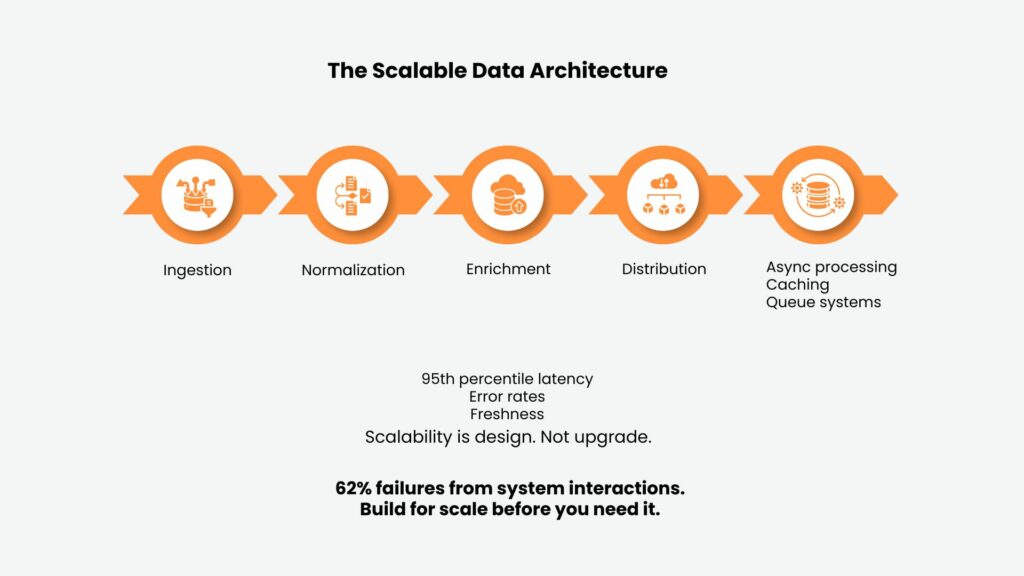
A robust data scalability architecture segregates functionality into independent yet loosely coupled modules. The architecture should avoid using a single big-enrichment model but rather employ an independent module-based approach that allows each transformation to run independently.

The initial stage will involve the creation of an ingestion module. Another stage will be to introduce a normalization module to standardize data. The third stage involves enriching data using another data module. Finally, the fourth stage entails distribution through yet another module. Scaling will depend on bottleneck analysis.

Asynchronous processing decouples data collection from enrichment from distribution. When a new lead enters your system, the immediate response confirms receipt. Enrichment happens separately. This prevents user-facing processes from slowing as backend operations scale. The trade-off is added complexity. You need queue management, retry logic, and monitoring to ensure eventual processing.

Caching strategies dramatically improve scalability for repetitive queries. If fifty sales reps view the same strategic account daily, enriching that account once and caching results for 24 hours reduces load by 98%. But caching introduces staleness. You’re explicitly choosing to show slightly outdated data for performance gains.

Implementing Data Scalability Architecture: Protection Strategies

Scalability protections need to be in place even before there is a failure.

Rate limiting and back pressure controls ensure that upstream services do not overload downstream services. For instance, if your enricher API supports 1,000 requests per minute, your ingestion system needs to limit itself to 800 requests per minute, which will provide room for spikes. Data prioritization tiers ensure critical operations scale first. Not all enrichment is equally valuable. A $500K enterprise opportunity needs immediate, complete enrichment. A $5K SMB lead can wait in the queue. Prioritization tiers allow avoiding the blocking of high-priority work by low-priority and large-volume tasks.

The choice of appropriate performance indicators is crucial. The average processing duration is almost meaningless, as it does not reveal anything about variability. In contrast, the 95th percentile of latencies – those slowest 5% – predict user dissatisfaction better. It’s critical to care about error rates, not uptime; in terms of actual service, when a system fails 15% of the time, it’s down anyway.
Conclusion: Scalability as Strategic Design

Data scalability isn’t a problem to solve after systems break. It’s an architectural decision made during initial design. The systems that survive 10x growth aren’t necessarily better engineered. They’re designed with different assumptions. They anticipate multiple integration points, plan for variable latency, and separate concerns into independently scalable components.

For RevOps leaders, the insight is all about timing. Investing in scalability before growth happens is exponentially more cost-effective than investing during the crisis. As far as tactics go, the insight here is measuring the right things. You’d be crazy not to measure 95th-percentile latency, error rates, and data freshness.

Data systems that fail under load weren’t necessarily built badly. They were built under different assumptions. This means that the question you have to ask yourself isn’t, “Can your current architecture scale?”, but “What did you plan for when it didn’t?”

Modular system blocks connected in network illustrating composable data architecture for scalable data systems

Composable Data Architecture: Build Flexible Systems

Two years and $5 million later your CIO created a data warehouse that will be the “single source of truth” for your organization. Now, 18 months later, you need to have real-time customer insights, predictive analytics for the new markets you are entering, and must integrate with six newly acquired companies. The time to accomplish this? Six months minimum to nine months maximum.

This scenario occurs each day in organizations struggling between their data systems and the need for speed in doing business. According to research done in 2025, only about 48% of the digital initiatives that companies implement reach their targeted business results. The issue is not bad quality of data or poor tools, but rather poor architectural design.

Many organizations are currently beginning to implement composable data architectures, which means they are moving away from traditional, large monolithic systems of data design and moving toward a modularized approach. Organizations are assembling individual modules to meet their ever-changing data needs. Therefore, instead of there being multiple monolithic systems, there will now be multiple modules that allow flexibility as an organization grows. By the year 2034, the composable applications market is supposed to grow from $6.44 billion in 2024 to $31.50 billion. Clearly, this is not a trend or experimental in nature; but rather represents the new standard.

Why Monolithic Systems Drive Composable Architecture Adoption

Enterprise data infrastructure has historically been built on a predictable model for decades. They are centralized systems that were developed to store, process, and aggregate all information (data) together with an overall one architecture method. The original large-scale systems were designed for both stability and control.

However, the modern data environment has changed dramatically and now businesses are generating data at volumes much larger than ever before from many diverse sources – cloud platforms, customer applications, marketing tools, sales technologies, Internet of Things (IoT) devices, and other third-party intelligence platforms.

Legacy systems also have limitations when it comes to performance. Long deployment times for analytics (both new and modified) result in lack of timely data availability. Additionally, tightly coupled components make upgrading legacy systems a very risky endeavor. Lastly, scalability may become limited if the usage of each database increases at an unplanned rate.

The Business Impact of Architectural Rigidity

Data quality continues to be a major integrity problem for organizations; over 60% of the organizations surveyed indicated that data quality is their biggest challenge with respect to integrity, and many studies have indicated that companies may be losing on average 25% of all their revenue because of poor data. Gartner’s research on data quality economics confirms that poor data quality costs organizations an average of $12.9 million annually, with revenue impacts reaching 20-30% in data-intensive industries. However, in addition to data quality being an issue, repairing data quality issues within a monolithic system is extremely difficult.

With a monolithic data platform, each question from the business feels like a complete re-platforming project. The time to produce a new data set (from when the question is first asked until that data set can be delivered for use) takes weeks or months. New projects require new code instead of being able to reuse existing components.

Monolithic platforms also cause paralysis in an organization’s ability to act. Data teams are bottlenecks while business stakeholders wait months for even simple enhancements to analytics. Strategic opportunities can be lost while IT attempts to figure out how to work around architectural limitations.

Gartner and McKinsey have conducted research that indicates that organizations that modernize their data infrastructure are generally able to innovate faster, operate more efficiently, and make decisions with more agility than their less modernized peers.

What Is Composable Data Architecture? (Definition & Principles)

Composable data architecture breaks away from the traditional centralized methods of storing and collecting data using one large integrated platform, to a new way of functioning by creating an architecture (data systems) using modular components (individually developed and deployed) that can be replaced as needed.

It treats the data platform as a series of small independent capabilities that come together as a built item using modularized building blocks and provides for developers to be able to develop and should be easier to scale than traditional systems, which must be manually integrated.

The defining concept for Composable Data Architecture is to allow companies to build reusable components that the company’s development teams can assemble and reassemble together, based on the company’s requirements. This is similar to how the software industry transitioned from monolithic applications to microservices.

Core Principles

Composable data architecture is built on four core principles that distinguish it from traditional systems.

Modularity – The parts of the system can work alone but fit into one whole very nicely.

Inter-operability – All systems can communicate with each other using the same method (i.e., API).

Scalability – The parts of the system can expand according to the demand placed on them.

Flexibility – An organization can change an individual service within a system without the whole system being affected.

Each of these traits provides a distinct difference between composable architecture and traditional architecture. The components remain loosely coupled with one another via a defined API and contract. Each of the domain teams is responsible for their data product, including the documentation, quality checks, and access control.

Traditional vs Composable Data Architecture: Key Differences

Traditional enterprise data architecture has a centralized nature to it, like a monolithic data warehouse, with tightly coupled systems and long implementation cycles. Composable models provide modularity of service, with API enabled integration and a fast cycle to deploy. A composable approach allows organizations to create the best solution that meets specific requirements, whereas traditional architecture typically requires everything to be released at once due to tight coupling resulting in the need to coordinate changes.

Composable environments work to eliminate the dependencies between components of an overall architecture within an organization, pushing responsibility for assuring quality back to the teams developing the components of an architecture.

Key Building Blocks of Composable Data Architecture

A composable ecosystem relies on several foundational technologies.

Microservices

Separate services conduct particular functions on a data set in the computation and processing layer, such as ingesting new data, transforming it, validating it, enriching it with external information, or delivering it to an end user (activation). Each developer designs the services to work independently of one another, and each service will have specific, clearly defined inputs and outputs.

The team designs the data in such a way, that it will be delivered through microservices (i.e., small, specific services that own and provide a specific capability or function). Each microservice will maintain its own data store and establish database technology to meet its needs.

A team can update, change, or scale a single service without affecting the overall system. Rather than rebuilding entire pipelines, organizations compose new capabilities from existing services. A marketing team needing real-time customer segmentation assembles ingestion, enrichment, and activation services without custom development.

APIs as the Connective Tissue

APIs are the universal language of composable architecture. Every component exposes its capabilities through APIs, enabling discovery, orchestration, and decoupling.

Well-designed API layers expose data and functionality through standardized interfaces multiple consumers access regardless of underlying implementation details. Research indicates the platform segment held the largest share of 73% in 2024, propelled by growing usage of cloud applications fueling demand for APIs and microservices.

B2B companies rely on APIs to move data around. These platforms share firmographic details, tech usage patterns, and signs of buyer interest. Marketing tools, customer databases, and analytics programs use those API feeds. The data helps teams make smarter decisions. Information moves directly between systems without extra steps. This setup keeps operations running smoothly. Each piece of data has clear value in real time. Platforms update constantly to reflect current behaviors. Teams can act fast when signals change. The flow supports day-to-day marketing workloads. It also improves how sales and marketing align. All information stays accessible across tools. That consistency helps avoid missteps. Data stays up to date through continuous updates. Teams see buyer movements instantly. Tools automatically pull new data as it appears. This keeps the workflow moving efficiently.

Cloud-Native Platforms

Modern composable systems operate on cloud-based platforms offering scalable resources, managed functions, and worldwide access. Instead of setting aside set levels of capacity initially, these platforms adjust resource amounts depending on real-time needs.

Gartner reports that by 2025, about 51% of IT budget will move to public cloud services. Cloud-native setups offer adaptability that traditional on-site systems fail to provide. This benefit stands out for tasks managing changing workloads. For now, this flexibility is at least in theory a strong advantage.

Modular Analytics Layers

Analytics capabilities are themselves modular. Organizations combine query engines, transformation tools, orchestration to coordinate workflows, and visualization through multiple BI tools serving different user communities.

The analytics layer enables domain teams to compose components into data marts, feature stores, and APIs supporting specific decisions. Organizations do not rely on a single analytics system. They create separate analytical tools for specific tasks. Many platforms now have built-in analytics. Data teams share insights within other apps. This lets analytics move past basic dashboards into daily operations. Decisions happen where they are needed most. These tools work best in real-world settings.

Data Contracts and Governance

As components multiply, consistency becomes critical. Data contracts, declarative specifications defining schema, quality rules, and access policies, ensure all components interpret data the same way. Contracts are embedded in pipelines, enabling automated validation.

Enterprise Advantages

Organizations successfully implementing composable data architecture realize transformative benefits traditional systems cannot deliver.

Scalability

Composable architectures are scalable in both technical and organizational aspects. On the one hand, cloud-native infrastructure and modular components achieve technical scalability by allowing independent expansion. For example, when data processing needs increase, teams only need to scale the particular components involved rather than the whole platform.

Organizational scalability proves equally important. More companies are embracing decentralized models where domain teams own their data products. Product, marketing, and operations teams now own and manage their trusted data assets rather than relying on centralized data teams for every request.

Agility

Business moves quicker when pieces fit together like blocks. Instead of starting over, groups adjust what they already have. As demands change, so do the parts – no need to begin again. Speed comes from swapping pieces, not rewriting everything.

Packed Data Services thrives in composable architecture. Firmographic APIs plug into data warehouses for ICP analytics. Intent streams flow to CRM systems. Composability unlocks B2B velocity.

Cost Efficiency

Composable architectures cut costs in multiple ways. Firstly, the system charges businesses solely for the resources that they utilize. Secondly, by choosing a combination of different vendors’ products, teams can select the most excellent solutions for their unique requirements without tying themselves to any one vendor. Thirdly, code reuse benefits time-to-market reduction for the new functionalities.

Building Your Composable Architecture

Transitioning from a monolithic setup to a composable one is a big step that needs good strategy.

First of all, you should have truly clear business goals in mind. Work out exactly what problems your existing setup is causing. Set the criteria for success based on business results rather than technical capabilities. Take it step by step. Pick a few small instances where composability is clearly providing value.

Demonstrate that the approach is effective before making it a wider practice. Besides that, it is important to develop the necessary skills progressively.

Invest in governance. Establish data contracts early. Define ownership models. Create discovery mechanisms so teams find and reuse existing components.

The vendors who win will not be those with the biggest platforms. They will be those who understand flexibility drives competitive advantage and design data ecosystems accordingly.