

Tag Archives: GTM operations

Analysts reviewing multiple records and source materials, illustrating the risks of data risk concentration when organizations rely on too few data sources

The Data Risk Concentration Problem: Why Over-Reliance on Few Data Sources Creates Vulnerability

Data risk concentration is silently crippling B2B revenue teams. Your enrichment vendor has been your sole source of firmographic data for three years. Your intent signals come from a single platform. Your CRM enrichment runs through one API. Then, without warning, that vendor throttles their service, changes pricing, or experiences an outage. Your GTM engine doesn’t slow down; it stops.

According to Gartner’s 2024 Data & Analytics Survey, 68% of B2B organizations source more than 70% of their contact and firmographic data from just one or two providers. When a major B2B SaaS company lost access to their primary enrichment provider for 72 hours in 2023, the result was immediate: $1.2M in pipeline delays and a 34% drop in qualified meeting bookings that quarter. The issue wasn’t poor execution. It was architectural fragility driven by data risk concentration.

What Data Risk Concentration Means for B2B Revenue Teams

Data risk concentration occurs when critical revenue functions depend on a narrow set of data sources. This manifests in three distinct patterns that compound to create systemic vulnerability.

Provider concentration happens when a single vendor supplies the majority of your contact data, technographic intelligence, or intent signals. If that provider experiences quality degradation, coverage gaps in your target market, or service interruptions, your entire go-to-market motion inherits that vulnerability. Research shows that organizations relying on one or two dominant sources often experience higher volatility in data quality and availability, especially when those sources change policies or degrade coverage.

Pipeline concentration emerges when multiple downstream systems like CRM enrichment, marketing automation, sales intelligence platforms, all pull from the same upstream source. A single error propagates across every tool in your stack. When one major provider experienced a data ingestion delay in 2024, thousands of customers simultaneously saw stale job change alerts, outdated contact information, and delayed intent signals across every integrated platform.

Dataset concentration is subtler but equally dangerous. Many organizations use providers that aggregate from overlapping sources. What appears to be diversification, using three different vendors, is actually redundancy when all three scrape the same LinkedIn profiles, parse the same corporate websites, and monitor the same intent networks. According to Forrester’s 2024 B2B Data Ecosystem Report, 73% of organizations using three or more data providers don’t realize those vendors share upstream sources for 40-60% of their data.

The compounding effect makes concentration dangerous. A sales team relying on a single enrichment API for contact validation, the same provider’s Chrome extension for prospecting, and that vendor’s intent data for prioritization has created a three-layer dependency on one data infrastructure. When quality degrades or coverage shifts, every workflow breaks simultaneously.

Why Data Risk Concentration Happens: The Economics of Vendor Consolidation

Data risk concentration isn’t accidental. It’s driven by rational economic and operational incentives that create risk as a byproduct.

Convenience economics favor consolidation. Enterprise data contracts offer volume discounts that make single-vendor relationships 30-40% cheaper than multi-source strategies. One contract, one integration, one invoice. IT teams support this logic: fewer APIs to maintain, simpler security reviews, reduced integration complexity. According to vendor management research, 68% of technology leaders are actively planning to reduce their vendor count by 20%, driven by operational complexity.

Integration debt accelerates the problem. Once your CRM enrichment, sales engagement platform, and marketing automation all connect to the same provider, switching costs compound. Each additional workflow built on that foundation raises the switching threshold. By the time concentration becomes obvious, you’ve built too much on top to easily diversify.

Quality perception bias masks the risk. Teams often consolidate around whichever provider solved their initial data problem most effectively. But data quality is domain-specific. A provider with excellent direct-dial accuracy may have weak technographic coverage or stale funding data. Over-indexing on initial positive experience leads to scope creep without due diligence.

The most dangerous driver is invisible correlation. Teams believe they’re diversified when they’re not. When asked to map source lineage, only 18% of revenue operations leaders could identify which providers used independent collection methodologies versus aggregated resellers. This creates false confidence in diversification that doesn’t exist.

Business Impact: When Data Risk Concentration Causes System Failure

The consequences of data risk concentration materialize across three dimensions: disruption, reliability, and perspective.

Disruption risk is the most visible failure mode. A mid-market cybersecurity vendor relying exclusively on one enrichment provider lost API access during a billing system migration in 2024. For six days, their lead routing broke, form submissions went unenriched, and their SDR team operated blind. The calculated impact: 412 leads stuck in processing, 67 qualified opportunities delayed past SLA, and an estimated $840K in pipeline pushed to the following quarter.

Reduced data reliability follows from lack of cross-validation. When you have only one source, you have no way to verify its accuracy. One enterprise sales organization discovered their primary data vendor had 62% contact accuracy in their core mid-market technology segment but only 31% accuracy in healthcare, their fastest-growing vertical. Because all prospecting, enrichment, and intent workflows used that single source, they’d been systematically deprioritizing their highest-potential accounts for eight months. The opportunity cost: $3.2M in addressable pipeline they never activated.

Limited perspective risk is the most insidious because it doesn’t look like failure, it looks like your data. A revenue operations leader at a marketing automation company discovered this when they layered a second intent provider for comparison. The overlap was only 34%. Both providers showed statistically significant intent signals but for almost entirely different account sets. Neither was wrong, but relying on just one meant missing two-thirds of the addressable in-market opportunity. When they activated the previously invisible segment, pipeline velocity increased 28% and win rates improved 12%.

The Data Source Diversification Framework

Building resilient data architecture requires a structured approach to identifying, assessing, and mitigating concentration risk.

Layer 1: Dependency Mapping

Document every revenue-critical workflow and its data dependencies. For lead enrichment, account prioritization, contact discovery, intent monitoring, and technographic intelligence, trace back to originating sources. Create a dependency matrix showing which vendor supplies each data point for each workflow. If one provider appears in 60% or more of cells, you have critical concentration.

Layer 2: Source Lineage Analysis

Not all diversification is real diversification. Ask vendors directly: What percentage of your data is self-collected versus licensed from aggregators? Which specific sources contribute to your datasets? Providers using independent methodologies: proprietary web scraping, direct partnerships, behavioral tracking offer true diversification. Resellers create the illusion of backup without reducing correlation risk.

Layer 3: Use-Case Matching

Different workflows have different tolerance for risk. High-stakes precision workflows require maximum accuracy even at the expense of coverage. High-volume discovery workflows tolerate lower individual record accuracy in exchange for comprehensive coverage. Time-sensitive activation workflows require real-time freshness. Route each use case to the source best architected for its specific requirements.

Layer 4: Validation and Redundancy

Implement tiered sourcing by designating primary and fallback providers for essential workflows. Deploy variance monitoring to detect degradation before it impacts outcomes. When two independent providers historically agree on 75% of firmographic data but agreement suddenly drops to 62%, investigate whether one source has introduced errors. Variance is your early warning system for quality problems that would be invisible with a single source.

Practical Steps to Mitigate Data Vendor Dependency Risk

Mitigating data risk concentration starts with visibility.

Audit your data dependencies

Map every data source by type, vendor, and criticality. Identify single points of failure where one vendor supplies 100% of a critical data type.

Implement multi-source for Tier 1 data

For firmographics, intent signals, and contact data that drive pipeline decisions, maintain at least two sources. The cost of the second source is insurance against the cost of the first failing.

Build cross-validation into workflows

Don’t just collect multiple sources, compare them. Flag discrepancies. Investigate root causes. Track metrics like contact-level accuracy, account-level completeness, intent signal precision, and data freshness against your actual business outcomes.

Monitor vendor health continuously

Vendor performance degrades over time. Track API reliability, data freshness, and accuracy trends. Create data quality scorecards that measure provider performance against real-world results, not vendor-supplied claims.

Plan for fallback

Document what happens when each source fails. Establish contingency protocols before you need them. When disruption occurs, execute a plan rather than improvising under pressure.
You can read more about it here.

Conclusion: Resilience Requires Diversification

Data risk concentration is a structural vulnerability embedded in how most revenue organizations architect their data infrastructure. The shift to data-driven go-to-market strategies has created new dependencies that traditional risk management doesn’t capture. Your uptime isn’t just your own systems anymore. It’s also your data providers’ uptime.

Building resilient data architecture means accepting that perfect information doesn’t exist and single sources of truth are single points of failure. The goal isn’t eliminating all dependency, it’s ensuring no single dependency can create systemic collapse. In a market where data quality directly determines pipeline quality, concentration risk is revenue risk.

The organizations building durable competitive advantages aren’t those with the most data or the most expensive providers. They’re the ones who’ve architected redundancy, monitored variance, and built workflows that degrade gracefully rather than fail catastrophically when data sources shift. Because in revenue operations, the question isn’t “Whether your data will fail?”, it’s, “Whether your business can keep running when it does?”

Professional managing big data systems illustrating data ownership accountability challenges in organizations

The Data Ownership Problem: Why No One Is Accountable for Data Quality

Your CRM shows a deal at 90% confidence. The forecast meeting confirms it. Two weeks later, the deal is dead. When you investigate, you discover the contact left the prospect company three months ago. The champion never existed. The 90% number was hope, wearing a spreadsheet. This is what happens when data ownership accountability doesn’t exist. No one is responsible for verifying the data quality that your revenue forecast relies on.

According to IBM’s Institute for Business Value, 43% of chief operations officers consider data quality as their primary concern, with more than one-quarter estimating losses of over $5 million annually. Gartner pegs the average at $12.9 million annually. But why does this issue continue to exist when nobody owns the data?

If data management is everyone’s responsibility, then it will be nobody’s priority. Marketing owns lead generation. Sales owns CRM updates. RevOps owns systems. External vendors own enrichment. Each team influences data quality, but no single team controls it end to end. The result is a GTM engine built on shifting sand.

What Data Ownership Accountability Actually Means

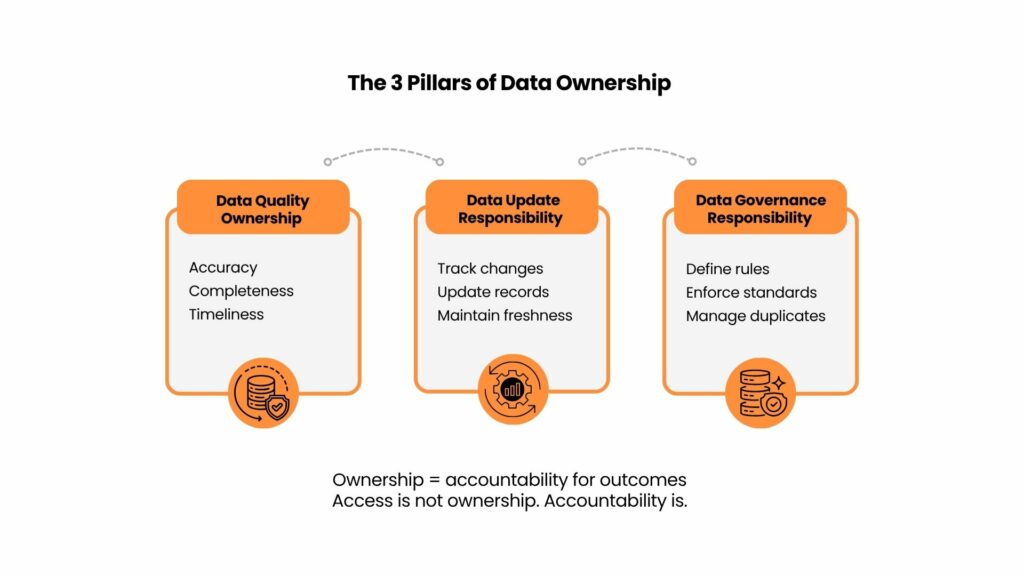
Data ownership accountability is frequently mistaken for data access. Data access does not necessarily imply data ownership. It implies accountability along three key axes.

Data quality ownership requires accountability for data accuracy, completeness, and timely updates for specified data types. If address information is incorrect, an individual can be held accountable for correcting them. This includes defining what “good data” actually means and maintaining standards for formatting, validation, and mandatory fields.

Data update responsibility means someone ensures records remain current. When a contact changes jobs or a company shifts technology stacks, ownership dictates who detects that change and updates the system. Without this, data becomes stale even if initially accurate.

Data governance responsibility means someone defines and enforces the rules. Standards for entry, modification, duplication resolution, and compliance require accountable stewards. DemandLab notes that no single group owns revenue data, but “what is owned is the primary responsibility at each phase of the revenue cycle.”

The underlying concept is straightforward. Ownership of data implies accountability for results, not merely processes. When the quality of data is compromised, the owner determines who is accountable, what necessary actions to take, and how to measure performance.

Why Data Ownership and Accountability Fail in B2B

The accountability gap emerges from predictable structural failures. Without clear data ownership accountability, these problems compound across every revenue function.

Cross-team dependencies create the primary problem. B2B data flows across multiple functions. Marketing generates leads. Sales qualifies them. Customer Success manages relationships. When data quality requires coordination across silos with competing incentives, no single team prioritizes it. Research from Integrate and Demand Metric found that over 60% of teams report poor data disrupts lead handoffs and slows sales productivity.

Unclear role definitions compound the issue. The majority of companies lack clear ownership of contact vs. account data, who is responsible for validation of the enrichment process, and who is accountable for duplicate management. How can we know whose record in the CRM, MAPs, and data warehouse is accurate if there is disagreement among them? Without clarity, the issue never gets sorted out.

Lack of governance structures means accountability is assumed rather than assigned. Many teams rely on informal processes, manual fixes, and reactive cleanup efforts. There are no defined standards, validation rules, or enforcement mechanisms. One industry study found that 84% of organizations struggle with inaccurate or duplicate data precisely because they lack formal quality measures.

Vendor dependency creates a false sense of security. Organizations often assume the data vendor ensures quality. In reality, vendors optimize for coverage, not precision. Accuracy varies by segment and geography. Data degrades after delivery. Without internal ownership, vendor data becomes unverified input that teams trust until it fails. A data procurement framework is a must.

The GTM Cost of Unowned Data

The absence of ownership creates compounding inefficiencies across every revenue function.

Inconsistent data quality means standards vary across teams. Enrichment is applied inconsistently. Validation is sporadic. This leads to unpredictable performance and three versions of truth. The sales department claims revenue is X. The finance department believes it is Y. The operations department has its own figure.

Unsolved errors mount up silently because no one is answerable for fixing them. Problems are deprioritized. Duplicate records can reach 10% to 30% of customer databases in organizations without data quality initiatives. Each duplicate means wasted outreach, confused reporting, and damaged customer experience.

Operational inefficiencies become normalized. Salesforce estimates that reps spend up to 27% of their time dealing with data issues instead of selling. Teams spend hours manually reconciling conflicting data. Sales reps begin “shadow researching,” ignoring the CRM and going to LinkedIn to manually verify every prospect. This is a massive waste of high-value labor that could be avoided with clear ownership.

Broken prioritization and targeting affect ICP alignment, lead scoring accuracy, and intent signal reliability. If data inputs are inconsistent, prioritization models produce misleading outputs. Intent signals point to churned contacts. Enrichment delivers 92% accuracy but only 61% becomes usable.

The IBM research found that data quality issues often go unnoticed because their impact appears downstream as lost revenue, not at the point of failure. Pipeline leaks. Conversion rates weaken. Sales cycles lengthen. The impact is not isolated. It affects the entire revenue system.

A Framework for Data Ownership Accountability

Building data ownership accountability requires a structured approach to assigning and enforcing ownership.

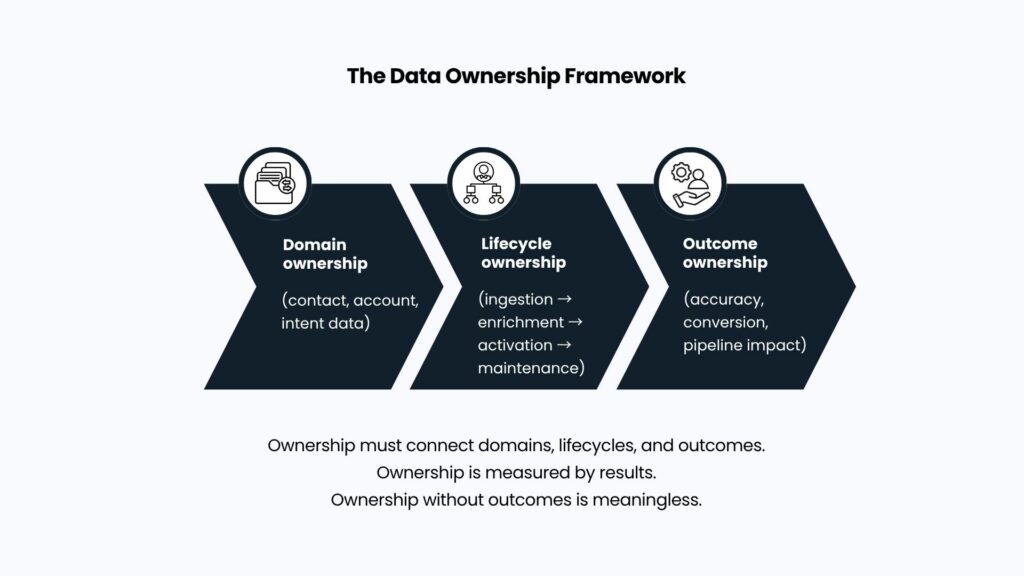
Domain ownership defines what is owned. Assign ownership by data domain: contact data, account data, enrichment data, intent signals. Each domain should have a clear owner. For example, RevOps owns contact enrichment and is accountable for 82% connect rates. Demand Gen owns intent signals and is measured on 35% progression lift. The data team owns firmographics with a 92% ICP match target.

Lifecycle ownership defines when it is owned. There must be ownership at each level: ingestion (data input and acquisition), enrichment (enhancement and verification), activation (usage within campaigns and routing), and maintenance (upgrades and cleaning). Ownership can be assigned to different groups for each step, but transition protocols should be clear.

Outcome ownership defines why it is owned. Ownership is validated through results, not activity. Define ownership based on outcomes such as data accuracy rates, contactability metrics, ICP fit consistency, and campaign performance impact. Most organizations assign ownership at the process level. High-performing organizations assign ownership at the outcome level.

Operationalizing Data Ownership

Moving from theory to practice requires embedding ownership into daily workflows and performance systems.

Data SLAs (service level agreements) define expected quality levels. For example, you must maintain contact data with greater than 90% deliverability, enrich data within defined intervals, and meet accuracy thresholds. SLAs make quality measurable and non-negotiable.

Quality benchmarks provide objective targets. Monitor the metrics of bounce rate, duplication rate, enrichment match rate, and ICP alignment. The fundamental criteria include accuracy, which should be 98% or more, completeness at 95% or more, consistency of 97% or more, timeliness of 99% within 24 hours, and uniqueness at 99% or more.

Performance tracking ties data quality metrics to team KPIs, operational reviews, and performance evaluations. Regular scorecards show each domain’s quality metrics against SLAs. When quality drops below thresholds, automated alerts trigger owner intervention. Include data integrity in performance reviews and reward the “data citizens” who actively improve the system.

Workflow integration ensures ownership is maintained during execution. Embed validation into CRM processes through required fields and validation rules. Build automated checks into enrichment pipelines. Use campaign readiness filters to prevent unowned data from reaching execution. Before any outreach deploys, validation confirms that required fields meet quality thresholds. Data ownership accountability must be embedded into daily workflows, not treated as a one-time project.

As one data governance framework emphasizes, “without accountability, measures become shelfware. Each critical data element should have both a data steward responsible for data quality rules and a system owner accountable for implementation.”

Practical Recommendations for RevOps Leaders

Start with a clear gap analysis. Map current ownership structures, which likely reveals that no one truly owns critical data domains. Calculate the quality cost using the $2.7 million annual benchmark for mid-market companies. Identify your top three pain points, typically bounce rates, duplicates, and stale intent signals.

Define ownership explicitly. Identify the owners of each data domain, the accountable parties at each phase of the lifecycle, and the criteria for measuring success. Apply a RACI model to assign ownership roles: accountable party, responsible party, and consumer (utilizes the data).

Prioritize those data domains that will make the biggest difference. Contact accuracy, relevance of roles, account-level data, and intent signals will make the largest contribution to the bottom line and will produce the quickest ROI from ownership.

Align ownership with revenue outcomes. Measure data quality based on pipeline contribution, conversion rates, and sales efficiency rather than just technical accuracy metrics. This ensures ownership drives business results.

Decrease dependence on vendors. Verify vendor information internally. Do not delegate responsibility. Establish continuous feedback cycles that utilize performance metrics like bounce rate and connect rate to detect problems with data and update validation criteria.

Conclusion: Data Quality Improves When Ownership is Clear

Typically, most B2B companies are concerned with getting better data, enriching it, and enhancing the technology. However, none of this works without proper ownership. This is not a technological challenge, but rather an organizational one.

What is needed is a paradigm shift to data ownership accountability; from shared responsibility to clear ownership, from process metrics to outcome measurement. And infrastructure only performs when someone is accountable for maintaining it.

You need to ask not whether you can afford data ownership, but whether you can afford to continue without it. With each passing day that this ambiguity continues, your data deteriorates, your decision-making skills deteriorate, and money flows out of your hands. Because ultimately, it is ownership that improves your data.