


Your CRM shows a deal at 90% confidence. The forecast meeting confirms it. Two weeks later, the deal is dead. When you investigate, you discover the contact left the prospect company three months ago. The champion never existed. The 90% number was hope, wearing a spreadsheet. This is what happens when data ownership accountability doesn’t exist. No one is responsible for verifying the data quality that your revenue forecast relies on.
According to IBM’s Institute for Business Value, 43% of chief operations officers consider data quality as their primary concern, with more than one-quarter estimating losses of over $5 million annually. Gartner pegs the average at $12.9 million annually. But why does this issue continue to exist when nobody owns the data?
If data management is everyone’s responsibility, then it will be nobody’s priority. Marketing owns lead generation. Sales owns CRM updates. RevOps owns systems. External vendors own enrichment. Each team influences data quality, but no single team controls it end to end. The result is a GTM engine built on shifting sand.
What Data Ownership Accountability Actually Means
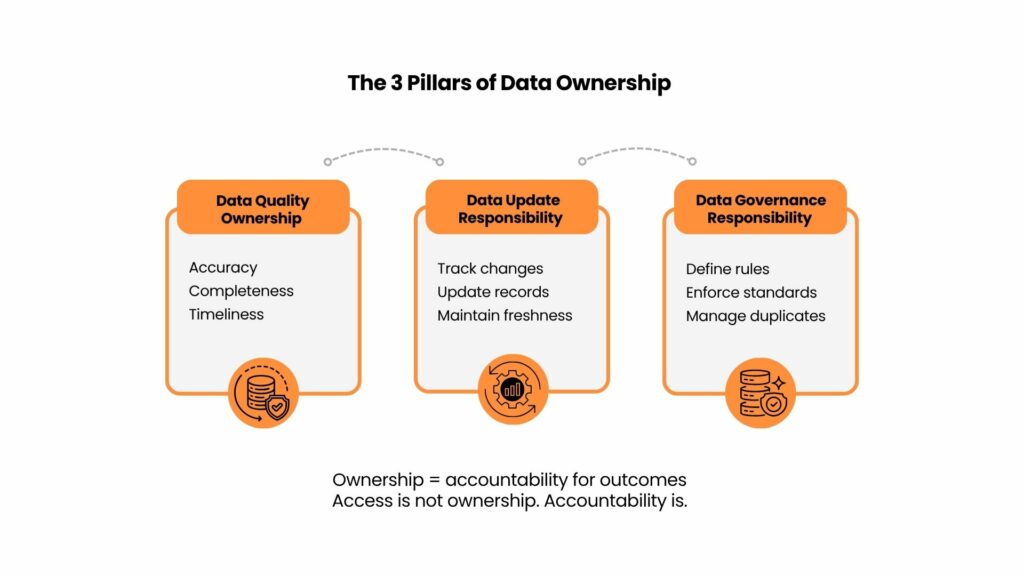
Data ownership accountability is frequently mistaken for data access. Data access does not necessarily imply data ownership. It implies accountability along three key axes.
Data quality ownership requires accountability for data accuracy, completeness, and timely updates for specified data types. If address information is incorrect, an individual can be held accountable for correcting them. This includes defining what “good data” actually means and maintaining standards for formatting, validation, and mandatory fields.
Data update responsibility means someone ensures records remain current. When a contact changes jobs or a company shifts technology stacks, ownership dictates who detects that change and updates the system. Without this, data becomes stale even if initially accurate.
Data governance responsibility means someone defines and enforces the rules. Standards for entry, modification, duplication resolution, and compliance require accountable stewards. DemandLab notes that no single group owns revenue data, but “what is owned is the primary responsibility at each phase of the revenue cycle.”
The underlying concept is straightforward. Ownership of data implies accountability for results, not merely processes. When the quality of data is compromised, the owner determines who is accountable, what necessary actions to take, and how to measure performance.
Why Data Ownership and Accountability Fail in B2B
The accountability gap emerges from predictable structural failures. Without clear data ownership accountability, these problems compound across every revenue function.
Cross-team dependencies create the primary problem. B2B data flows across multiple functions. Marketing generates leads. Sales qualifies them. Customer Success manages relationships. When data quality requires coordination across silos with competing incentives, no single team prioritizes it. Research from Integrate and Demand Metric found that over 60% of teams report poor data disrupts lead handoffs and slows sales productivity.
Unclear role definitions compound the issue. The majority of companies lack clear ownership of contact vs. account data, who is responsible for validation of the enrichment process, and who is accountable for duplicate management. How can we know whose record in the CRM, MAPs, and data warehouse is accurate if there is disagreement among them? Without clarity, the issue never gets sorted out.
Lack of governance structures means accountability is assumed rather than assigned. Many teams rely on informal processes, manual fixes, and reactive cleanup efforts. There are no defined standards, validation rules, or enforcement mechanisms. One industry study found that 84% of organizations struggle with inaccurate or duplicate data precisely because they lack formal quality measures.
Vendor dependency creates a false sense of security. Organizations often assume the data vendor ensures quality. In reality, vendors optimize for coverage, not precision. Accuracy varies by segment and geography. Data degrades after delivery. Without internal ownership, vendor data becomes unverified input that teams trust until it fails. A data procurement framework is a must.
The GTM Cost of Unowned Data
The absence of ownership creates compounding inefficiencies across every revenue function.
Inconsistent data quality means standards vary across teams. Enrichment is applied inconsistently. Validation is sporadic. This leads to unpredictable performance and three versions of truth. The sales department claims revenue is X. The finance department believes it is Y. The operations department has its own figure.
Unsolved errors mount up silently because no one is answerable for fixing them. Problems are deprioritized. Duplicate records can reach 10% to 30% of customer databases in organizations without data quality initiatives. Each duplicate means wasted outreach, confused reporting, and damaged customer experience.
Operational inefficiencies become normalized. Salesforce estimates that reps spend up to 27% of their time dealing with data issues instead of selling. Teams spend hours manually reconciling conflicting data. Sales reps begin “shadow researching,” ignoring the CRM and going to LinkedIn to manually verify every prospect. This is a massive waste of high-value labor that could be avoided with clear ownership.
Broken prioritization and targeting affect ICP alignment, lead scoring accuracy, and intent signal reliability. If data inputs are inconsistent, prioritization models produce misleading outputs. Intent signals point to churned contacts. Enrichment delivers 92% accuracy but only 61% becomes usable.
The IBM research found that data quality issues often go unnoticed because their impact appears downstream as lost revenue, not at the point of failure. Pipeline leaks. Conversion rates weaken. Sales cycles lengthen. The impact is not isolated. It affects the entire revenue system.
A Framework for Data Ownership Accountability
Building data ownership accountability requires a structured approach to assigning and enforcing ownership.
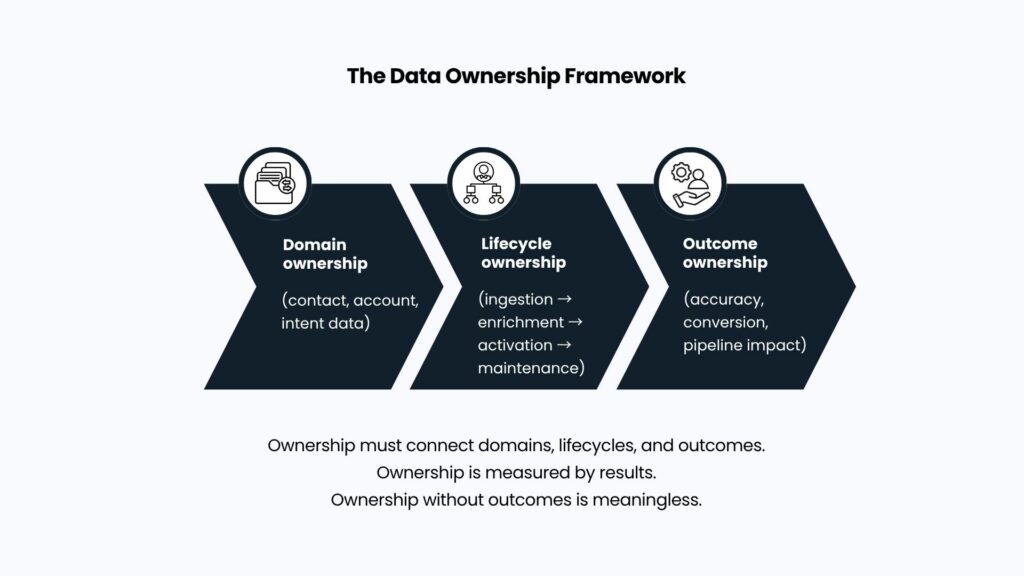
Domain ownership defines what is owned. Assign ownership by data domain: contact data, account data, enrichment data, intent signals. Each domain should have a clear owner. For example, RevOps owns contact enrichment and is accountable for 82% connect rates. Demand Gen owns intent signals and is measured on 35% progression lift. The data team owns firmographics with a 92% ICP match target.
Lifecycle ownership defines when it is owned. There must be ownership at each level: ingestion (data input and acquisition), enrichment (enhancement and verification), activation (usage within campaigns and routing), and maintenance (upgrades and cleaning). Ownership can be assigned to different groups for each step, but transition protocols should be clear.
Outcome ownership defines why it is owned. Ownership is validated through results, not activity. Define ownership based on outcomes such as data accuracy rates, contactability metrics, ICP fit consistency, and campaign performance impact. Most organizations assign ownership at the process level. High-performing organizations assign ownership at the outcome level.
Operationalizing Data Ownership
Moving from theory to practice requires embedding ownership into daily workflows and performance systems.
Data SLAs (service level agreements) define expected quality levels. For example, you must maintain contact data with greater than 90% deliverability, enrich data within defined intervals, and meet accuracy thresholds. SLAs make quality measurable and non-negotiable.
Quality benchmarks provide objective targets. Monitor the metrics of bounce rate, duplication rate, enrichment match rate, and ICP alignment. The fundamental criteria include accuracy, which should be 98% or more, completeness at 95% or more, consistency of 97% or more, timeliness of 99% within 24 hours, and uniqueness at 99% or more.
Performance tracking ties data quality metrics to team KPIs, operational reviews, and performance evaluations. Regular scorecards show each domain’s quality metrics against SLAs. When quality drops below thresholds, automated alerts trigger owner intervention. Include data integrity in performance reviews and reward the “data citizens” who actively improve the system.
Workflow integration ensures ownership is maintained during execution. Embed validation into CRM processes through required fields and validation rules. Build automated checks into enrichment pipelines. Use campaign readiness filters to prevent unowned data from reaching execution. Before any outreach deploys, validation confirms that required fields meet quality thresholds. Data ownership accountability must be embedded into daily workflows, not treated as a one-time project.
As one data governance framework emphasizes, “without accountability, measures become shelfware. Each critical data element should have both a data steward responsible for data quality rules and a system owner accountable for implementation.”
Practical Recommendations for RevOps Leaders
Start with a clear gap analysis. Map current ownership structures, which likely reveals that no one truly owns critical data domains. Calculate the quality cost using the $2.7 million annual benchmark for mid-market companies. Identify your top three pain points, typically bounce rates, duplicates, and stale intent signals.
Define ownership explicitly. Identify the owners of each data domain, the accountable parties at each phase of the lifecycle, and the criteria for measuring success. Apply a RACI model to assign ownership roles: accountable party, responsible party, and consumer (utilizes the data).
Prioritize those data domains that will make the biggest difference. Contact accuracy, relevance of roles, account-level data, and intent signals will make the largest contribution to the bottom line and will produce the quickest ROI from ownership.
Align ownership with revenue outcomes. Measure data quality based on pipeline contribution, conversion rates, and sales efficiency rather than just technical accuracy metrics. This ensures ownership drives business results.
Decrease dependence on vendors. Verify vendor information internally. Do not delegate responsibility. Establish continuous feedback cycles that utilize performance metrics like bounce rate and connect rate to detect problems with data and update validation criteria.
Conclusion: Data Quality Improves When Ownership is Clear
Typically, most B2B companies are concerned with getting better data, enriching it, and enhancing the technology. However, none of this works without proper ownership. This is not a technological challenge, but rather an organizational one.
What is needed is a paradigm shift to data ownership accountability; from shared responsibility to clear ownership, from process metrics to outcome measurement. And infrastructure only performs when someone is accountable for maintaining it.
You need to ask not whether you can afford data ownership, but whether you can afford to continue without it. With each passing day that this ambiguity continues, your data deteriorates, your decision-making skills deteriorate, and money flows out of your hands. Because ultimately, it is ownership that improves your data.