


Tag Archives: RevOps Strategy

Professional reviewing and approving digital records as part of a data trust architecture for reliable business decision-making

Data Trust Architecture: Why Reliable Data Matters More Than More Data

When the VP of Sales questions the pipeline forecast three hours before the board meeting, the problem isn’t data scarcity; it’s data credibility. This is the core challenge that data trust architecture is designed to solve. Modern B2B organizations run CRMs, enrichment platforms, intent providers, attribution tools, and AI-driven scoring engines in parallel. Yet a 2025 survey of 72 revenue-focused companies found that 68% of executives and 59% of RevOps leaders regularly questioned the accuracy of their core dashboards. That is not a volume problem. That is a data trust collapse.

According to OneStream, 72% of companies say bad data costs them at least $500,000, and more than one-third report losses over $1 million. A mid-market B2B firm, with $50 million in yearly income, actually loses around $1.25 million each quarter for every week their strategic decisions are held up because of data issues. The future competitive advantage in B2B intelligence belongs to organizations with the most trusted data systems, not the largest ones.

Why Data Trust Breaks in Revenue Organizations

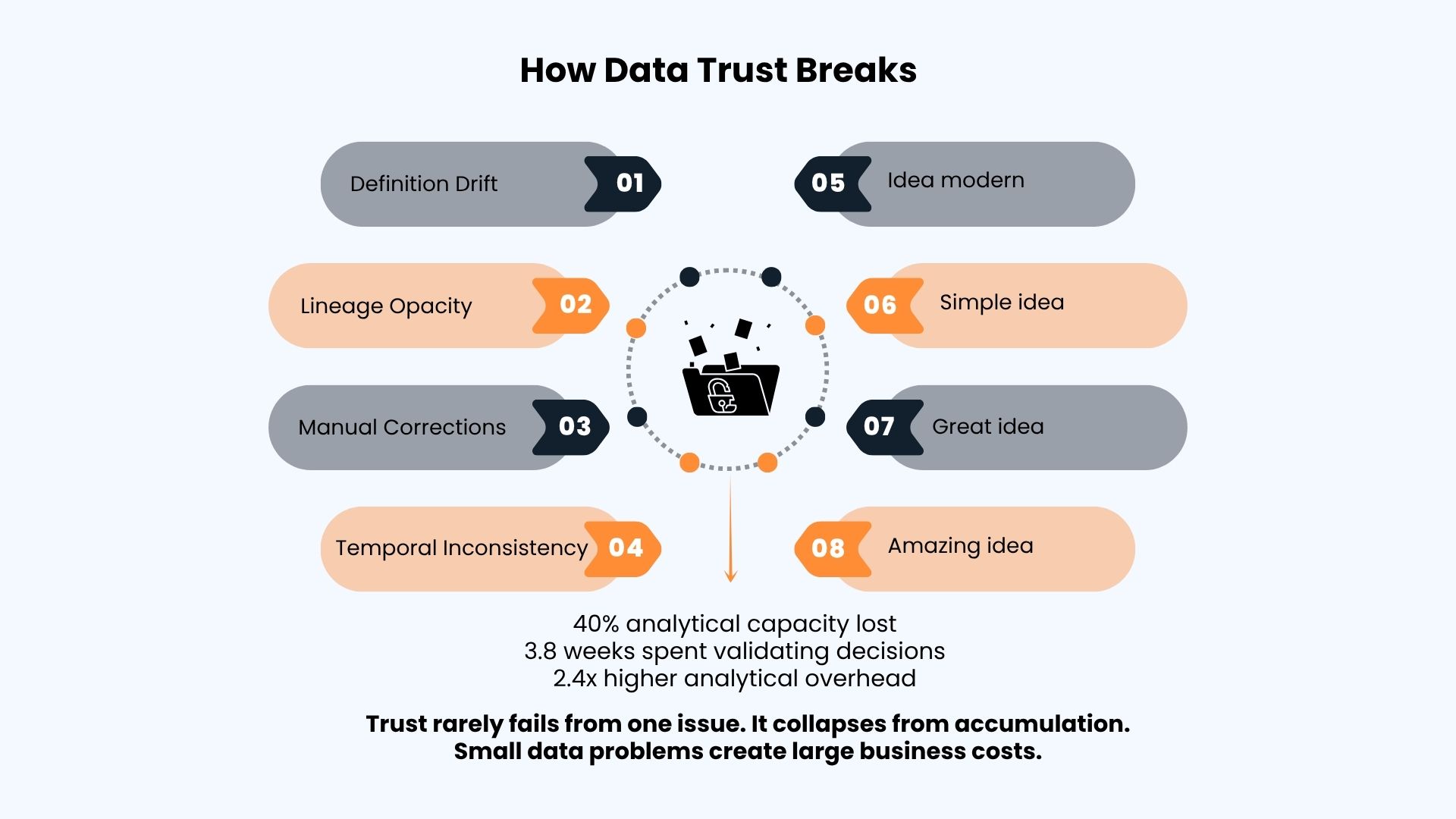
Data trust rarely collapses from a single failure. It erodes through four compounding structural problems.
Definition Drift and Lineage Opacity

Definition drift is the most common fracture point. Marketing counts an “active account” using website intent signals. Sales counts it only after a validated opportunity exists in the pipeline. Finance recognizes it after the first invoice clears. A 2024 analysis of 200 B2B organizations found an average of 4.7 conflicting definitions for core metrics across departments. One SaaS company discovered a 23% discrepancy between marketing and sales pipeline numbers that stalled a market expansion decision for six weeks. RevOps teams in low-definition environments waste an estimated 40% of their analytical capacity reconciling conflicts rather than generating actionable insight.

Lineage opacity compounds the damage. Modern B2B data architectures pass through 7 to 12 transformation layers between source systems and executive dashboards. A 2025 RevOps survey found that only 19% of teams could reliably trace 90% of core revenue metrics back to their source. A telecommunications B2B provider traced an 18% variance in customer lifetime value calculations through five transformation layers to a JOIN operation excluding multi-product customers. The error had misdirected $4.2 million in R&D resources over eight months. Without lineage, debugging is archaeology.

Manual Corrections and Temporal Inconsistency

Undocumented manual corrections are equally destructive. In 68% of B2B organizations studied, finance teams make manual adjustments to revenue data that are never logged in audit-accessible formats. One manufacturing company’s monthly reporting incorporated 127 undocumented Excel adjustments maintained by three analysts. When two departed within six weeks, month-end close extended from four days to nineteen days while the team reverse-engineered the correction logic.

Temporal inconsistency in snapshot data creates a subtler but equally costly problem. When March pipeline forecasts use February 15 data but the comparison baseline uses February 28 data, the 13-day delta introduces noise that masquerades as signal. A private equity firm discovered their month-over-month growth calculations compared snapshots across different billing cycles, causing three portfolio companies to be systematically underfunded.

The Compounding Revenue Cost of Low Data Trust

Low data trust does not just slow decisions. It restructures how organizations operate, creating cascading costs that function as a hidden tax on the entire revenue pipeline.

Analytical duplication alone is substantial. A 2024 RevOps case study found an organization spending 11,000 analyst hours per year reconciling data that should have been settled once. Organizations with low data trust spend 2.4 times more on analytical headcount relative to revenue than high-trust peers.

Tool adoption collapses in low-trust environments. Enterprise analytics implementations average $2.8 million in first-year costs. When users continue relying on legacy spreadsheets, adoption stalls near 40%, tripling the effective cost per active user. A 2025 benchmark of 50 revenue teams found that 63% of SDRs and AEs used spreadsheets as their primary source for account prioritization, not the company-wide BI system.

The speed penalty is measurable. The median B2B company takes 6.2 weeks to agree on big decisions, and it spends 3.8 weeks just verifying data. Companies with low trust in their data take 31% longer to wrap up their plans. On the flip side, rivals who trust their data cut their decision-making time by 60%, gaining first-mover benefits that stack up in every cycle.

The LIVE Framework: Four Pillars of Data Trust Architecture

Building a reliable data trust architecture requires four foundational capabilities that work together.
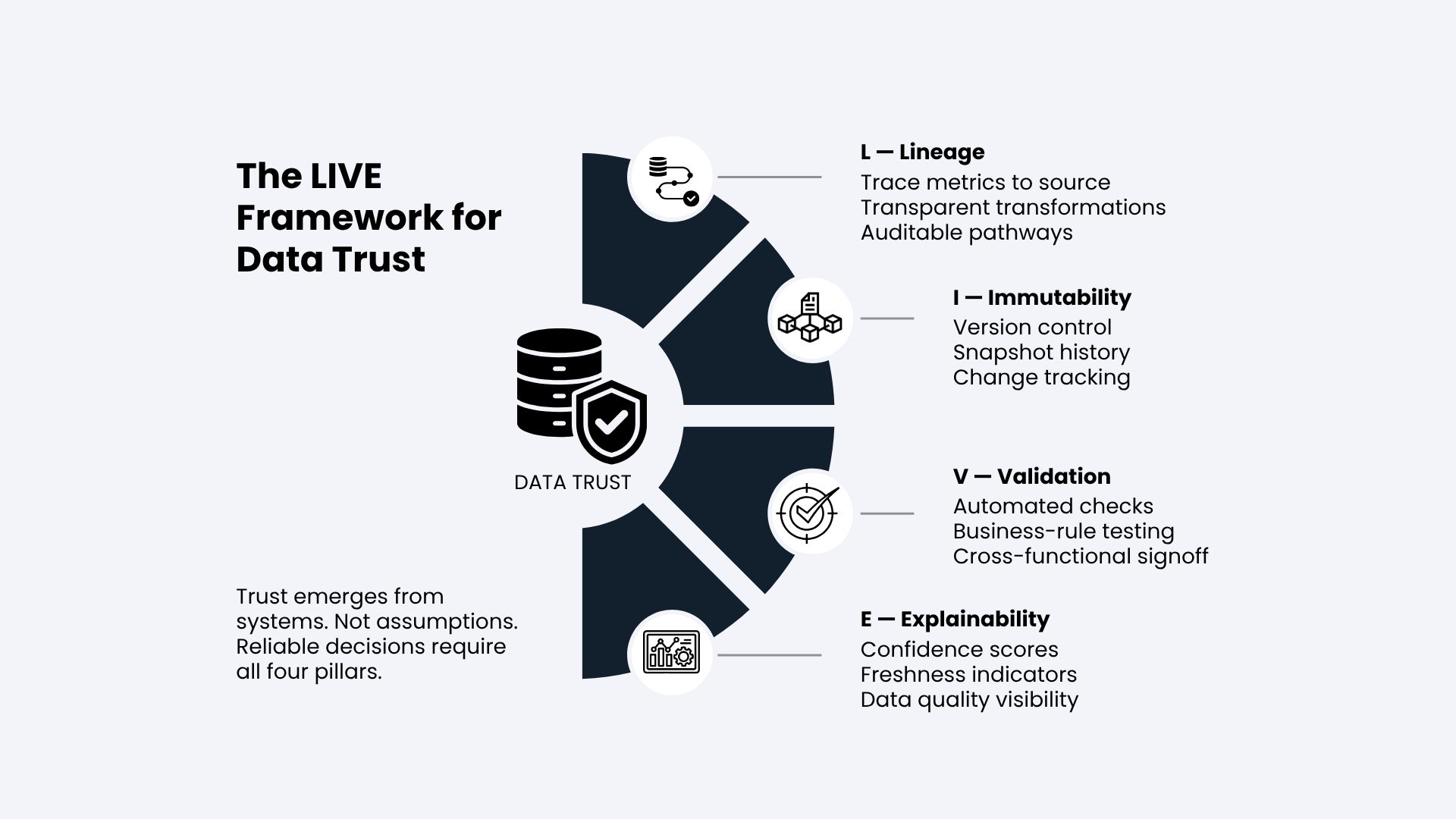
Lineage means every metric traces back to its source through documented, auditable pathways visible to business stakeholders, not just data engineers. Column-level lineage implementation at one enterprise software company reduced analyst time spent on “where does this number come from” investigations by 73%.

Making datasets immutable is about treating them like code. This means versioning each transformation, taking snapshots at key decision points, and keeping logs of changes and reasons why those changes happened. Take a B2B logistics firm; after they started versioning their datasets, they reduced their monthly discrepancy solving time from 40 hours to just 7 hours. That’s huge!

For validation, you need checks across different levels. Start with checksums in the source system to make sure the data warehouse is accurate. Add automated business rule tests for logic checks before report publishing. Also, include cross-departmental approval steps where finance and sales teams must sign off on figures together. At a manufacturing company, a similar setup caught a currency conversion mistake in cost calculations that had gone unnoticed for 14 long months. With the new validation process, they spotted it right on day one.

Explainability means showing confidence levels right in dashboards. Including data freshness, completeness scores, and source quality ratings gives stakeholders the context needed to properly interpret the metrics. One SaaS company added confidence scoring and saw executive engagement with analytics dashboards rise 45%, as leaders got more visibility into data limitations.

You can read more about building a composable data architecture here.

A Practical Evaluation Tool: The Data Trust Scorecard

A practical way to audit your data trust architecture is the RevOps Scorecard. RevOps leaders can use a Data Trust Scorecard to measure trust in core revenue metrics. This scorecard rates each metric on four things from 0 to 5.

First, Lineage Transparency: Can we trace the metric to its origin?

Second, Governance and Process: Does paperwork exist for changes and have people been told about them?

Third, Definition Clarity: Has everyone agreed to one definition?

Fourth, Adoption and Reliance: Do stakeholders make calls based on the metric or do they secretly use other spreadsheets?

The Trust Score is the average of those four parts. When used in a 2025 RevOps study, it cut data-checking delays by 28% and boosted analytics adoption by 19%, all within a year and a half.

Practical Recommendations for RevOps Leaders

Audit trust failures directly. Map where stakeholders distrust systems, which dashboards face the most scrutiny, and where manual verification recurs. Trust friction reveals the weak points that accuracy metrics alone cannot surface.

Create a shared metric glossary for the most crucial GTM metrics. Include the definition, source system, key rules, owner, and change history for each one. Show this to everyone, and make it a requirement to review it before getting access to the executive dashboard.

Build cross-functional data governance. Form a working group with representatives from RevOps, sales operations, marketing operations, and finance. Define change-control processes and require that all substantive changes are communicated before they affect operational reporting. Organizations with complete alignment between finance and IT are 5.5 times more likely to report full confidence in their data.

Monitor continuously. Set service-level indicators for key revenue metrics, automate freshness and anomaly checks, and treat data quality like application performance. Catching structural errors in real time prevents downstream sales impact before it registers in the pipeline.

Reliable Data Is the Actual Competitive Advantage

Data volume is no longer the differentiator. Most B2B companies already have way more data than they know what to do with. The big issue isn’t about having enough data; it’s whether the people making decisions trust that data enough to actually use it.

The organizations that thrive are the ones that invest in data trust architecture treat trust as infrastructure, not a by-product. Every measurement needs to be clearly defined and understood by everyone involved. When you treat trust as something concrete and build systems around it, teams start seeing how reliable their data is right in their workflow. This means no more wasting time; like 3.8 weeks per quarter just checking numbers, are needed before moving forward.

The organizations that will lead in the next phase of B2B intelligence are not those collecting the most signals. They are those who have built the infrastructure to verify, govern, and confidently activate the data they already have.

Reliable data is not a luxury. It is the foundation for every strategic advantage that follows.

Business professionals reviewing analytics dashboards and performance metrics to improve data-driven decision making across teams

Data-Driven Decision Making: Closing the Analytics Gap

Revenue operations leaders struggle with data-driven decision making despite massive infrastructure investments. Organizations deploy intent platforms, enrichment APIs, and real-time analytics, yet strategic decision quality remains stagnant.The problem is not data scarcity. It is decision inefficiency.

A 2025 study of 750 business leaders found that 58% say key decisions are based on inaccurate or inconsistent data most of the time. More concerning: 65% believe no one at their organization fully understands all collected data or how to access it. Between 60% and 73% of enterprise data goes unused for analytics, while up to 90% of dashboards eventually become abandoned digital assets.

This is the data decision gap: the disconnect between generating insights and executing decisions that change business outcomes. In go-to-market systems, this gap directly impacts pipeline velocity, conversion rates, and revenue predictability.

What the Data-Driven Decision Gap Actually Means

Data-driven decision making fails when insights don’t translate to action. The data decision gap is the organizational failure to convert analytical outputs into timely, confident business actions. It manifests in three critical patterns.

First, insight availability without decision clarity. A demand generation team identifies that enterprise accounts from financial services convert at 3.2x higher rates than other segments. The insight is clear. The decision is not. Does this mean reallocating all outbound resources? Adjusting pricing? Changing content strategy? Without a decision framework, insights become conversation topics rather than action triggers.

Second, analysis complexity creating decision hesitancy. When sales operations receives a quarterly review tracking 17 metrics across six regions, cognitive overload produces decision avoidance rather than better choices. Research from the Corporate Executive Board found that providing more information decreased purchase confidence by 23%. The same principle applies internally.

Third, time lag between insight generation and decision relevance. Customer success discovers through cohort analysis that accounts without executive engagement in the first 90 days churn at twice the baseline rate. By the time this insight reaches decision-makers and gets operationalized into playbooks, the current cohort has already passed the 90-day window. The insight was accurate but temporally disconnected from its moment of utility.

Organizations optimize for analytical comprehensiveness rather than decision speed and clarity. This is the core failure.

Why the Data Decision Gap Exists

Three structural deficiencies prevent data from translating into decisions.

Lack of interpretation frameworks. Data answers what is happening but not what should be done. When pipeline velocity decreases by 12%, that number alone does not indicate whether the problem stems from lead quality degradation, sales capacity constraints, or deal complexity increases. Without established frameworks that translate metrics into diagnostic categories, each insight triggers a new investigation rather than a predetermined response.

High-performing revenue teams implement decision architectures: pre-defined logic connecting specific data patterns to decision options. For example, if MQL-to-SQL conversion drops below 18% for two consecutive weeks and lead source distribution has not changed, then audit lead scoring criteria and contact SDRs for qualification feedback within 48 hours.

Unclear decision ownership. Data democratization promised better data-driven decision making but created insight accessibility but dissolved decision accountability. A SaaS company analyzed why expansion revenue consistently underperformed despite accurate usage data predicting expansion propensity. The root cause was organizational. Customer success saw expansion signals, but account executives controlled the commercial relationship. Neither team had clear authority to act, so both analyzed repeatedly without executing.

Forbes Council research confirms this pattern: 77% of business leaders say dashboards and charts they receive do not directly inform their decisions. According to Gallup, only 21% of employees strongly agree they have performance metrics within their control.

Over-engineered analysis for under-specified decisions. Revenue teams often pursue analytical sophistication that exceeds decision complexity. Building a machine learning model to predict deal close probability with 87% accuracy sounds valuable until you recognize the business decision is binary: prioritize this deal or do not. If the threshold for prioritization was 70%, the additional 17 points of precision consumed weeks of resources without improving decision quality.

Impact on GTM Performance and Revenue

The decision gap erodes revenue across three dimensions.

Velocity degradation through decision bottlenecks. Revenue intelligence analysis of 200 B2B companies found that organizations in the slowest quartile for internal decision-making had 34% longer sales cycles than the fastest quartile, even when controlling for deal size and industry. The delay was not in customer decision-making. It was in seller decision-making about discount approvals, contract terms, and resource escalation.

Opportunity cost from missed timing windows. Intent signals decay rapidly. Bombora research shows buyer intent signals have a half-life of 7 to 12 days depending on signal strength. Marketing teams that take three weeks to decide on campaign adjustments based on intent data are optimizing for opportunities that have already moved to competitors. The analysis was accurate when generated. It became irrelevant before execution.

Resource misallocation from strategy-execution lag. A technology company identified that inside sales closed deals 40% faster than field sales for accounts under $50K ARR, suggesting a channel strategy shift. Operationalizing that insight required decisions about compensation restructuring, territory reassignment, and customer communication that took two quarters to finalize. During those quarters, the company continued staffing the less efficient channel at full capacity, burning approximately $800K in excess cost of sales.

The Decision-Ready Data Framework

Bridging the gap requires restructuring how organizations prepare data for data-driven decision making, not just analysis. The Decision-Ready Data Framework operates on three principles.

Decision-backward design. Start with the decision, then specify data requirements. Not what insights can we extract, but what decision needs to be made and what is the minimum viable data set to make it confidently. For quota setting, this means prior year attainment by territory, territory-level pipeline coverage ratio, and rep tenure. Excluded: individual deal narratives, competitive intelligence reports, product roadmap details. These might be interesting but do not change the quota decision.

Insight-to-action mapping. Every analytical output should include an explicit decision prompt. Replace “Enterprise segment conversion rate decreased 8% quarter over quarter” with “Enterprise segment conversion rate decreased 8% QoQ, decision required: investigate lead quality with marketing or adjust sales training focus, decision owner: VP Sales, decision deadline: end of week.” This forces clarity on what decision the insight enables, who has authority to make it, and what the decision timeline is.

Confidence thresholds over precision maximization. Establish the confidence level required for each decision category, then stop analyzing when that threshold is met. A demand generation team implemented confidence thresholds for channel budget decisions: 50% confidence to reallocate up to 10% of monthly budget, 70% confidence to reallocate up to 25%, and 85% confidence to eliminate a channel entirely. This created decision speed. The team moved from quarterly optimization requiring 90% statistical significance to monthly optimization accepting lower confidence for lower-stakes decisions.

Operationalizing Data-Driven Decisions

Three operational mechanisms convert framework into practice.

Embedded decision workflows. Insights must enter operational workflows, not standalone reports. A customer success platform integrated churn risk scores directly into weekly account review meetings with pre-populated decision options: escalate to executive sponsor, offer product training, adjust check-in cadence, or monitor. The CS team stopped receiving churn reports and started receiving decision queues.

Decision velocity metrics. Track time-from-insight-to-decision alongside traditional business metrics. A marketing operations team measured insight age: how many days elapsed between identifying an attribution problem and implementing a campaign adjustment. They set a target of less than 14 days for non-structural issues. Tracking decision latency created accountability for bottleneck identification.

Retrospective decision audits. Quarterly, review major decisions against outcomes to calibrate confidence requirements. Did decisions made at 65% confidence produce worse outcomes than those made at 85% confidence? If not, lower the analysis threshold. This prevents analytical over-engineering and builds organizational confidence in faster decision-making.

Practical Steps to Improve Data-Driven Decision Making

Start with the decision, not the data. Before any analysis, ask what decision this will inform and when it needs to be made. If the answer is unclear, the analysis should not proceed.

Assign ownership to every metric. For each KPI on your executive dashboard, there must be a named individual accountable for acting when it moves outside acceptable ranges.

Reduce dashboard complexity. Audit your dashboard portfolio quarterly. Remove what is not driving action. Focus on decision-driving insights, not monitoring metrics.

Automate action where possible. Build workflows that trigger action automatically when predefined conditions are met. Do not wait for humans to interpret signals.

Measure decision impact, not data accuracy. Track pipeline improvements and conversion changes resulting from data-driven decision making. If you are not measuring the result of the decision, you are not doing data-driven business.

Conclusion: Data Must Drive Action, Not Just Analysis

The competitive advantage in modern revenue operations is not data volume or analytical sophistication. It is decision velocity calibrated to business impact. Organizations that treat treat data-driven decision making as a revenue accelerant rather than an analytical end state compress the insight-to-action cycle and translate information advantage into revenue performance.

You can read more here.

The data decision gap closes when revenue leaders ask not what does the data say but what will we do about it, by when, and who decides. That shift from analysis as the goal to decisions as the output transforms data from a reporting function into a revenue driver. In the intelligence era, the distance between knowing and doing is the primary measure of organizational health.

Business professionals reviewing analytics reports and charts to assess B2B data lifecycle management and identify where data loses value over time

The Data Lifecycle Breakdown: Where Data Loses Value Across Its Journey

There are 100,000 customers in your CRM. Your marketing automation system measures millions of actions. Your data warehouse holds years of transaction history. Yet effective B2B data lifecycle management remains elusive: salespeople cannot identify decision makers, marketing campaigns miss targets, and forecast numbers fall short. The problem isn’t data quantity, it’s how data degrades across the B2B data lifecycle stages from collection to activation.

Research shows that poor data quality costs B2B organizations an average of $12.9 million annually, with 73% of enterprise data losing 47% of its value as it moves from collection to activation. For RevOps leaders, this represents a systematic revenue drain that compounds at every stage.

The Six-Stage B2B Data Lifecycle Management Framework

Effective B2B data lifecycle management requires understanding that data doesn’t lose value at a single point. It degrades continuously across six distinct stages, each presenting opportunities for value preservation or deterioration.

Collection

Collection establishes the foundation. Whether data enters through form fills, API integrations, or third-party providers, initial capture determines maximum potential value. Industry analysis reveals that 68% of collected data lacks contextual relevance despite 94% technical accuracy. A form capturing job title without role function or buying stage limits downstream utility regardless of processing quality.

Processing

Processing transforms raw inputs into structured formats through deduplication, normalization, validation, and field mapping. Validity’s 2024 report found that 25% of B2B contact records contain critical errors introduced during processing, not at collection. When transformation rules fail to handle input variety, “IBM,” “International Business Machines,” and “IBM Corp” create separate account records, fragmenting engagement history and account intelligence.

Storage

Storage preserves data integrity and accessibility. Architecture determines whether historical context remains available when needed. Research indicates that 60% of Tier 1 data remains untouched for over 90 days, consuming expensive storage for dormant records. The critical failure is context loss. When storage systems don’t preserve enrichment timestamps, teams can’t distinguish stale intent signals from current buying behavior.

Enrichment

Enrichment adds external context that enhances decision-making. Forrester research shows that organizations using intent data see 20% higher conversion rates, but only when signals remain recent (under 14 days) and contextually relevant. Generic intent scoring that flags “technology interest” isn’t actionable. Specific signals like “evaluating Salesforce competitors” enable precise outreach. The coverage versus accuracy dilemma persists: one B2B company reduced enrichment costs by 40% by eliminating 11 low-usage fields and reinvesting in higher-quality technographic data sales actually referenced.

Activation

Activation converts stored data into action through lead routing, email sequences, opportunity scoring, and account identification. Data value follows an exponential decay curve once activation conditions are met. InsideSales research shows response rates are highest within 4 hours of a trigger event, drop 35% after 24 hours, and fall below baseline after 72 hours. Yet most systems operate on batch processing, creating systematic activation delays that erode value even when upstream processes work perfectly.

Maintaining

Maintaining sustains the value of your data by doing things like updates and deletions. Your B2B database tends to depreciate at a rate of 22.5-30% per year due to changes in jobs and mergers of companies. Failure to maintain your list results in bounced emails and ineffective campaigns.

Where Data Lifecycle Breakdowns Destroy Pipeline Value

Value erosion compounds across stage transitions. A pipeline intelligence analysis showed accounts collected with 94% hygiene processed into 91% accurate enrichment and stored for 89% query coverage, but activation delivered only 47% ICP-relevant signals to SDRs. By maintenance, intent scores decayed 28% quarterly, costing $4.1 million in pursuing invalid opportunities.

The collection breakdown

The collection breakdown occurs when organizations optimize for volume over signal quality. A SaaS company might capture 10,000 inbound leads monthly with 95% email deliverability yet see only 8% MQL conversion because forms don’t capture buying stage, budget authority, or implementation timeline. Salesforce research found that 70% of B2B buyers fully define requirements before engaging vendors. Collection systems that don’t identify where prospects are in this journey create misalignment between sales readiness and outreach timing.

The processing breakdown

The processing breakdown fragments intelligence across systems. One enterprise software company discovered that processing errors created 18% duplicate account records, causing sales teams to unknowingly multi-thread 1 in 5 target accounts with conflicting messaging. When “Head of Marketing” maps differently across systems, segmentation outputs conflict and prioritization becomes unreliable.
You can read more here.

The storage breakdown

The storage breakdown trades query speed for historical context. When contact records show current job titles but not previous roles, sales teams can’t identify job changes, a buying trigger that increases close rates by 30% according to LinkedIn data. A healthcare company implementing proper tiered storage moved 95% of patient records to lower-cost tiers, reducing monthly storage costs by 52% while maintaining compliance.

The enrichment breakdown

The enrichment breakdown layers on data without evaluating utility. Coverage metrics advertise database size, but a contact database with 90% email deliverability and only 40% accuracy on buying committee roles fails enterprise sales requirements. Enrichment vendors updating only 70% of records create uneven data quality that introduces bias into segmentation and scoring models.

The activation breakdown

The activation breakdown creates timing value decay. A mid-size company tracked that leads waited 18 hours for enrichment processing, 6 hours for scoring rules to run, and 4 more hours for routing logic to execute. This 28-hour delay destroyed conversion potential. When a prospect downloads a competitive comparison guide, every hour of delay reduces response rates and pipeline probability.

The maintenance breakdown

The maintenance breakdown allows quality to degrade invisibly. One company audited infrastructure and found 14 terabytes of duplicate customer records, outdated lead files, and orphaned CSV exports. Their annual storage bill exceeded $47,000 for data nobody accessed. Without validation processes and monitoring, organizations operate blind to accumulating waste.

The Data Lifecycle Value Preservation Framework

High-performing B2B data lifecycle management teams optimize value flow across transitions rather than stages in isolation. This requires measuring value retention at each handoff point.

Metrics at stage level set baselines for performance: collection signal-to-noise ratio (portion of fields used in qualification), processing deduplication efficiency, storage query latency at P95, field usage rate in enrichments, median time to route for activations, and refresh schedule versus recommended intervals.

Cross-stage value measurement links decisions made at earlier stages to their outcomes.When collection forms change, measure not just completion rates but 30-day conversion impact. When enrichment vendors change, track sales qualification efficiency. This creates feedback loops optimizing for business outcomes rather than isolated KPIs.

Bottleneck identification reveals where data spends time without value addition. If the median lead waits 14 hours in enrichment queues but only 2 hours in scoring, enrichment is the constraint. If 60% of leads fail activation due to missing phone numbers but collection forms don’t require them, collection is the bottleneck.

Threshold-based activation preserves value by eliminating unnecessary processing steps. Instead of enriching all leads to 100% completeness before routing, route immediately on three intent signals and enrich asynchronously. An enterprise software organization was able to drop time to first sales touch from 31 hours to 4.5 hours.

Practical Recommendations for RevOps Leaders

Audit your complete process lifecycle. Map each stage and measure value drop per transition. Industry data suggests siloed systems achieve 47% end-to-end value preservation compared to 91% for integrated lifecycle approaches. The gap represents recoverable pipeline opportunity.

Define stage-level SLAs. Collection relevance above 94%, processing yield above 91%, storage freshness under 7 days, enrichment precision above 87%, activation utilization above 94%, and maintenance decay below 3% monthly. Lifecycle value equals the minimum stage SLA because the weakest link governs revenue impact.

Implement tiered storage. Move data not accessed in 90 days out of expensive Tier 1 storage. Automated policies for archiving reduce costs while maintaining accessibility for legitimate future use.

Prioritize activation velocity over enrichment completeness. Data value isn’t determined by quality at rest but utility in motion. An 80% complete record activating within 4 hours of a trigger event drives more pipeline than a perfectly accurate record reaching sales three weeks after showing buying intent.

Build continuous validation into workflows. When an SDR flags a bad number, that signal should flow back to maintenance and collection stages instantly. The automated system detects the depletion in enrichment levels at 18%, day 7 as against day 47.

Master Data Lifecycle Management for Revenue Impact

The degradation rate of data due to natural decay is 30% per year. But lifecycle breakdowns accelerate erosion to 53%, destroying $4.1 million in pipeline effectiveness for a typical mid-market organization.

RevOps leaders who master data lifecycle management in B2B understand that not all data needs perfection before activation, that coverage matters less than relevance, and that speed often creates more value than completeness. The organizations that win don’t hoard the most data. They manage the journey with intentionality at every stage, preserving actionable intelligence from collection through activation.

Because in 2026, perfect activation on decayed data wastes cycles. Lifecycle intelligence compounds pipeline value continuously.

Professional reviewing analytics dashboard highlighting the importance of B2B data freshness in decision-making

B2B Data Freshness: Why Fresh Data Beats Accurate Data

Your CRM shows 94% data accuracy. Your vendor refreshed the database three weeks ago. Yet your SDRs are burning hours on disconnected numbers and outdated contacts. The data is not wrong. It is just no longer right. This is the B2B data freshness gap: the critical window where technically accurate data loses operational value. While accuracy measures correctness at a point in time, B2B data freshness measures real-time usability. Understanding this distinction is essential for modern RevOps teams.

According to Gartner, poor data quality will cost organizations on average $12.9 million a year. However, if we factor in the impact of freshness decay, the costs will be much higher than that. B2B contact data degrades at a rate of about 30% per year, while in technology, VP-level contacts are likely to churn at 40-50% annually. Most RevOps teams currently optimize for accuracy; however, they should be optimized for timeliness.

For example, a record that has an email address that is 45 days old can be thought of as meeting the criteria for ‘accuracy’ set by most vendors. However, if that contact’s job title changed 30 days ago, then your outbound engagement sequence will end at that point – (you have evaluated based on the wrong measure).

B2B Data Freshness: Why Timing Defines Intelligence Value

B2B data freshness requires understanding three categories of constant movement.

The first is personnel movements, which are extremely fluid. According to the recently released workforce data by LinkedIn, the average tenure on the job for tech sales roles is 1.8 years, a decline from 2.4 years in 2019. Therefore, your ideal customer profile contact list loses its validity at a rate of 4-5% per month for high velocity organizations. For fast-growing industries like technology, healthcare, and professional services, this figure stands at 30-40%.

There are organizational changes as well, which include alterations to targeting criteria and hierarchy. When a target company spins off a division or merges with another entity, your account mapping becomes instantly obsolete. These changes cascade across potentially hundreds of records.

Technology and intent signals degrade rapidly because they reflect current behavior and priorities. A company researching marketing automation platforms in Q1 may have already selected a vendor by Q2. Intent data has a functional half-life measured in weeks, not months. Research suggests that intent signals show maximum relevance within a 30-45 day window, after which predictive value drops by 60%.

The compounding effect is severe. A record with outdated contact information and stale intent signals and incorrect organizational hierarchy is not three problems. It is a total targeting failure.

Data Freshness vs. Data Decay: The Critical Distinction

Most vendors conflate freshness with decay prevention, but these represent fundamentally different data qualities.

Data decay is deterioration. It is the natural entropy where previously accurate information becomes incorrect over time. A phone number that worked six months ago but is now disconnected. An email address that bounces. These are measurable inaccuracies.

Data freshness is real-time usability. It measures the degree to which information reflects current operational reality, regardless of historical accuracy. A contact who was correctly listed as Marketing Director three months ago but promoted to CMO last week presents a freshness problem, not a decay problem. The original data was never inaccurate. It simply became outdated.

This distinction exposes a critical vendor blindspot. Most data providers measure accuracy through verification cycles: “We validate emails monthly” or “Phone numbers are checked quarterly.” But verification cadence does not equal freshness. A quarterly refresh cycle means your data is, on average, 45 days old at any given moment. For roles with high velocity, 45-day-old data can easily be 15-20% stale.

Here is the distinction that matters: a dataset can be 100% accurate for the moment it was captured and 100% unusable for today’s execution.

Where B2B Data Freshness Gaps Cost You Deals

Freshness gaps emerge at three critical junctures.

Between data refresh cycles, the gap widens linearly. If your vendor refreshes data monthly, day one post-refresh represents peak freshness, but day 30 carries accumulated decay. Most vendors update their central databases on 90-120 day cycles. With data decaying at 2-3% monthly, approximately 3-6% of the contacts you purchase will be invalid on the day of delivery simply due to the age of the record.

Between enrichment and execution, delays create tactical gaps. Marketing identifies high intent targets, initiates enrichment to create contact lists, and passes to sales. If your enrichment period is 72 hours, and you start your sales cadence after another 48 hours, you’re reacting to signals that are five or more days old. For competitive deals or time-sensitive triggers like funding announcements, executive changes, or technology implementations, this delay materially reduces conversion probability.

Across global datasets, regional refresh rates vary dramatically. US-based data benefits from more frequent updates and higher-quality sources than EMEA or APAC datasets. A vendor claiming “monthly refresh” may refresh US records monthly but EMEA records quarterly. Global GTM teams operating under assumed data parity are making targeting decisions on fundamentally different freshness baselines.

The Data Freshness Tax: GTM Performance Impact

The freshness gap manifests in three measurable GTM failures.

Missed opportunities from timing gaps. Intent signals and trigger events have narrow windows. A company posting a job requisition for a new RevOps leader signals evaluation-stage interest in relevant tooling, but only for 30-60 days. Acting on this trigger 45 days late means entering conversations after shortlists are formed or decisions made. Data shows that response time to intent signals correlates with 35% higher demo-to-opportunity conversion when contact occurs within 14 days versus 30+ days.

Reduced contactability from role churn. Email decay has increased rapidly to 3.6% monthly. Rates higher than 2% can lead to penalties from Gmail and Outlook. This will significantly lower deliverability rates. Anything above 5% may result in blacklisting, which can take several months to resolve. ZoomInfo found out that sales representatives spend about 27.3% of their working hours addressing erroneous information. That translates to 546 hours per year per representative.

Outdated targeting due to organizational lag. Account-based selling requires fresh data regarding organization structure, technology stack, and firmographics. As soon as the target organization upgrades to a new CRM and marketing automation tool, you have lost ground in the competition. If you cannot adapt within 60-90 days, you will be offering integrations that they already have in place.

Data Freshness Framework: Evaluating B2B Data Fitness

Not all data requires the same level of freshness. Evaluate B2B data freshness needs across two dimensions.

Contacts, job functions, telephone numbers, and intentions indicate high variance. Structure of hierarchy, structure of technology, and headcount indicate moderate variance. Age of establishment, industry, and headquarters indicate low volatility.

Impact measures the cost of using stale data. Primary contact, decision-maker role, and active intent signals have high impact. Supporting contacts, account hierarchy, and firmographics have medium impact. Background information, historical data, and reference fields have low impact.

This creates a matrix with nine data fitness categories. High volatility and high impact information, such as contacts of decision makers who show signs of intention to act, need frequent updates. Low volatility and low impact data, for example the date of foundation of a company, may be updated annually or quarterly.

Building Data Freshness Systems: Beyond Batch Updates

Traditional data strategies optimize for accuracy. Modern B2B data freshness systems optimize for recency and relevance.

Continuous refresh models replace batch updates with streaming or near-real-time updates for high-value segments. Instead of refreshing 100% of your database each month, consider refreshing daily or weekly for active opportunities, high intent accounts, and ICP segments. An example of a tiered refresh approach includes refreshing tier 1 active opportunities daily, tier 2 high intent accounts weekly, tier 3 database monthly, and tier 4 dormant accounts quarterly.

Triggers will ensure that data stays fresh whenever possible by automatically triggering a refresh based on specific trigger events. For example, when someone changes their role on LinkedIn, when a company acquires another business, when there is a change in technology stack, then all this information would be updated.

Freshness built-in workflow means that you integrate your workflows with your data. Before an SDR launches a sequence, before marketing sends an ABM campaign, automated freshness validation flags records older than defined thresholds. Surface “last verified” dates in CRM workflow views and require SDRs to validate any contact older than 60 days before inclusion in sequences.

Implementing B2B Data Freshness: 4 Practical Steps

Consider data freshness, not just accuracy. Introduce “average age of data” and “age of data at time of conversion” into your data quality dashboard. Measure freshness on a per-record-type, per-source, and per-segment basis. An “average age of data” of 18 days for closed-won deals versus 52 days for closed-lost is an indicator of freshness as a conversion element.

Negotiate fresh vendor contracts. Instead of a broad “refresh monthly,” demand an age limit on the data for the key fields. Also demand that vendors provide average data age statistics by field, and support triggers for updates when necessary.

Build freshness decay curves for your ICP. Different roles and industries show different decay rates. Map your target personas against actual observed decay to establish persona-specific refresh requirements. Track how quickly titles, phone numbers, and emails become invalid.

Implement operational freshness gates. Do not allow records older than defined thresholds into high-value workflows. If a strategic ABM campaign targets 200 accounts, require all primary contacts to be verified within the previous 30 days before campaign launch.

Data Freshness as Competitive Advantage

The fundamental error in B2B data strategy is treating information as a persistent asset. Data is not persistent. It is perishable. Learn more here.

The accuracy-freshness distinction separates leaders from laggards. B2B data freshness is not a feature, it’s a competitive requirement. RevOps leaders need to think about data quality criteria in terms of relevance, not historic precision. An 85% accurate database that is 30 days old is less relevant than an 82% accurate database that is only one week old. Freshness is an attribute of quality, not functionality.

The companies that will dominate revenue execution over the next decade will be those who see their data as an ongoing stream, not a static asset. They will allocate resources for platforms that favor freshness over comprehensiveness, that optimize refreshing, not uniformity, and that evaluate data quality in real-time, not at collection.

Your data is decaying right now. The question is not whether you can afford to prioritize freshness. It is whether you can afford not to.