


Tag Archives: sales data quality

Professional analyzing unstable data dashboards highlighting the data observability gap in monitoring data systems

The Data Observability Gap: Why Teams Don’t Know When Their Data Is Breaking

Dashboards are green, pipelines are working, and alerts are silent. But at the same time, you’re spending valuable time chasing down non-existent accounts, your SDRs’ days are wasted reaching out to bad leads, and your forecast accuracy rate has gone down by 41%. This is a case of invisible data corruption. It happens quietly and costs businesses an estimated $12.9 million per year. Data corruption is one of the main reasons why almost 42% of enterprises stated that more than half of their AI initiatives were postponed or failed, according to a survey conducted in 2025 among 401 data leaders.

Most organizations monitor infrastructure religiously. They track CPU usage, memory consumption, and API response times. But they do not monitor their data, the actual asset driving decisions. This is the data observability gap, and for revenue operations teams managing seven and eight-figure pipelines, it represents an invisible tax on every strategic choice.

What Data Observability Measures (And Why the Gap Exists)

Data observability extends beyond traditional system monitoring. It answers not “Is the system running?” but “Is the system producing reliable outputs?”

The distinction matters. A CRM sync might complete successfully while dropping 15% of contact updates. An enrichment job processes on schedule but only covers 60% of records due to API limits. Intent signals arrive with 72-hour delays. No errors trigger. No alerts fire. The damage compounds silently.
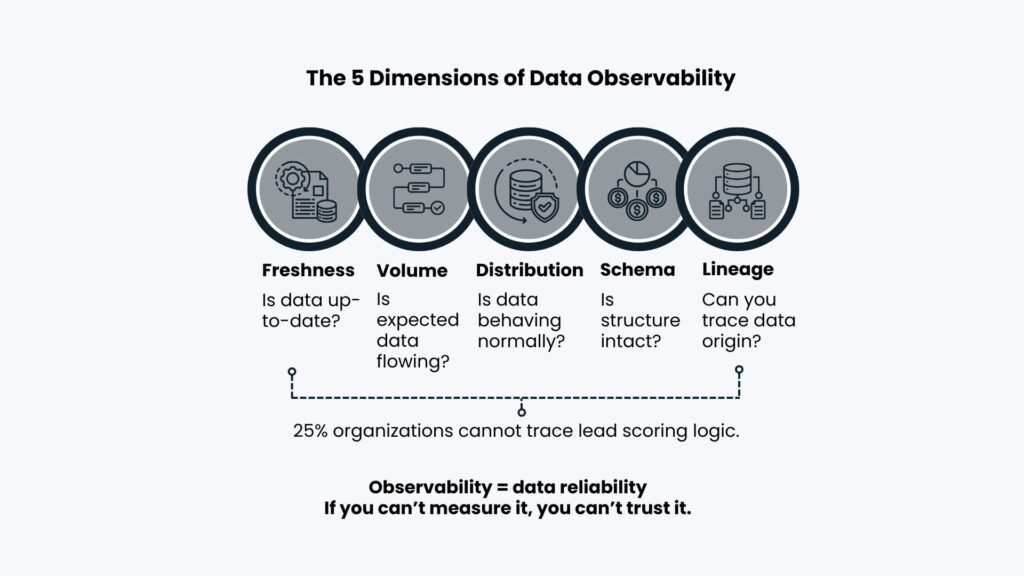
The Five Critical Dimensions of Data Observability Gap

Freshness measures how recent data is and whether updates arrive on time. In B2B, an intent signal loses value rapidly. If latency jumps from 5 minutes to 5 hours, the data has failed even if the pipeline succeeded.

Volume tracks whether expected amounts of data flow through systems. A sudden spike or flatline typically indicates broken tracking pixels or failed API integrations. A daily enrichment job that processes 40% fewer records than baseline has failed, regardless of technical completion status.

Distribution catches problems that do not violate rules but distort reality. If 35% of your pipeline typically comes from enterprise accounts and suddenly shifts to 55%, you face either a market breakthrough or a segmentation failure. When email open rates jump 40% overnight, you probably have a tracking implementation break, not an engagement miracle.

Schema monitors structural integrity. When the “Industry” field starts receiving job titles, your schema has drifted. When a data provider shifts existing values from a “size” field to “legacy_size” without notification, your segmentation rules execute against empty fields. No errors appear. Your ICP targeting just stops working.

Lineage provides the audit trail from source to dashboard. When conversion rates look wrong, lineage allows you to trace back through transformations to find exactly where logic failed. According to SiriusDecisions research, 25% of B2B organizations cannot trace how their lead scores are calculated, making silent failures nearly impossible to diagnose.

Four Data Observability Failures Hiding in Revenue Pipelines

Revenue teams operate with broken data longer than they realize because observability gaps manifest in ways that evade standard monitoring. Each of the following failure modes is a direct symptom of the data observability gap.

Silent schema drift occurs when upstream systems change structures without notification. A data provider modifies their taxonomy, now categorizing directors as “management” instead of “leadership.” Your lead scoring model continues executing perfectly. Results become meaningless. Detection happens quarters later when reviewing win rates by segment.

Gradual decay masquerading as variance presents as normal fluctuation. Email bounce rates creep from 3% to 11% over eight months. Each week feels within range. No single day trips an alert. But the cumulative impact; thousands of unreachable prospects, declining sender reputation, contaminated lists, represents material revenue leakage with no definitive break moment.

Transformation logic failures emerge when business rules and data reality diverge. Marketing automation shows 450 MQLs this quarter. CRM reports 520. Your data warehouse calculates 475. Each system is internally consistent. Each team defends their number. Revenue forecasts built on any of them are equally wrong, but no error appears in any log.

Cross-system inconsistency creates multiple versions of truth. One enterprise SaaS company discovered their entire Q3 demand generation budget targeted accounts using an enrichment feed that had not updated industry classifications in 14 months. Their “high-growth fintech” segment was actually legacy financial services companies that had since pivoted or been acquired.

The Revenue Cost of the Data Observability Gap

The business cost of the data observability gap concentrates in three areas.

Pipeline inefficiency manifests when teams operate on degraded data. If 20% of contact information is outdated and systems cannot flag which 20%, reps either waste time on dead ends or spend resources re-verifying everything. Salesforce’s 2023 State of Sales report found that reps spend 72% of their week on non-selling activities, with data quality issues consuming the largest share. For a 50-person sales team, a 10% reduction in selling time from bad data represents roughly $2.1 million in lost productivity annually.

Misallocated GTM spend occurs when targeting relies on corrupted signals. Intent data with 48-hour latency gets treated as real-time, causing marketing to engage prospects after buying windows close. Firmographic data with 35% accuracy drives ABM campaigns to wrong personas.

Delayed problem detection compounds every other failure. The leader of revenue operations in a Series C firm found that they were using inaccurate information to make important business decisions due to an error in their pipeline reports, which had been going on for five months without the team’s knowledge. Deals that got synced from Salesforce to the warehouse were somehow getting filtered out of the report depending on where they stood in the pipeline process.

How to Close the Data Observability Gap: 5 Operational Steps

Implementation requires structured measurement across the data lifecycle.

Define data health metrics explicitly. Do not rely on implicit assumptions. Set tolerable fill rates, freshness levels, and accuracy standards for mission-critical resources. A contact record fit for newsletter segmentation might not suffice for sales campaigns. Measure data quality on factors that count: completeness of the fields needed for engagement, freshness of enrichments (job title updated within 90 days), credibility of signals (intent scores with proven accuracy >70%).

Implement automated anomaly detection. Track expected distributions and trigger alerts when patterns shift. If firmographic coverage typically holds at 90% and drops to 65%, high-value accounts are being excluded from campaigns. Manual checks do not scale. Deploy statistical or machine learning-based detection for volume, freshness, and distribution anomalies.

Create centralized visibility dashboards. These are not engineering dashboards showing server metrics. Such metrics include:

“Freshness of contact information for Q1 target customers: 78% refreshed within 30 days” or
“Latency of intent signal: Median 8 hours, 95th percentile 26 hours.”

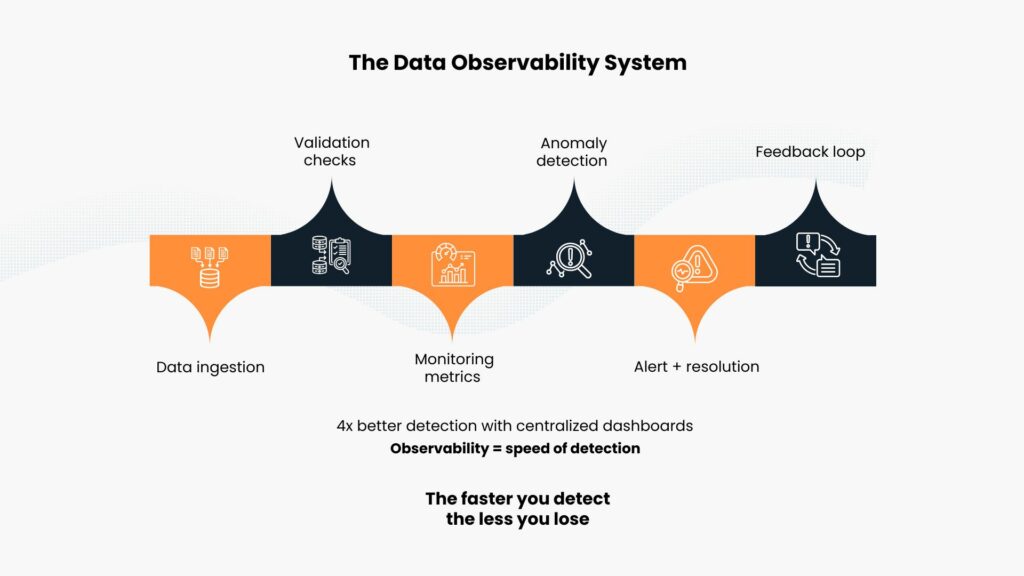
Firms having unified dashboards measuring data health have a fourfold higher ability to detect problems than those that depend on reactive reports from users.

Assign clear ownership with defined protocols. Revenue operations typically owns CRM data integrity, sales owns account and opportunity data, marketing owns campaign and engagement data. Each owner needs authority to reject bad data. When anomaly detection flags a 25% drop in daily contact imports, documented protocols should specify who gets alerted, investigation SLAs, and rollback procedures.

Integrate observability into workflows. Before campaigns launch, reporting, and before scaling, validate data readiness, data integrity and data reliability respectively. Track mean time to detection (MTTD) and mean time to resolution (MTTR) for data incidents. Improving these metrics is the goal of observability.

The foundation of revenue growth strategy is having a unified RevOps data infrastructure.
Why Closing the Data Observability Gap Is a Strategic Advantage

The data observability gap is not about systems going down, it is about broken data continuing to drive decisions undetected.

Fixing pipeline inefficiency is impossible if you can’t see that 30% of contact data is stale. Optimizing conversion is impossible when you don’t even know your lead scoring broke six weeks ago. And if you can’t quantify the revenue impact of current failures, you’ll never justify data quality investments.

For revenue leaders, the observability gap represents a fundamental strategic vulnerability: flying blind while believing you can see. Based on industry standards, data problems may affect between 20-30% of all operational data pipelines at any given moment, yet without causing any failure points. These problems go unnoticed for a long time, which means that decisions are being made based on inaccurate data.

Data maturity’s next step is not about having more data, using more tools, or creating additional dashboards. The focus should be on improving data visibility. Because targeting depends on accurate data, prioritization depends on timely data, and conversion depends on relevant data.

Organizations implementing comprehensive observability see measurable improvements. Full-stack observability reduces outage costs by 37% and mean time to recovery by 50%. Research shows 51% of organizations report achieving a 2-3x ROI on their observability spend.

Closing the data observability gap is the next step in data maturity and the most underdiscussed competitive advantage in modern GTM.

Professional reviewing archived records and reports illustrating data validation B2B processes for accuracy and reliability

B2B Data Validation Systems: How to Test, Verify, and Trust Your Data Before Activation

Data validation B2B systems determine whether your go-to-market campaigns succeed or fail before they launch. Consider this example: An exemplary mid-market SaaS business took 6 months to develop an Account-Based Marketing/ABM initiative targeted at 5,000 high-intent accounts. They sourced and enriched their contact databases with technographic insight and executed the respective strategies. 3 months post implementation, the pipeline contribution was only 2% of planned projections.

There was no messaging or timing issue. A post-mortem review revealed that 34% of email addresses were invalid, 28% of titles were out-of-date, and 19% of companies had been wrongly categorized. Essentially, the team created a large-scale deployment of unvalidated data resulting in optimization on top of an already broken foundation.

This example happens each week throughout B2B organizations. Gartner states that poor data quality costs businesses approximately $12.9 million per year. According to Salesforce, the average sales rep loses up to 27% of their time working with bad data instead of selling. This is not just a few inefficient processes; this is a systemic revenue leak due to a lack of trust in data operations.

What Data Validation Actually Means

Data validation is a dynamic process that continuously verifies that one single query is fulfilled: Is this data credible enough to be used right now?

In most cases, businesses mistake data procurement for data credibility, as they acquire a mailing list, update their database accordingly, and think everything is ready. However, there are three fundamental areas where this logic falls apart.

Contact-level accuracy ensures that the contact is indeed present in that very role and can be reached in data validation B2B workflows. Does the email resolve? Does the number connect to the intended individual? Is the title current? Even small inaccuracies here directly impact connect rates and outreach efficiency.

Company attribute validation confirms that firmographic and technographic data reflects current reality. Is the headcount accurate? Is the technology stack still in use? Has the company been acquired? B2B data decays at approximately 30% annually due to job changes, company transitions, and technology migrations.

Segmentation logic verification ensures that the rules used to prioritize and route data produce intended outcomes. Are high-value accounts correctly identified? Does the scoring model match actual conversion patterns? This layer determines whether data is strategically usable, not just technically correct.

The distinction matters. Most teams validate fields. High-performing teams validate decisions.

The Three Validation Checkpoints That Drive Performance

Validation must occur at multiple stages of the data lifecycle, each catching different failure modes.

Pre-ingestion validation occurs before data enters your CRM or marketing automation platform. This checkpoint prevents contaminated data from polluting your systems. It includes email syntax verification, domain existence checks, duplicate detection, and basic deliverability assessment. According to research conducted by Forrester in 2023, businesses using pre-ingestion validation experienced a saving of 67% on data remediation costs compared to those using post-integration validation.

Post-enrichment validation ensures that enrichment operations have enhanced, rather than compromised, the quality of the data. A 2026 accuracy study of eight website visitor identification platforms found dramatic quality variation. The highest-scoring platform achieved 82% correct identification of known visitors, while the lowest returned entirely wrong individuals from unrelated companies. The study attributed quality gaps to underlying identification methods. Deterministic matching produced significantly fewer false positives than probabilistic methods that infer identity from behavioral patterns.

This means testing a sample of enriched records against known ground truth before trusting the entire dataset. Cross-verification of firmographic fields, role validation against organizational structure, and technographic consistency checks are essential at this stage.

Validation at the campaign level is the last hurdle before deployment. Ensure that your targeted list is of high quality before starting an outreach campaign. Run tests on the deliverability of your emails to a small number of contacts. Check that the phone numbers work.Confirm that company attributes match targeting criteria. Skipping this step leads to silent execution failures where campaigns run and data looks fine, but performance drops without clear attribution.

Common B2B Data Validation Failures and Their Revenue Impact

Most data validation B2B failures follow predictable patterns, each with compounding costs.

Skipping validation entirely is the most common and most expensive failure. Teams assume that purchased data is validated by the vendor. According to a survey conducted by Integrate, almost 50% of marketers take more than ten hours each month for data cleansing. However, this effort can be greatly minimized through validation procedures.

Over-reliance on vendor claims creates hidden risks. A vendor’s claimed accuracy rate is a marketing statement, not a guarantee. “95% accuracy” is often measured at the field level, averaged across datasets, and not reflective of your target segment. Without independent validation, these metrics are misleading at best.

The absence of systematic checks leads to ad hoc validation. In the absence of automated data validation processes, data quality deteriorates without anyone’s knowledge until an audit takes place manually. Close to 75% of marketing professionals believe that at least 10% of their leads have erroneous information. Over 60% of companies find data quality issues interfering with lead transitions. The impact is quantifiable. When validation fails, SDRs lose an average of 545 hours per year dealing with bad data. For a team of 10 SDRs, you are effectively paying for two full-time employees to spend their entire year navigating data errors instead of selling.

Building a Practical Validation Framework

Effective data validation B2B systems combine statistical rigor with operational efficiency.

Stratified sampling methods guarantee validation coverage without having to go through 100 percent manual verification. If the number of contacts is less than 1,000, then apply the method of stratified sampling for validation at 15 percent on criteria such as data origin, seniority level of the contact, company size category, and recency of acquisition. If error rates in any segment exceed 10%, expand sampling or reject the data entirely.

Multi-source verification cross-references critical attributes against independent data sources. No source of information can be considered entirely accurate. Validating contact data through several vendors makes the process of validation much more robust, validating firmographic data against publicly and privately sourced data strengthens it, and validating signals of intent with behavior data enhances it.

Automated validation rules enable continuous validation at scale. Manual validation does not scale. Key automation examples include flagging records with conflicting firmographic data, identifying outdated job titles based on tenure thresholds, detecting anomalies in enrichment fields, and scoring records based on confidence levels. Modern CRM platforms now enable real-time checks on save, on import, and via scheduled bulk jobs.

Embedding Data Validation B2B into GTM Workflows

Data validation B2B workflows fail when disconnected from execution. They must embed directly into daily operations.

CRM level validation checks for the validity of each data entry before accepting it and discards incomplete or low-confidence records. It also calculates the confidence score of each record.

Campaign readiness filters apply before activation. Exclude any contact not verified in the last 30 days. Set minimum confidence score requirements. Verify ICP alignment criteria and contactability thresholds. This single filter eliminates the majority of decay-related failures.

Continuous validation loops maintain data freshness between campaigns. Key feedback signals include bounce rates, connect rates, reply rates, and conversion performance. Incorporate the feedback from these signals into the validation process to adjust the rules, re-evaluate the trust score, and select better data.

Practical Data Validation B2B Recommendations for Revenue Teams

Begin with an initial assessment. Take a sample of 10,000 records among the vendors and manually verify 500 accounts to measure your initial trust score.

Build core framework elements within 30 days. Implement 12 automated checks covering email deliverability, firmographic accuracy, and intent signal validity. Apply stratified 2% sampling per segment and cross-reference against three vendors minimum.

Integrate validation into workflows within 90 days. Use plugins to auto-quarantine imported records. Conduct weekly campaigns using 1,000 record tests. Produce scorecards each week for revenue leadership that display validation coverage trends.

Test the validity of validation itself by examining measures such as quarantine ratio, validation coverage, false positive ratio, and time-to-detection.

Conclusion: B2B Data Validation Trust Must Be Engineered

Most B2B organizations do not have a data problem: they collect, enrich, and activate it. They have a data trust problem. But they do not verify it.

Without validation, even accurate data becomes unreliable in execution. We must transform data gathering into data verification, trust in vendors into trust in systems, and static quality into ongoing validation.

Almost half of all RevOps practitioners say that poor data quality leads to inefficient pipeline management. Almost half believe that data discrepancies happen often or always within their organizations. These companies launch unverified data and pay for it indefinitely.

Competitive advantage in data validation B2B doesn’t come from having more data, it comes from having data you can trust. Validation is not a cost center. It is the foundation of predictable revenue and the difference between a guess and a qualified opportunity.