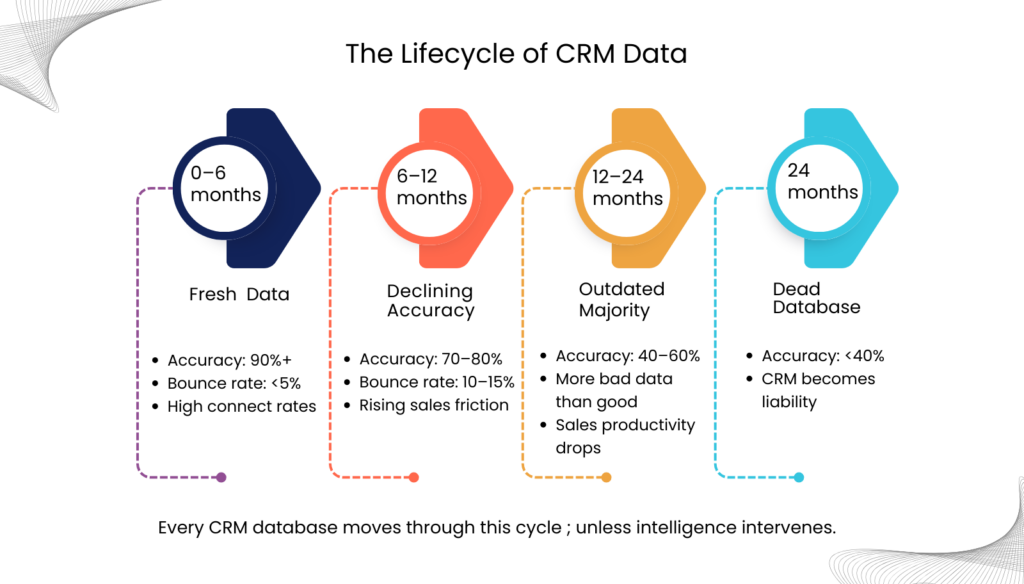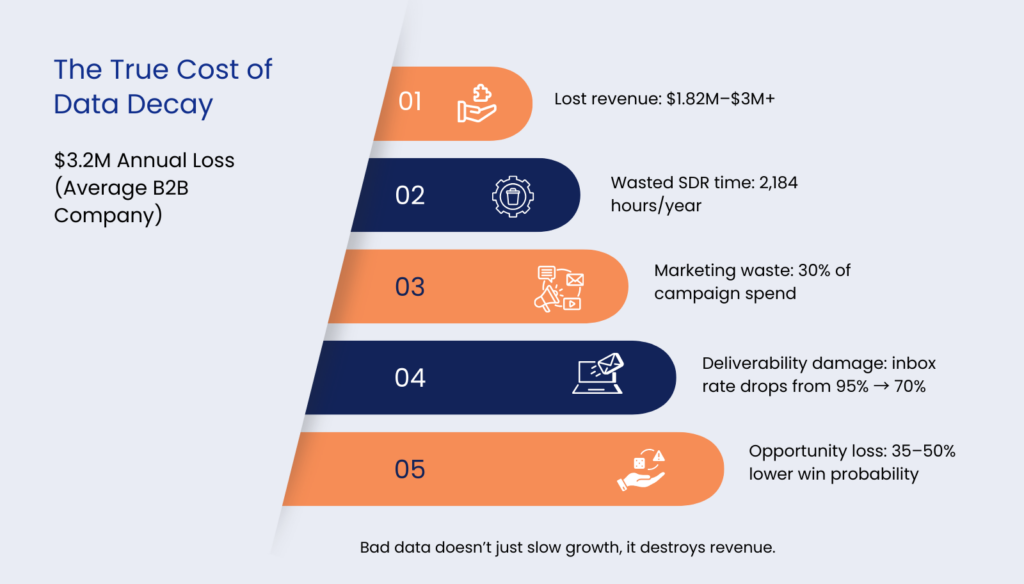


You have 50,000 contacts in your CRM. You process millions of behavioral events in your data warehouse. There are 247 active leads on your dashboard. But your salespeople still can’t tell when customers are ready to purchase. Your marketing campaigns seem generic. And your forecasts are still a shot in the dark.
The problem isn’t data volume, it’s data context. Without context, even accurate data produces no results.
Industry statistics show that up to 80% of all enterprise data is never leveraged because it lacks any kind of context. People just aren’t able to apply this data into meaningful action. That’s the problem with data context, data that is accurate yet unable to produce results simply because it’s not contextualized within the business process and decision-making.
GTM is one area where this challenge makes an immediate impact.
What Data Context Means for GTM Teams
Data context consists of three interconnected layers that transform raw information into intelligence: Why is this data important? To whom does the data apply? And how should this impact on their decision-making process?
The business relevance layer connects the data to your unique GTM strategy. The significance of someone holding the director’s title varies in different organizations. A fundraise event will only have implications for expansion only if your product helps enterprises scale. Without such context, firmographic details such as industry and company size lack precision for segmenting customers.
The role context layer defines where a person fits in the buying decision process. Is the individual an influencer, decision-maker, or end-user? What is the significance of the same title in small firms versus large corporations? A VP of marketing role holds entirely different responsibilities when compared between a Series A startup and Fortune 500 company.
Usage context determines when and how data should trigger action. A product usage spike indicates expansion readiness only if it follows adoption of key features. A job change matters only if the new role has budget authority. Intent signals without buying stage context lead to misguided outreach.
As one analysis explains, without semantic definitions mapping business terms to precise data, teams improvise. They see a customers table and assume every row is a customer. These assumptions are wrong often enough to make systems unreliable.
Where Data Context Breaks Down in RevOps
The data context gap appears in four predictable areas across revenue operations.
Generic datasets provide standardized fields and broad coverage but not business-specific relevance. A typical B2B database delivers company size, industry, and job titles without growth stage, technology stack, or buying intent. According to analysis of intent data evolution, first-wave intent failed precisely because it lacked persona-level precision needed to identify actual buying group members. Sales received lists of hot accounts with no context on who to call or what their role-specific pain points were.
Lack of segmentation means treating all contacts within a title cohort as identical. Marketing targets all Marketing Managers without filtering by industry, company size, or intent. The result is diluted messaging and lower engagement.
Absence of linking prevents understanding relationships between data points. A funding announcement without hiring data does not indicate expansion capacity. A job change without company growth context does not signal authority. In most cases, there is intent data on one platform, technographic data in another, and the CRM history on yet another. In this case, because there is no connection between all these points, you may be seeing someone visiting the pricing page when they have just created a support ticket.
Over-reliance on raw fields leads teams to depend on individual attributes instead of derived insights. Using job title alone misses the value of combining role, influence level, and buying stage into a composite signal.

How Missing Data Context Impacts GTM Performance
Missing context cascades through every revenue function.
Poor targeting results from treating all accounts within firmographic bands as equal. Without growth stage, technology fit, and intent context, marketing campaigns reach companies that cannot buy. Sales teams prioritize accounts that will not convert. Campaigns targeting all Marketing Managers without context include low-fit segments, producing diluted messaging and lower conversion rates.
Weak prioritization means all leads receive equal treatment. High-value accounts get ignored while low-potential prospects consume resources. Without scoring based on intent plus fit, pipeline quality suffers. One analysis notes that without access to complete context, execution breaks down. A hyper-growth customer showing early churn signals needs proactive outreach before they start evaluating alternatives. None of these plays work effectively without deep, unified context about the account.
Ineffective decision-making follows from incomplete intelligence. A lead score based solely on engagement volume misses whether the engaged contact is a decision-maker. A territory plan based solely on company count misses growth trajectory. Leaders might allocate more budget to the region with the most leads, not realizing another region has leads with much higher contextual fit.
Operational inefficiency emerges when large datasets are processed without context. Low signal quality means wasted effort and increased customer acquisition costs. Scaling raw data without context leads to more noise, not more insight.

A Framework for Building Data Context in Your Stack
Building effective data context requires a four-layer approach:
Layer 1: Raw Data includes contacts, accounts, activities, and signals. It has high volume but low inherent meaning.
Layer 2: Enrichment adds firmographics, technographics, and intent signals to increase data depth. According to 6sense analysis, data enrichment solves the context problem by filling gaps and adding context that turns skeletal records into complete, actionable profiles.
Layer 3: Context transforms data into ICP alignment, account tiers, buying stage, and role relevance through scoring models, segmentation frameworks, and relationship mapping. This is where most teams stop at enrichment but high performers invest in true context because enrichment adds data while context adds meaning.
Layer 4: Decision connects data to actions, workflows, and campaigns through lead routing, outreach triggers, and prioritization queues.
According to the evolution of intent data, the fundamental shift is how data is used. Intent data is now the engine of signal-based revenue operations. When a high-value signal is detected, modern systems can trigger a nurture sequence, send an instant notification to the BDR, and populate an ad audience.
Making Data Actionable in GTM Systems
Adding context is necessary but insufficient. Context must be integrated into workflows to drive action.
Align with business goals before adding context. Every dataset should answer how this impacts pipeline. As one Chief Data Officer learned, data initiatives fail when they exist in isolation. The approach changed when they stopped treating data as a separate function and started embedding it directly into business strategy.
Integrate into workflows so context triggers action. Ensure data feeds into CRM actions, campaign triggers, and sales prioritization. Context viewed in reports is unused. Context embedded in CRM records, alert workflows, and campaign segmentation drives action.
Facilitate interpretation on a large scale with semantic layers to determine meaning. Avoid unnecessary analysis by offering explicit signals and pre-classified data types. Ensure consistency with standardized logic for all applications, including artificial intelligence, business intelligence, and analytics.
You can read more, here.
Strike a balance between coverage and relevance. Data quantity does not guarantee quality decision-making. Prioritize meaningful data over sheer numbers.
Data Context Implementation: RevOps Best Practices
Audit data usage. Identify which data fields actually influence decisions. Most organizations discover they are enriching for volume rather than decision-critical attributes.
Define context models explicitly. Create clear frameworks for ICP, segmentation, and prioritization. Build a semantic layer that defines what key terms mean for your business. Active lead, qualified account, and expansion opportunity must have precise, shared definitions.
Layer intent on top of fit. Firmographic fit tells you who could buy. Intent context tells you who is ready to buy now. Without both, prioritization remains guesswork.
Reduce raw data dependency. Shift from field-level analysis to derived insights. Create scores, categories, and segments instead of depending on individual attributes.
Standardize context across teams. Ensure consistent definitions and unified usage. When different teams operate from different contexts, marketing builds campaigns around generic personas while sales discovers actual decision-makers in conversations.
Measure context effectiveness. Track conversion improvements, targeting accuracy, and pipeline quality to validate that context is driving business outcomes.
Conclusion: Data Context Transforms Raw Data Into Revenue
Raw data is potential. Context is activation.
The organizations that scale successfully are not those with the most data but those that add the most relevant context, transforming fragments into insights, records into relationships, and signals into pipeline.
In modern GTM systems, data collection is easy and enrichment is scalable. But context remains the differentiator. Organizations that solve the data context problem move from noise to signal, from activity to efficiency, from data to revenue.
The question is not whether you have enough data. The question is whether you understand what it means. Because without context, you do not have intelligence. You have noise.