

Tag Archives: database

Professional presenting analytics dashboard illustrating the need for a data obsolescence strategy in evolving data systems

Data Obsolescence Strategy: Why Every Dataset Needs One

Every B2B organization needs a data obsolescence strategy. Your data warehouse contains every lead interaction over the last seven years, and some customer records date to 2018.

Yesterday, a member of your analytics department spent three hours fixing a report that included prospects from the past five years completely forgetting to compare that data with any actual contacts that changed organizations. While the analysis from that report has no value, the opportunity loss caused by mistakes made while creating it does. A structured data obsolescence strategy prevents this waste.

Poor data quality costs organizations an average of $12.9 million annually. MIT Sloan Management Review research indicates companies lose 15 to 25% of revenue due to bad data. 85% of companies attribute bad decision-making directly to stale data. B2B contact data decays at 2.1% per month, meaning 70% of your database becomes unreliable within three years. Yet most organizations treat 7-year-old prospect records identically to seven-day-old intelligence.

Storage is cheap. Confusion is expensive. Data that outlives its relevance does not become neutral. It becomes a liability that pollutes decision systems, degrades model performance, and creates governance problems. This is the problem that data obsolescence planning solves.

The True Cost of Ignoring Data Obsolescence Strategy

How Stale Data Creates Conflicting Analytics Insights

When current and historical data coexist without clear temporal separation, analytics systems generate contradictory outputs. An old firmographic record classifies an account as a small business. A new record reflects its growth into an enterprise. Both sit in your pipeline. Your segmentation engine pulls from both. Your marketing team and sales team draw different conclusions from the same system and neither trusts the other’s numbers.

This is a huge issue for those who rely on buyer intent signals and account intelligence. If prospects showed interest as an intent signal six months ago, then those figures may no longer be valid if the buying committee completely overhauled, if they added new line items to the budget, or if they changed strategic priorities.

Therefore, your team may still be pursuing opportunities that disappeared five or six months back due to not having any sort of method to identify and rule out these types of stale signals.

Preventing ML Model Drift Through Data Expiration

Machine learning models trained on historical data perform poorly when underlying patterns shift. A lead scoring model built on 2021 buying behavior fails in today’s market where decision cycles, committee sizes, and evaluation criteria evolved substantially. Harvard Business Review research shows many ML models lose 20 to 30% predictive accuracy within months when training datasets are not continuously refreshed.

Organizations using AI-driven lead prioritization face a specific vulnerability here. When models ingest firmographic and technographic data that is eighteen months old, they produce high scores for stagnant companies and low scores for rapidly scaling prospects. The model appears to function while generating outputs that consistently mislead the sales team.

Reducing Compliance Risk with Data Expiration Policies

Every retained record demands governance attention: backup, security, audit inclusion, and compliance tracking. UK private sector researchers found that businesses saved 41% of stored data without a business reason, costing an estimated 3.7 billion pounds annually. Individual businesses average 213,000 pounds in annual storage and management spending, much of it on data that they should have discarded years ago.

For B2B organizations managing contact data across jurisdictions, the regulatory exposure compounds. GDPR’s data minimization principle requires retaining only what is necessary for stated purposes. Fines for serious violations reach 17.5 million pounds or 4% of global turnover. An organization holding seven years of accumulated personal data carries far more exposure than one with a disciplined expiration strategy.

Three Types of Expiration Policy

Time-Based Expiration

The simplest and most common approach: data expires after predetermined periods reflecting typical useful lifespan. Contact enrichment data refreshes every 90 days. Behavioral engagement signals expire after 180 days. Campaign interaction logs archive after one year. Intent signals carry a 60-day active window before decay weighting reduces their influence to zero. Organizations implementing time-based policies report 30 to 40% reductions in active data volumes without material impact on analytical capability, because the expired data provided minimal ongoing value.

Event-Based Expiration

Some data should expire based on business events, not calendar time. A prospect’s intent signals expire the moment they sign with a competitor. Firmographic records trigger re-enrichment following an acquisition. Technographic datasets reset when a company migrates its technology stack. Contact enrichment refreshes automatically when someone detects a job change.

Event-based policies align data lifecycle with business reality. When deals close as won or lost, granular interaction history loses operational relevance. The aggregate learning matters. The contact-level detail does not.

Relevance Scoring: Advanced Data Obsolescence Control

The most sophisticated approach uses measurable signals to determine when data has passed its useful life. Has anyone accessed this record in the past year? Does it score above minimum thresholds in your ICP model? Does any active campaign or model reference it? Records falling below defined relevance thresholds trigger expiration regardless of age or events. At Packed Data, we establish the foundation of the refresh velocity model: we continuously score intent signals and technographic data and automatically expire them when they fall below the threshold required to inform a meaningful sales decision. The goal is a database where every active record is worth acting on.

How to Operationalize Your Data Obsolescence Strategy

Building an effective data obsolescence strategy requires three operational components:

Automated Data Archival for Continuous Hygiene

Manual data cleanup is not done consistently, as most teams don’t want or have enough time to do this consistently. Automated archival processes remove expired data from the active environment to a long-term storage or archival solution based on predefined procedures, and these solutions execute automatically without any human interaction.

Organizations who have implemented automated archival systems typically have experienced 25 to 35% improvement in query performance as the size of the active data set shrinks to only those records that are operationally relevant. In one case, a retail organization, which automated its archival process, experienced a reduction in data storage costs of 60% along with a 45% increase in query speed.

Tiered Storage: Cost-Efficient Data Lifecycle Management

Not all data that has reached its end of life requires hard deletion. As relevance decreases, the system will migrate tiered storage through increasingly lower-priced tiers until the data is either permanently deleted or reaches its end of life (EOL). Active operational data remains in fast performance databases (millisecond query speed), while recently expired data gets archived into standard cloud storage (low cost). Older historical data moves into cold storage (archival storage). Permanent deletion occurs only after all required legal retention periods have been satisfied.

By managing the various categories of storage and retention obligations through a tiered storage strategy, you can optimize the cost of storing data while retaining the ability to recover that data if needed, comply with data retention obligations, and prevent compliance-related data from adversely affecting operational analytics.

Managing Access Controls for Expired Data

Active systems manage archived data differently from how they manage current data. When there are no access restrictions, analysts might mistakenly include expired records in analyses, training data sets, and reports. Utilize the concept of least privilege for accessing archived data (sales and marketing should only access current intelligence, and analytics should receive only recent historical data to perform trend analysis; compliance should receive full archives when the retention period is mandated). By having expiration date and tier meta tagging on each record will make the enforcement of access systematized rather than manual.

Data Obsolescence Strategy ROI: The Business Case

A B2B SaaS organization that implemented a structured data obsolescence strategy across its account intelligence database reported storage costs dropping from $180,000 to $65,000 annually, lead scoring accuracy improving from 72% to 93%, decision velocity increasing by 25%, and $5.4 million in incremental revenue attributed to cleaner targeting. A fintech firm that refreshed eighteen-month-old firmographic data recovered $3.7 million in ARR from accounts that had been misrouted to wrong territories.

The compliance benefits add up alongside the financial results. Automatic expiration can lead to up to 80% less exposure to personal data and it also halves the time required for audit preparation. In 2024, the average costs of data breaches were $4.88 million and companies that have well-established data governance programs have breach costs that are 45% lower. Each record that is deleted means one less exposure to data breach risk.

Building Your Data Obsolescence Strategy: First Steps

Start your data obsolescence strategy with these practical steps. Conduct a staleness audit. Take a sample of 500 records from your current CRM/account intelligence database and determine when they were last validated. You will want to flag anything greater than 90 days old for contacts, greater than 180 days for intent signals, and greater than 12 months for firmographic data. The percentage of records that do not meet these thresholds is your current level of obsolescence.

Define expiration policies for your three highest-volume data types. Build time-based rules, identify business events that should trigger re-enrichment or expiration, and set the relevance thresholds that mark a record as no longer actionable. Automate enforcement so the system maintains itself.

Packed Data’s continuous enrichment model is built on this principle: enrichment is not only additive. It overwrites what is old. The CRM integration for sales intelligence acts as a constant filter, identifying contacts who left their companies, accounts that changed their technology stacks, and intent signals that aged past the point of actionability. The result is a database where everything present is worth using.

Data strategy isn’t only about what you collect, but also about recognizing when that data is no longer relevant.

An abstract digital illustration showing data icons, charts, and currency symbols shattering and exploding from a central point, symbolizing CRM data decay.

Data Decay: The $3.2M Problem Hiding in Your CRM

Your CRM displays 50,000 contacts, while the marketing automation platform sits fully optimized. Now, the SDR team is geared to run the plays; and then emails start bouncing. Phone numbers get disconnected. Decision-makers have left their companies months ago. What seemed like a strong pipeline turned out to be a dump of obsolete records. This is CRM data decay in action; and it’s costing you millions.

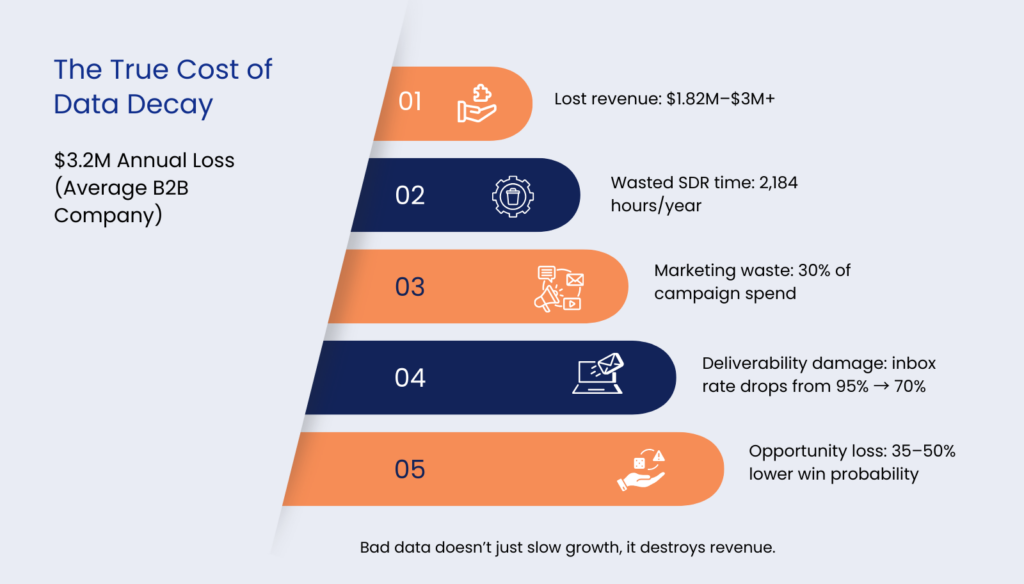
Simply put, CRM data decay is not just missing data. It’s the major reason behind an average loss of $3.2 million per annum by B2B companies through lost revenue, wasted marketing spend, and diminished sales productivity. While demand gen heads talk about filling pipelines and CMOs invest in fancy marketing technology stacks, contact data decays at 30% a year, sometimes even faster. Understanding CRM data decay is the first step to stopping this silent revenue killer.

The Silent Revenue Killer

B2B contact data doesn’t stay fresh. Studies have shown that contact information loses its accuracy by 2.1% every month. Thus, more than 22.5% of the data on the average can be wrong after a year. However, the pace at which contacts become inactive or change is more than 30% a year during the times of economic downturn, such as the COVID-19 pandemic in 2020, or layoffs in the IT industry in 2023-2024. The attrition rate of business email addresses was 3.6% in just one month, according to the latest statistics available in November 2024. This is far higher than the average monthly rate of 1.5–2.0%.

The Impact of Professional Turnover

Decay is an inevitable yet natural process. Job turnover is the primary cause of data decay. The average tenure of B2B decision-makers is about 2.5 years, and 30% of the staff change jobs every year. When a VP of Marketing changes companies from Company A to Company B, your carefully built relationship database is no longer valid. The email address is no longer functional. The direct dial number belongs to a different person. Your personalized messages reach the wrong individual.

How Market Volatility Accelerates CRM Data Decay

Company dynamics accelerate decay beyond individual job changes. Mergers and acquisitions restructure entire organizations overnight. A study by ZoomInfo examining 1,000 business cards found that 70.8% had one or more changes within 12 months. Company closures, especially among startups and mid-market firms, instantly obsolete entire account records.

The High Cost of Inaccurate Data

Consider a database of 50,000 contacts with a conservative 22.5% annual decay rate. If your average contract value is $1,080 and your conversion rate is 15%, data decay costs you approximately $1.82 million in lost revenue annually. For companies with higher ACVs or larger databases, losses easily exceed $3 million.

Over time, this gets worse due to the compounding impact. Decay does not wait for your yearly database cleanup. An additional 2% of your contacts become unreachable each month if nothing is done. 12 % of your database is out of date by the sixth month. By the twelfth month, about 25% of your carefully created pipeline has disappeared.

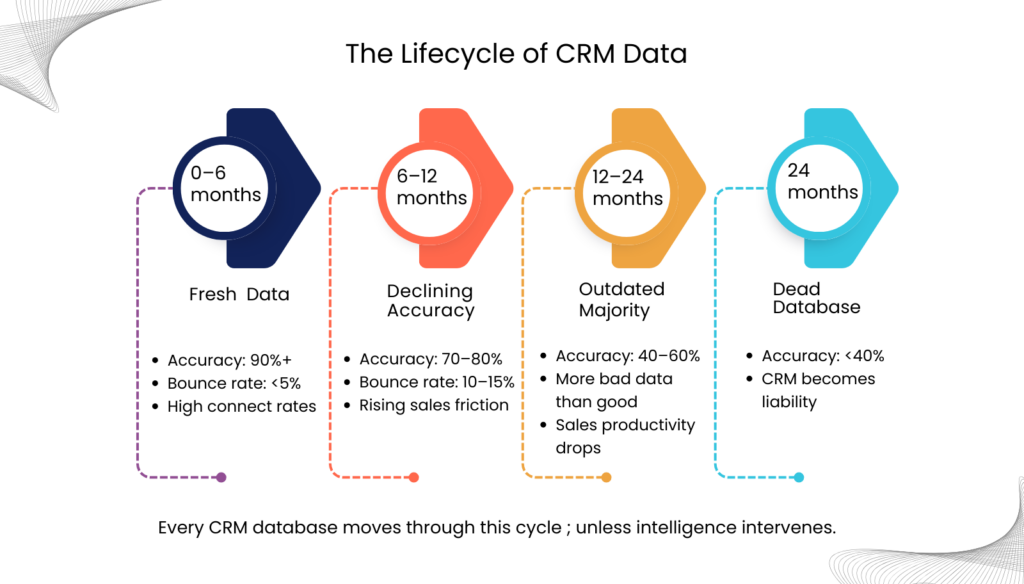
The Four Stages of CRM Data Decay

The Four Stages of CRM Data Degradation

CRM data decay follows predictable stages that help identify when intervention becomes critical.

Stage 1:

Fresh Data (0-6 months) represents optimal conditions. Accuracy sits above 90%, bounce rates remain under 5%, and sales teams report high connect rates. This is the window when outreach delivers maximum ROI.

Stage 2:

Declining Accuracy (6-12 months) starts to create a visible friction. Accuracy decreases to 70-80%. Bounce rates increase to 10-15%. Sales representatives began to complain: “I wasted my whole day yesterday contacting people who don’t even work in those companies anymore.”

Stage 3:

Outdated Majority (12-24 months) is the point of no return when the number of bad data exceeds the good data. Accuracy decreases to 40-60%. More than half of your database contains errors. Sales team frustration peaks as they waste hours daily chasing ghosts.

Stage 4:

Dead Database (24+ months without maintenance) renders data essentially unusable. The accuracy falls below 40%. In the end, this database is more of a liability than an asset. Salespeople eventually lose faith in the CRM data altogether and start doing manual research for every new prospect. If you start with 1, 000 contacts, without active maintenance, there will be less than 400 usable ones after 2 years.

Hidden Costs Beyond Bounce Rates

How CRM Data Decay Destroys Deliverability and Efficiency

The obvious costs, wasted email sends and failed phone calls, represent only the visible portion of data decay’s impact. Sender reputation damage creates long-term consequences. Email service providers keep close eye on a number of variables, including engagement data, spam complaints, and bounce rates. If your emails are consistently sent to invalid addresses, they will damage your sender reputation. Firms with faulty data can experience their deliverability rates fall from 95% to less than 70%, which means almost a third of the sent messages do not get to the recipient’s inbox, no matter if the address is correct or not.

Sales productivity drain quantifies in time and opportunity cost. It is estimated that on average sales reps waste about 4.2 hours each week on leads that have gone cold, based on various reports. Now, for a sales development representative (SDR) team consisting of ten people, the total time wasted is 42 hours per week, which is equal to 2, 184 hours per year. Moreover, if we take an average annual salary of an SDR as $75, 000, then the labor cost alone for this team going after dead leads would be a waste of $78, 624.

Financial Impact and Regulatory Risk

Marketing budget waste becomes starkest when examining campaign economics. If you spend $50,000 on an email marketing campaign with 10,000 contacts and 30% of the addresses are invalid, you have essentially wasted $15,000. As a result, the dosage per valid contact will rise.

The compliance breaches are a cause of legal and financial risks. The frameworks of GDPR and CCPA oblige the organizations to keep the contact information accurate and to respect the privacy rights of the individuals. GDPR penalties can be as high as 20 million or 4% of the total turnover of the world.

Opportunity cost shows itself through the loss of potential earnings. While your SDR team calls outdated numbers, your competitors with fresh data reach the same prospects first. The first company to engage a prospect has a 35-50% higher likelihood of eventual purchase compared to later entrants.

The True Cost of Data Decay- Bad data doesn’t just slow growth, it destroys revenue.

Why Traditional Methods Fail to Stop CRM Data Decay

Most organizations approach data cleansing reactively and insufficiently.

Annual data cleansing means 6-12 months of decay accumulates unchecked between cleaning cycles. With 2.1% monthly decay, your database loses 12.6% accuracy between annual cleanses. The cleaned database starts deteriorating immediately, creating a saw-tooth pattern of quality.

Manual verification doesn’t scale beyond 100-200 contacts. At 5 minutes per contact verification, a 10,000 contact database requires 833 hours of manual work.

Most organizations treat their CRM as a static repository, updated only when someone manually enters new information. Meanwhile, the business world operates dynamically. People change jobs daily. Companies get acquired weekly.

Building a System to Prevent CRM Data Decay Continuously

Modern teams treat data health as an always-on operational function, not a cleanup project. This is where platforms like Packed Data fundamentally change the game.

Real-time verification validates email deliverability and contact accuracy before every send, not after damage is done. Automated enrichment triggers refresh records automatically when contacts are accessed, accounts show intent signals, or deals move stages.

As the team at Packed Data Services emphasizes, B2B data is a living ecosystem. Their approach combines firmographic and technographic data with buyer intent signals to keep your database current. Their account intelligence platform identifies when decision-makers change roles, when companies receive funding indicating purchase readiness, and when technical environments shift in ways relevant to your solutions.

AI-powered anomaly detection pinpoints periods of inactivity, suspicious role mismatches, and likely job changes even before an employee leaves. Multi-source validation performs a cross, check of firmographic and technographic data, which results in a significant accuracy improvement as compared to single, source enrichment. Native CRM integration helps to create set, and forget workflows right inside Salesforce and HubSpot so that the data remains up to date without increasing the operational workload.

Data decay isn’t a failure of execution. In modern B2B, data is a living asset. Without continuous intelligence, even the best GTM strategies collapse under bad inputs. By combining account intelligence, technographics, buyer intent signals, and AI-driven enrichment, Packed Data enables teams to stop data decay before it starts and turn CRM accuracy into a competitive advantage.

Database Marketing

Benefits of Database Marketing!

The word itself is very deliberative to the mutual collaboration between data research along with maintenance with business infrastructure expanding. It is being online trend growing as fast as can to have healthy business relationship between the organization and the clients including excellent marketing and selling strategies with targeted potential customer network. Database marketing is a form of direct marketing. It involves collecting customer data like names, addresses, emails, phone numbers, transaction histories, customer support tickets, and so on. This information is then analysed and used to create a personalized experience for each customer

A Brief role played by Database marketing

Database marketing is the most efficient way to generate personalized communications in order to promote a product or service for marketing purposes.

It is a data presentation on the basis of real time clients updation.

Beneficial in lead generation through better prediction of customer along with marketing behavior.

The database marketing can be summarised as:

Content Creation

Audience Targeting

Campaign Automation

Track and optimise

Integrated CRM data

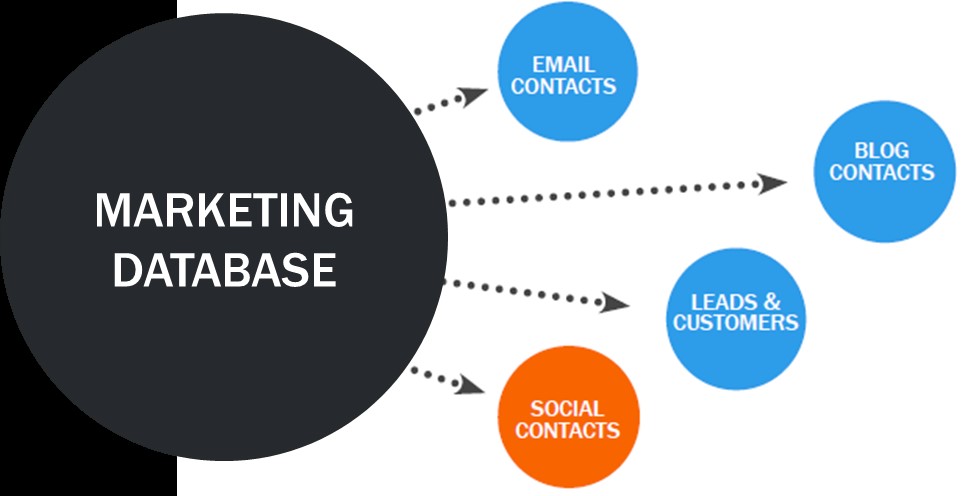
The term database itself consist of vast amount of data  which is to be marketed worldwide so the core of this marketing is the content which we use of absolute accuracy and absolute accuracy in data leads to substantial growth in business world, that means the data we are dealing with should be with valid context whatever we use like contact details, email details or the designation details. So the very first step will be the content creation, the data we filter with validate context and real time updating facilities this also be called as content creation in first place, as per the requirement the data is pulled out of an database by applying proper search criteria, after this the targeted audience get tracked down in the potential marketing with using the search criteria we prefer along with response in return. Afterwards campaigns are run in order to hit the targeted sales, along with campaign running the customer data  are tracked and optimised for the successful lead generation, at the end the data is integrated with CRM, as CRM is ongoing excellent solution provider for maintaining online customer relationship by providing various platform for clients, so that they can user friendly interact with the organisation. CRM software can automatically update profiles when customers enter new information, and online tools can protect against data decay by integrating with your software and updating each contact as they browse your website with activity data. The content mainly is a composition of the contacts details from various online medias categorised as

Email contacts

Blog Contacts

Leads and Customer

Social contacts

Email Contacts: The influence holds up by email marketing becoming a buzzword and its trending due to its most effective and efficient way of communication leading to the right amount of sell among the targeted potential customers just need to be absolute product oriented with no irrelevant description. Also, about 60 % of preferred promo channels is occupied by email marketing which means consumers subscribe to a brand’s list to get promotional messages which eventually leads to the lead generation and greater business development.     

Blog Contacts: well the technology oriented blog leads you to the technology awareness among the customers which is being part of your organization leading you to healthy business relationships leading you to the lead generations and its becoming the great way of database marketing, we can advertise, we can share the concept behind the upraising of the product, we can deliberately have client’s poles ,we can dig deeper with social media to know the influential ongoing this, also to know the market flow and what’s makes you persistent in the marketing field.

Leads and Customers: Social media makes it easier than ever to get detailed insights into your customers’ interests, perspectives, and life updates. Effective personalization is about providing a relevant message to an interested audience — not proving how much personal data you have. Collecting and analysing customer data is just the first step. You must act quickly enough to capitalize on a customer’s interest in and interactions with your brand.

Social Contacts: By handling a firm contribution behind the database marketing, social contacts make one of its inseparable part of this worldwide ongoing trade. The social media influences the brand, which is the big deal in this field, how the client approaches the product, their reviews become more predictable around the media. So, it’s the necessity of trade, one with excellent social command over the marketing business.

Email marketing not dead

Email marketing is not dead! Its alive kicking and even stronger!!

There are myths and then there are MYTHS! the one we are talking about is, email marketing is dead as a goose and people hate being marketed to via email.

Ask marketers and they will tell you probably the best way to engage with customers is through social media (Facebook, Instagram) for instance. It is where the millennials are congressing. Let’s address some of these myths with a few statistics.

Average usage by age group in US:

Age group % usage
15-24 91%
25-44 93.4%
45-64 90.5%
65+ 85.5%

Despite a plethora of social media apps, the millennials and all generations are actually using email.

Usage is fine, what about conversion? isn’t social media the holy grail? Wrong again, here’s another myth buster.

For the “Big 3” of social media (Facebook, Instagram, and Twitter), the engagement rate isn’t even 0.6%. Compare that to email’s average open rate of 22.86% and even its click-through rate of 3.71%.

Now that we are all on the same page due to some eye-opening myth busters, how is email marketing evolving and developing?

Email marketing’s biggest advantage remains that it is non-intrusive, it’s not like an ad that comes in between when you are watching your favorite videos. Its great strength can also become its greatest weakness, as customers have the chance to ignore your email completely.

It is our responsibility to make the content more relevant for a positive reception from the audience. Just bombarding the audience with plethora of emails to stay relevant is not enough. The emails have to be engaging and rewarding for the audience. Everytime you create an email campaign, and send it to your target audience, have one rule to check – What is the audience gaining from the email?

Relevance is the key word, account-based marketing (ABM) is one of the model ways to reach out to B2B customers. This means the content not only has to be relevant but also consistent and constant messaging are the other two pillars for successful engagement.

The key to conversion or CTR always remains being there at the right time, since we cannot envisage when a business need arises, we address that through constant, consistent and relevant email communication.

This means constant email campaigns and a regular dosage of quality lead list. Step 1 is to get the data set right, verified leads provide higher CTR and also make the effort in content creation worth it. The right kind of company to get your lead generation right and which understands your needs properly is pivotal for successful email campaign.

If you have the lead list right, then congrats Step 1 is complete and you are ready for my next blog. Else don’t fret reach out to us and we will assist you in Step 1.

What is Step 2? One line – Don’t be an email marketer, be an email concierge!! Coming soon!!