


Your CRM displays 50,000 contacts, while the marketing automation platform sits fully optimized. Now, the SDR team is geared to run the plays; and then emails start bouncing. Phone numbers get disconnected. Decision-makers have left their companies months ago. What seemed like a strong pipeline turned out to be a dump of obsolete records. This is CRM data decay in action; and it’s costing you millions.
Simply put, CRM data decay is not just missing data. It’s the major reason behind an average loss of $3.2 million per annum by B2B companies through lost revenue, wasted marketing spend, and diminished sales productivity. While demand gen heads talk about filling pipelines and CMOs invest in fancy marketing technology stacks, contact data decays at 30% a year, sometimes even faster. Understanding CRM data decay is the first step to stopping this silent revenue killer.
The Silent Revenue Killer
B2B contact data doesn’t stay fresh. Studies have shown that contact information loses its accuracy by 2.1% every month. Thus, more than 22.5% of the data on the average can be wrong after a year. However, the pace at which contacts become inactive or change is more than 30% a year during the times of economic downturn, such as the COVID-19 pandemic in 2020, or layoffs in the IT industry in 2023-2024. The attrition rate of business email addresses was 3.6% in just one month, according to the latest statistics available in November 2024. This is far higher than the average monthly rate of 1.5–2.0%.
The Impact of Professional Turnover
Decay is an inevitable yet natural process. Job turnover is the primary cause of data decay. The average tenure of B2B decision-makers is about 2.5 years, and 30% of the staff change jobs every year. When a VP of Marketing changes companies from Company A to Company B, your carefully built relationship database is no longer valid. The email address is no longer functional. The direct dial number belongs to a different person. Your personalized messages reach the wrong individual.
How Market Volatility Accelerates CRM Data Decay
Company dynamics accelerate decay beyond individual job changes. Mergers and acquisitions restructure entire organizations overnight. A study by ZoomInfo examining 1,000 business cards found that 70.8% had one or more changes within 12 months. Company closures, especially among startups and mid-market firms, instantly obsolete entire account records.
The High Cost of Inaccurate Data
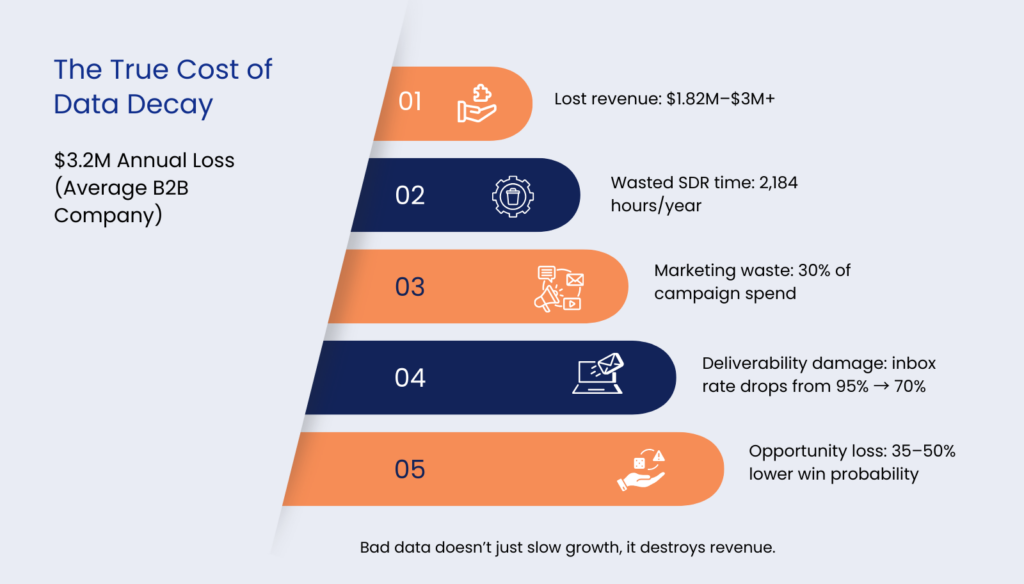
Consider a database of 50,000 contacts with a conservative 22.5% annual decay rate. If your average contract value is $1,080 and your conversion rate is 15%, data decay costs you approximately $1.82 million in lost revenue annually. For companies with higher ACVs or larger databases, losses easily exceed $3 million.
Over time, this gets worse due to the compounding impact. Decay does not wait for your yearly database cleanup. An additional 2% of your contacts become unreachable each month if nothing is done. 12 % of your database is out of date by the sixth month. By the twelfth month, about 25% of your carefully created pipeline has disappeared.
The Four Stages of CRM Data Decay
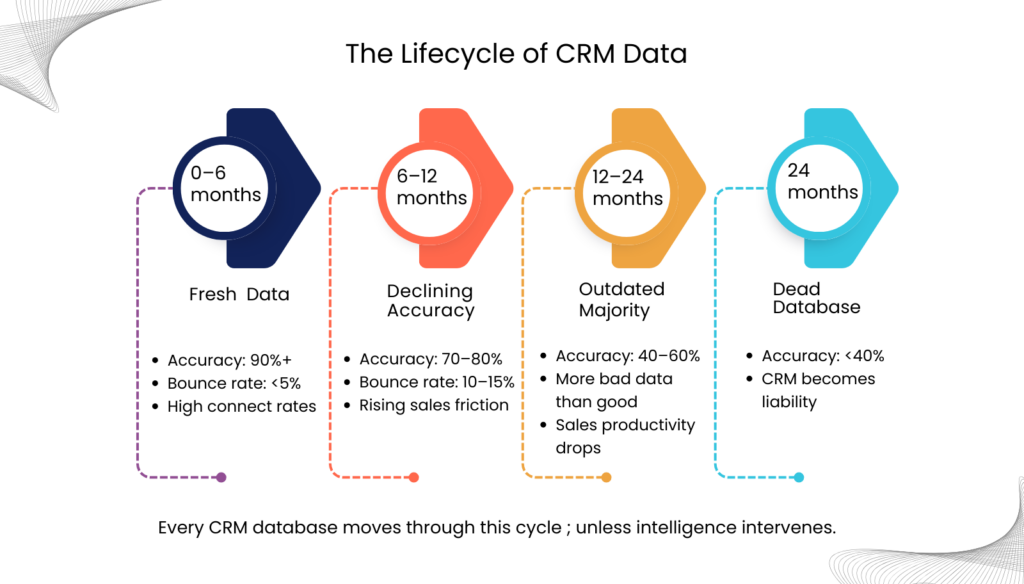
CRM data decay follows predictable stages that help identify when intervention becomes critical.
Stage 1:
Fresh Data (0-6 months) represents optimal conditions. Accuracy sits above 90%, bounce rates remain under 5%, and sales teams report high connect rates. This is the window when outreach delivers maximum ROI.
Stage 2:
Declining Accuracy (6-12 months) starts to create a visible friction. Accuracy decreases to 70-80%. Bounce rates increase to 10-15%. Sales representatives began to complain: “I wasted my whole day yesterday contacting people who don’t even work in those companies anymore.”
Stage 3:
Outdated Majority (12-24 months) is the point of no return when the number of bad data exceeds the good data. Accuracy decreases to 40-60%. More than half of your database contains errors. Sales team frustration peaks as they waste hours daily chasing ghosts.
Stage 4:
Dead Database (24+ months without maintenance) renders data essentially unusable. The accuracy falls below 40%. In the end, this database is more of a liability than an asset. Salespeople eventually lose faith in the CRM data altogether and start doing manual research for every new prospect. If you start with 1, 000 contacts, without active maintenance, there will be less than 400 usable ones after 2 years.
Hidden Costs Beyond Bounce Rates
How CRM Data Decay Destroys Deliverability and Efficiency
The obvious costs, wasted email sends and failed phone calls, represent only the visible portion of data decay’s impact. Sender reputation damage creates long-term consequences. Email service providers keep close eye on a number of variables, including engagement data, spam complaints, and bounce rates. If your emails are consistently sent to invalid addresses, they will damage your sender reputation. Firms with faulty data can experience their deliverability rates fall from 95% to less than 70%, which means almost a third of the sent messages do not get to the recipient’s inbox, no matter if the address is correct or not.
Sales productivity drain quantifies in time and opportunity cost. It is estimated that on average sales reps waste about 4.2 hours each week on leads that have gone cold, based on various reports. Now, for a sales development representative (SDR) team consisting of ten people, the total time wasted is 42 hours per week, which is equal to 2, 184 hours per year. Moreover, if we take an average annual salary of an SDR as $75, 000, then the labor cost alone for this team going after dead leads would be a waste of $78, 624.
Financial Impact and Regulatory Risk
Marketing budget waste becomes starkest when examining campaign economics. If you spend $50,000 on an email marketing campaign with 10,000 contacts and 30% of the addresses are invalid, you have essentially wasted $15,000. As a result, the dosage per valid contact will rise.
The compliance breaches are a cause of legal and financial risks. The frameworks of GDPR and CCPA oblige the organizations to keep the contact information accurate and to respect the privacy rights of the individuals. GDPR penalties can be as high as 20 million or 4% of the total turnover of the world.
Opportunity cost shows itself through the loss of potential earnings. While your SDR team calls outdated numbers, your competitors with fresh data reach the same prospects first. The first company to engage a prospect has a 35-50% higher likelihood of eventual purchase compared to later entrants.
Why Traditional Methods Fail to Stop CRM Data Decay
Most organizations approach data cleansing reactively and insufficiently.
Annual data cleansing means 6-12 months of decay accumulates unchecked between cleaning cycles. With 2.1% monthly decay, your database loses 12.6% accuracy between annual cleanses. The cleaned database starts deteriorating immediately, creating a saw-tooth pattern of quality.
Manual verification doesn’t scale beyond 100-200 contacts. At 5 minutes per contact verification, a 10,000 contact database requires 833 hours of manual work.
Most organizations treat their CRM as a static repository, updated only when someone manually enters new information. Meanwhile, the business world operates dynamically. People change jobs daily. Companies get acquired weekly.
Building a System to Prevent CRM Data Decay Continuously
Modern teams treat data health as an always-on operational function, not a cleanup project. This is where platforms like Packed Data fundamentally change the game.
Real-time verification validates email deliverability and contact accuracy before every send, not after damage is done. Automated enrichment triggers refresh records automatically when contacts are accessed, accounts show intent signals, or deals move stages.
As the team at Packed Data Services emphasizes, B2B data is a living ecosystem. Their approach combines firmographic and technographic data with buyer intent signals to keep your database current. Their account intelligence platform identifies when decision-makers change roles, when companies receive funding indicating purchase readiness, and when technical environments shift in ways relevant to your solutions.
AI-powered anomaly detection pinpoints periods of inactivity, suspicious role mismatches, and likely job changes even before an employee leaves. Multi-source validation performs a cross, check of firmographic and technographic data, which results in a significant accuracy improvement as compared to single, source enrichment. Native CRM integration helps to create set, and forget workflows right inside Salesforce and HubSpot so that the data remains up to date without increasing the operational workload.
Data decay isn’t a failure of execution. In modern B2B, data is a living asset. Without continuous intelligence, even the best GTM strategies collapse under bad inputs. By combining account intelligence, technographics, buyer intent signals, and AI-driven enrichment, Packed Data enables teams to stop data decay before it starts and turn CRM accuracy into a competitive advantage.