


While your sales VP reports $2.3 million in pipeline, your marketing director presents $2.8 million and your finance team forecasts only $1.9 million. Three different versions of the truth. Three teams pointing fingers. Zero confidence in any number. This is what happens without proper RevOps data infrastructure.
Your business is losing millions as a result of this RevOps data crisis. Recent Salesforce research indicate that sales representatives only spend 28% of their time selling. Finding accurate contact details, resolving inconsistent account records, and manually updating systems where automation should exist take up the remaining time. According to research, data fragmentation costs businesses between 15 and 20 percent of their potential revenue. This amounts to an annual loss of $7.5 to $10 million for a $50 million firm. Building proper RevOps data infrastructure eliminates this waste.
When every team maintains different numbers, trust erodes. Executives question every forecast. Sales reps ignore CRM data. Marketing campaigns target outdated contacts. Customer success teams lack visibility into early warning signs.
Single Source of Truth: RevOps Data Infrastructure Foundation
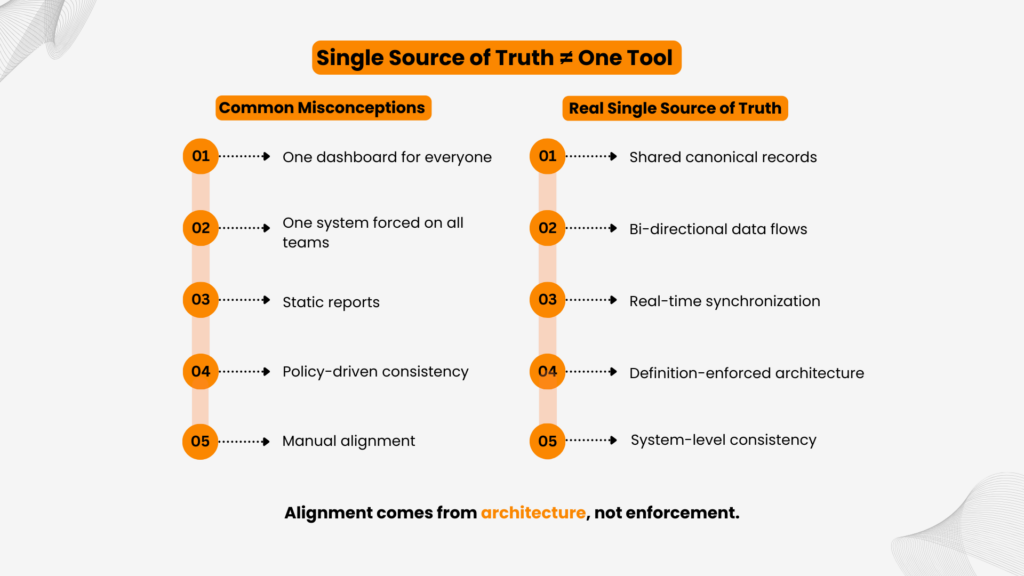
Single source of truth doesn’t mean forcing everyone onto one tool or making all teams use identical dashboards. Those approaches fail because they ignore how different functions need different views of the same underlying data.
Real single source of truth means ensuring data flows bidirectionally between systems automatically. When a sales rep updates an opportunity in Salesforce, marketing automation platforms reflect that change instantly; meanwhile, when marketing scores a lead based on engagement, sales sees updated prioritization in real-time, and when customer success logs a support ticket, account health scores adjust across all systems.
This requires maintaining consistent definitions across teams. What qualifies as a Marketing Qualified Lead? When does an opportunity enter “Negotiation” stage? What constitutes an active account versus dormant? Organizations with unified data strategies establish these definitions early and enforce them through technical architecture, not policy documents gathering dust.
The foundation is having one canonical record for each account and contact accessible everywhere. Account hierarchy matters. Parent-subsidiary relationships. Territory assignments. These key data elements need to be based on a single source of truth, with all other systems reading from these sources instead of duplicating each other with multiple versions.
Most RevOps data infrastructure uses a hub-and-spoke model. Your CRM acts as the hub. Data enrichment platforms, marketing automation tools, sales engagement tools, and analytics systems are the spokes. Data flows into the hub from all sources. The hub cleanses it. Standardizes it. Returns it to operational systems.
The Five Data Types RevOps Must Unify
All of the metrics mentioned below can be measured independently, through multiple technologies (marketing automation platforms; website analytics systems; sales engagement software) and they all indicate a different kind of engagement type. Unified engagement scoring combines these signals into comprehensive account-level metrics showing overall interest and activity patterns over time.
Customer and Account Data
Customer and account data forms the foundation. Firmographics (e.g. account size), technographics (e.g. individual software applications), and the overall account history will provide your team with context when interacting with accounts. Key fields in an account include firmographics, such as parent-child accounts; technographics based on rep ownership at individual accounts geographically and/or demographically; and historical engagement information that will help with future conversations at the account. Enrichment platforms continuously append missing firmographic and technographic data, ensuring profiles remain complete as accounts evolve.
Contact and People Data
Contact and people data identifies who influences decisions. The individuals in the buying committee as well as those who will influence or decide upon a purchase will determine how you go about reaching out to you. The role of each individual, at what level, who they work for, and how accurate their contact details are can help you to effectively target all potential contacts. Systems must be in place to track these contacts, since 30% of B2B contacts change roles every year. When a champion moves companies, sales needs immediate notification to maintain relationships and potentially follow them to new opportunities.
Engagement Statistics
Engagement statistics determine the level of engagement between accounts and your brand. The following are just a few examples of metrics that you can use to track how much interest an account has shown in your business or brand: email open/clicks; website visits; content downloads; number of meetings attended; requests for demos.
Intent Data
Intent data reveals research signals and buying stage indicators. Third-party intent providers track when accounts research solutions in your category across B2B publications and review sites. First-party behavior tracking captures on-site signals. Surge timing matters. When multiple decision-makers from an account suddenly increase research activity, timing and relevance improve.
Revenue Data
Revenue data drives forecasting and planning. Opportunities, pipeline stages, close dates, deal values, and forecasts must reconcile across sales, finance, and executive dashboards. CRM systems, configure-price-quote tools, and finance platforms each maintain revenue records. Inconsistencies here create the “three versions of truth” problem. Stage definitions, probability assignments, and forecast categories need standardization enforced through workflow automation.
Building Your RevOps Data Infrastructure Hub
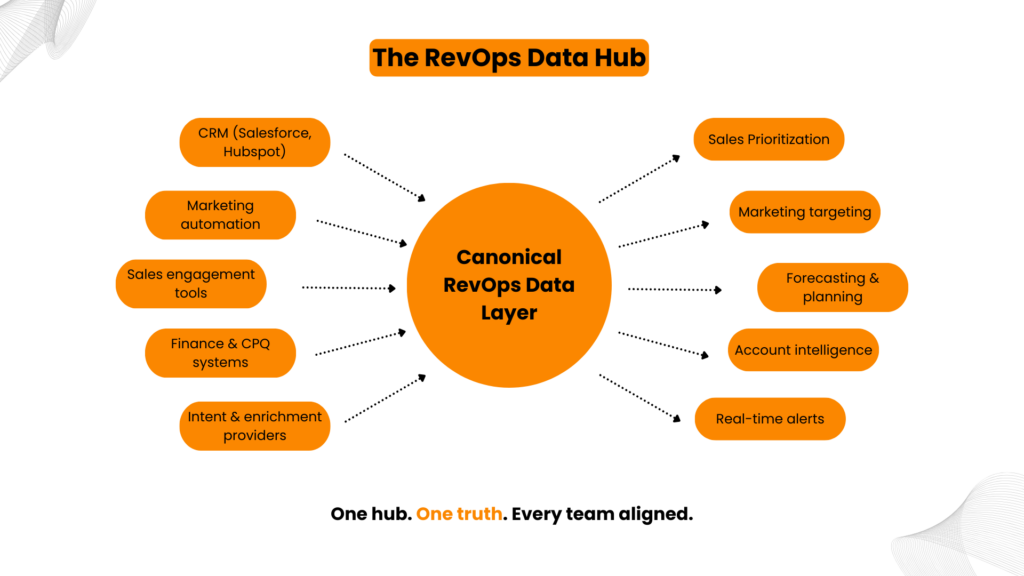
Leading organizations adopt centralized data enrichment approaches rather than point-to-point integrations that create unmaintainable complexity. A central hub receives data from all sources, enriches and standardizes information, then distributes clean data back to operational systems.
Account intelligence platforms serve this role by providing single points for firmographic and technographic append. When fresh records are added into your CRM, the enrichment APIs will cover any deficiencies, including the following fields: employee count, annual revenue, industry classification, technology stack, and funding stage.
Companies such as Packed Data Services provide the essential central enrichment functions by adding info about firmographics, technographics and aggregating intent signals from various sources and assigning a unified score to each account. They combine account intelligence, intent signals and AI-driven lead prioritization to provide customers with a complete view of their accounts in real-time and in tandem with each other between sales and marketing tools, thereby minimizing the integration difficulties that have traditionally created a point-to-point linking model.
Actionable Intelligence and Real-Time Scaling
Intent signal aggregation centralizes scoring across multiple intent sources. Third-party providers each track different publication networks and research behaviors. Centralized platforms normalize these signals into unified intent scores showing which accounts are actively researching solutions. Combined with fit and engagement data, account scoring engines produce single prioritization scores guiding both sales and marketing efforts.
Real-time alerting notifies teams when accounts hit threshold scores or show buying signals. When an enterprise account’s intent score surges, engagement increases, and technographic signals indicate budget approval, automated workflows alert assigned sales reps and trigger personalized outreach sequences.
With an API-first architecture you can connect any tool within your architecture, including pre-built connectors such as those used for Salesforce, HubSpot, Marketo, Outreach, etc., which will speed up your implementation process; however, if you have any custom systems or tools that are specific to your workflow, there are APIs available that integrate those tools into your API stack.
The 90-Day RevOps Data Infrastructure Roadmap
Days 1-30
Focus on audit and definition. Map all current data sources and flows. Records that refer to accounts, contacts, opportunities, and engagement data are kept in various systems. A thorough study of the data flow between systems at the present time and the identification of manual operations that cause bottlenecks in the workflow should be done. Definitions of fields should be recorded and a data dictionary should be compiled. The question “What is a Marketing Qualified Lead?” can be asked. What are the different stages of the opportunity process? Recognize discrepancies, multiple records, and contradictory information. Define KPIs and success metrics aligned with revenue outcomes.
Days 31-60
Shift to connection and cleansing. Integrate data enrichment platforms with CRM. Establish automated workflows where new accounts trigger enrichment jobs filling missing fields. Fill in the missing data fields by enriching the existing database. Carry out a bulk enrichment of current account and contact records with the prioritization of high-value segments. Establish bi-directional dataflows. Make sure that modifications in the operational systems get synchronized with the central hub and then get distributed to other connected platforms.
Days 61-90
Activate and optimize. Train teams on new unified data access. Show sales reps how to access complete account intelligence. Demonstrate to marketing teams how intent signals inform campaign targeting. Build dashboards using enriched data. Replace old reports with new views leveraging complete firmographic, technographic, and intent information. Set up governance and data quality protocols. Agree on who data stewards will be and what their roles and responsibilities will be. Assess the influence on sales and marketing productivity. Monitor the time saved from data searching. Work out the rise in connect rates and meeting bookings.
Those companies that manage to finish this phase generally experience quicker pipeline velocity, better cross, team alignment, and more accurate forecasting. Companies disclose 40 percent rises in sales efficiency that have been energised by clean data foundations.
Conclusion
RevOps is no longer an operational function. The foundation of revenue growth strategy is having a unified RevOps data infrastructure. Organizations that use disparate datasets will fail in their attempt to grow, their ability to forecast accurately, and their ability to personalize engagement with customers. When organizations create a RevOps data infrastructure, they benefit from an accelerated decision-making process, improved conversion rates, more accurate forecasting, and better alignment between marketing, sales, and finance functions. The development of scalable, dependable growth engines requires a single source of truth as the cornerstone.