


Tag Archives: B2B Sales Intelligence

Business analyst reviewing performance dashboards to address the GTM data latency problem and improve decision-making speed

The Data Latency Problem: Why GTM Teams Lose Pipeline to Stale Insights

The GTM data latency problem is not about wrong data, it’s about late data. Most organizations assume poor decisions trace back to inaccurate information. The real culprit is timing: intelligence that arrives after the window to act has already closed.

This timing problem is a hidden risk in Revenue Operations and Go-To-Market systems. Their analytics focus more on deep reporting rather than how quickly data can be delivered. Monthly pipeline reviews inform weekly execution calls. SDR teams receive intent signals after buying windows have cooled. Forecasting models reflect historical snapshots instead of live pipeline movement.

A 2024 RevOps survey found that 57% of critical GTM decisions are made before fresh data is even available. A 2025 benchmark of 68 revenue-focused organizations found that 79% of revenue-critical systems were still fed by batch-based pipelines, with a median end-to-end latency of 26 hours.

In B2B environments where buyers move from anonymous research to vendor shortlists in days, a 26-hour intelligence lag is not a minor inefficiency. It is a structural competitive disadvantage.

Why the GTM Data Latency Problem Is Now a Revenue Liability

Modern B2B buyer behavior moves faster than legacy reporting cycles were built to handle. Buying committees form and evolve rapidly. Budget priorities shift within weeks. Leadership changes open or close pipeline opportunities with no advance notice.

A 2024 study of high-intent accounts found that 54% of accounts signaling strong buying intent converted to meetings within 48 hours, and 78% showed no active signal beyond the 72-hour mark. GTM teams often act on outdated data, one to three days old, which means they target buyers who’ve moved on and rely on signals that have already expired.

Research by HBR shows that firms responding to inbound leads within an hour are seven times more likely to qualify those opportunities than those who take even a little longer. Still, most revenue stacks take 8 to 24 hours to provide insights. This delay can be a real issue. For example, a lead generated on Monday might not reach a sales rep until Wednesday, accumulating about 54 hours of delay. Since the chances of converting a lead fall off sharply after just an hour, that backlog turns into missed opportunities.

You can read more about data prioritization in B2B here.

Four Structural Sources of Data Latency in GTM Stacks
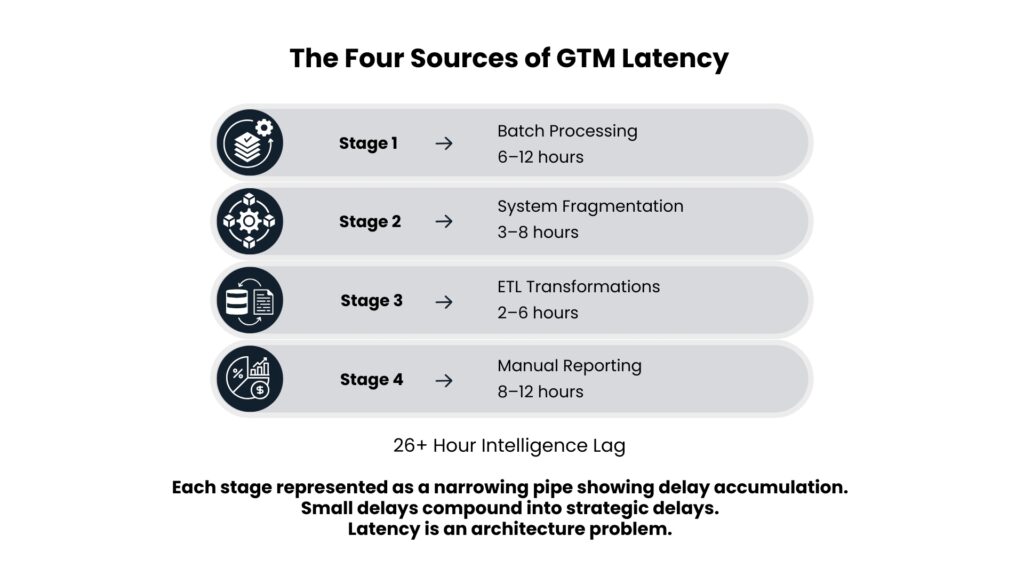
The GTM data latency problem is not a single bottleneck. It compounds across four interconnected layers.

Batch Processing Pipelines

Most enterprise data warehouses still run on batch-oriented ETL cycles. Raw events are grouped and processed on hourly or daily schedules. Even when event collection happens in real time, batch transformation introduces hours of processing lag before any signal reaches an operational system. A 2025 audit found the median end-to-end latency across these systems at 26 hours.

Fragmented System Architecture

On average, businesses use 8 to 12 tools for their revenue stack. When a high-intent signal comes in, it needs to go through web analytics, marketing automation, a data warehouse, enrichment services, a scoring engine, a CRM, and a sales engagement platform. With each step taking 30 to 90 minutes, the urgent lead from the start of the day can become outdated by hours. And it gets worse – integration issues don’t just add time; they multiply delays.

ETL Transformation Delays

Transformation logic introduces additional lag through complex joins between Salesforce, CDPs, enrichment providers, and intent platforms. Late-updating reference tables and territory mappings create a patchwork state where some attributes are current and others are weeks old. This partial staleness is operationally worse than plain latency because it produces misleading intelligence rather than a visible gap.

Manual Reporting Cycles

A significant share of business intelligence still runs through human-generated analysis. Analysts export data, clean it in spreadsheets, and prepare slides for leadership. This cycle often adds 8 to 12 hours on top of system latency. One 2025 case study found that 41% of urgent pipeline and forecasting requests were not completed until two calendar days after the triggering event.

Revenue Consequences of Unresolved Data Latency in GTM Systems

Each of the following consequences traces directly to unresolved data latency in GTM systems.

Missed Buyer Windows

High-intent signals lose conversion value rapidly. A 48-hour delay in routing intent-driven accounts was estimated in one RevOps stack to cost 19% of potential pipeline from that cohort. Organizations technically possess the right intelligence. They operationally fail to act before the opportunity expires.

Structurally Inaccurate Forecasting

A 2025 RevOps benchmark found that models updated once per week had 16 to 22% higher error rates compared to models ingesting data within 12 hours. Models trained on daily snapshots overestimated close rates by an average of 13% because they lagged short-cycle velocity changes. These errors cascade into quota allocation, territory design, and budget decisions built on a pipeline state that no longer exists.

Operational Waste Across GTM Teams

Stale data forces reactive behavior. Sales reps spend hours researching accounts based on last week’s profiles, unaware of executive changes or competitive tool adoptions that occurred 48 hours prior. Customer success teams identify churn risk after intervention windows narrow. The waste is invisible in individual workflows but accumulates into measurable capacity loss across the organization.

Framework: The Intelligence Velocity Matrix

Not all data requires real-time processing. Solving the GTM data latency problem starts with identifying where latency directly degrades revenue outcomes and where batch processing remains sufficient.

A practical model evaluates each data flow across two dimensions: decision frequency and value decay rate.

Tier 1: Real-Time Critical. High frequency plus fast decay. Examples include inbound lead routing, buying intent signals, and product trial engagement. These require sub-15-minute latency and justify event-driven streaming infrastructure.

Tier 2: Near-Real-Time Operational. High frequency plus slower decay. Examples include account-level engagement scoring and contact enrichment. These benefit from 15 to 60-minute refresh cycles through incremental processing or change data capture.

Tier 3: Strategic Analytical. Low frequency, used for planning. Examples include quarterly business reviews and territory design. Daily or weekly batch processing is appropriate here.

This tiering prevents over-engineering and aligns infrastructure cost with revenue impact.

How to Build a Low-Latency GTM Intelligence System

Event-Driven Architectures for Critical Signals

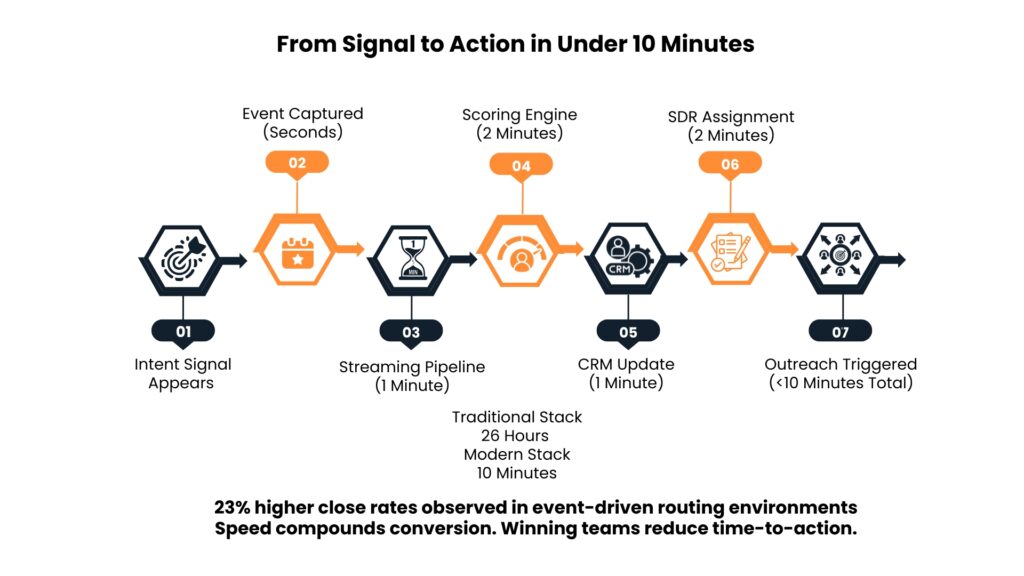
Instead of waiting for those scheduled syncs, event-driven architectures catch signals right when they happen and instantly send them off. So, when a prospect visits a pricing page or hits a product usage milestone, an event record gets sent through something like Apache Kafka. Then, downstream systems can grab that info in seconds, not hours. In one case, a RevOps team used this method to assign enterprise accounts with sudden interest spikes to a dedicated SDR pod within minutes. This led to a 23% higher close rate compared to accounts processed through batch pipelines.

Incremental Processing as a Middle Path

For organizations not quite ready for full streaming, incremental processing offers major upgrades without an extensive revamp. Rather than refreshing whole datasets nightly, systems now update only what’s changed, every 5 to 15 minutes. Plus, platforms like Snowflake, Databricks, and BigQuery make this easy via change data capture and materialized views. So, a firm dealing with 100,000 daily CRM updates could go from that big 24-hour lag to just 15 minutes – all with minor infra tweaks.

Automated Alerting and Decision Triggers

Low latency only matters when paired with automation. Top performers link smarts right into their workflows, sending real-time notifications for intent spikes, kicking off plays when pipelines lag, and routing stuff automatically based on fit. Advanced setups take it up a notch too. They can pause campaigns or switch to retargeting when conversions slow down, and adjust the timing and channels based on actual engagement.
Practical Recommendations for RevOps Leaders

First, audit the current latency and then make those infrastructure changes. Document when data hits source systems, when it gets to GTM platforms, and when decision-makers see it. You’d be surprised how many delays are lurking around that nobody tracked before.

So rank the high-value data flows first. Give each one a score based on decision criticality, market dynamics, and latency tolerance. After that, focus on upgrading streaming or incremental processing for the top two to four data flows. Also, aim to get latency down from 24 hours to less than an hour first. Then, you can target reducing times from one hour to under one minute.

Set clear goals for how fresh your data needs to be. For top performers, key revenue signals should hit action inlets in under 10 minutes, lead scoring updates within 30, and opportunity data sync’d up in an hour. Companies acting ten times slower are working with stale info that could mislead decision-making.

Also, keep an eye on how long it takes for an event to affect sales actions. Treat end-to-end latency as a crucial performance indicator right next to pipeline and conversion rates.

Conclusion: Speed Determines Whether Insights Have Value

In modern GTM systems, accurate information alone is no longer sufficient. Timing determines whether intelligence creates competitive advantage or becomes operational hindsight.

The future of B2B intelligence will not be defined solely by data quality or data volume. Closing the GTM data latency gap will define which organizations convert signals into decisions.

Insights that arrive too late are, in every practical sense, indistinguishable from no insights at all.

Business professional analyzing charts on a screen representing B2B data procurement and data source evaluation

B2B Data Procurement Framework: How to Evaluate, Compare, and Select the Right Data Sources

Most B2B organizations believe they have a data problem. In reality, they have a B2B data procurement problem.

Data is often purchased reactively. A VP of Sales needs more leads. A budget is carved out. A contract is signed based on total record count. Six months later, the investment sits unused. The accuracy was lower than promised. The refresh cycle was too slow. SDRs burn through premium databases only to find 48% bounce rates and conversion rates below 2.5%.

The cost is severe. The loss incurred due to poor data quality by firms stands at an annual $12.9 million, mainly due to inefficient outreach efforts, reduced sender credibility, and low productivity. The sales force ends up wasting 500 hours each year verifying data integrity. This amounts to 25% of the sales effort that should have been utilized for creating a sales pipeline.

This is not an issue created by the vendor; rather, it is the fault of procurement practices. Firms that procure their data well can create efficient and highly performing go-to-market systems.

What B2B Data Procurement Actually Involves

Strategic B2B data procurement begins with understanding the vendor landscape. Not all providers serve the same purpose.

Static database providers sell pre-built contact lists organized by firmographics, industry, and job function. They excel at providing broad coverage but struggle with maintaining real-time accuracy. Their business model incentivizes volume over verification.

The main aim of enrichment tools is to enrich current CRM database entries with additional data fields like contact emails, phone numbers, and technographics. This tool works effectively when there is some available data that needs to be completed, especially when dealing with inbound marketing leads.

An intent or signal solution detects user behavior related to actual purchase intentions. It monitors web visits, downloads, technology usage patterns, and employment trends. Modern tools combine firmographics, technographics, and intent signals to provide comprehensive account intelligence. The team can focus on contacting customers with higher purchase intentions.

The procurement decision extends beyond vendor type to engagement model. One-time database purchases may seem cost-effective initially, but they ignore decay reality. The contact decay rate is roughly 2.1% per month or 22.5% per year. E-mail addresses have an even higher decay rate, ranging from 23% to 30% per year. The accuracy rate of a data set can fall from 95% at inception to just 70% after twelve months.

Continuous data models with refreshes ensure alignment of incentives with data quality by keeping contacts up-to-date as organizational restructuring takes place.

Key B2B Data Vendor Evaluation Criteria

Evaluating data vendors calls for going beyond simplistic measures to grasp the underlying dynamics that distinguish top-tier vendors from bottom-rung vendors.

Coverage vs. Accuracy: The Core B2B Data Trade-off

While a vendor offering 500 million contacts seems very appealing, it turns out that 70% of businesses find their marketing and sales efforts hindered by inaccuracies in their data sets. Premium data vendors provide contacts with 97% accuracy or more, whereas industry standards hover at 50%.

Measure usable contact rates, not the number of contacts. With 97% accuracy, 50,000 contacts become 48,500 contacts that work. With 50% accuracy, 200,000 contacts yield only 100,000 usable contacts. Economics are clearly on the side of accuracy over sheer quantity when the cost of wasted effort is considered. You can learn more about it here.

Data Refresh Rate: Why It Dictates Campaign Success

With decay rates above 2% per month, annual updates ensure outdated data throughout the bulk of the subscription period. Quarterly refresh rates are essential, with monthly or even real-time validation required for critical segments. Leading vendors now offer continuous enrichment that updates records as changes occur rather than on fixed schedules.

Data Source Transparency Signals Vendor Reliability

How does the vendor collect and verify data? Reputable providers disclose their methodologies: public sources, partnership networks, human verification processes, and algorithmic validation. Opacity often indicates compliance issues or data aggregation from questionable sources. Ask for sample data matched against your existing CRM to benchmark accuracy before committing to large purchases.

Geographic and Industry Coverage: Verify Depth Before Buying

Broad databases often sacrifice depth in specific markets. If your ideal customer profile includes healthcare organizations in Germany or financial services firms in Southeast Asia, verify the vendor’s actual coverage in these segments. A dataset strong in North America may have limited coverage in APAC.

GDPR and Data Compliance: Non-Negotiable Standards

Following GDPR and CCPA, 45% of B2B companies have erased more than 20% of legacy data, while 89% of B2B marketers have marked compliance and privacy as their high priorities. The non-compliance penalty includes fines amounting up to 4% of the annual global turnover. Ensure your vendors have compliance and privacy practices in place for collecting data.

Common B2B Data Procurement Mistakes to Avoid

The gap between data spend and data value often traces to predictable mistakes that compound over time.

Choosing based on volume, not quality, drives poor vendor selection. Organizations prioritize cost per contact over usable contact rate, then wonder why campaigns underperform. High-accuracy providers delivering 97% or higher verification actually cost 16.5% less overall than low-accuracy alternatives despite charging higher per-contact prices. This counterintuitive economics stems from dramatically reduced waste and 66% higher conversion rates.

Ignoring decay and refresh cycles guarantees degrading quality. Purchasing annual database licenses without continuous updates means your database loses value the moment you load it. Organizations need ongoing verification rather than static purchases.

Overlapping vendors with redundant data creates budget waste. Many organizations pay multiple vendors for the same underlying contact records, simply repackaged through different platforms. Multi-source strategies make sense when vendors provide genuinely differentiated data. But redundant coverage of the same contacts offers no strategic value. Without a clear vendor hierarchy, companies often accumulate overlapping tools that increase complexity and cost.

Lack of internal validation removes accountability. Organizations that skip pre-purchase testing have no baseline for vendor performance. Sample a subset of vendor data and verify accuracy against known contacts. Track bounce rates, response rates, and conversion rates by data source to quantify which vendors deliver ROI.

Building a Strategic B2B Data Procurement Stack

Effective B2B data procurement entails gathering complementary capabilities, not just depending on one vendor.

The complete stack should have a primary contact database for extensive reach, an enrichment tool to fill in the details of incoming leads, an intent data vendor for focusing on accounts that demonstrate purchasing intent, and specialized vendors for difficult-to-reach segments. This ensures redundancy in areas of importance without redundant capabilities.

Use a primary vendor for baseline contact coverage, especially those with high accuracy in key market segments. Use other vendors to address deficiencies in specific niches or regions.

Many teams now use platforms that combine real-time company insights, technology usage tracking, and buying signals into unified account intelligence. These next-generation solutions reduce the need for separate point solutions by providing comprehensive data within a single platform.

Map your data stack to real-world use cases. If your sales development representatives need email and phone verification for outbound prospecting, make sure that your main vendor is top-notch when it comes to contact quality. If you need account-based marketing data, incorporate technographics and intent data to help prioritize accounts without creating another contact list.

Measuring B2B Data Procurement ROI Post-Purchase

Data procurement doesn’t just finish once the contract is signed. Continuing the measurement is what differentiates the successful campaigns from the costly errors. Keep an eye on the usability rate. Among the contacts you have purchased, what percentage is truly usable? Identify the hard bounces, the invalid phone numbers, and the outdated job titles. In case you are buying 10,000 contacts but only 5,000 can be used, your actual cost per contact has gone up by 2 times.

Tracking Activation and Pipeline Contribution

Monitor activation rate in campaigns. How many purchased contacts make it into actual campaigns? Low activation rates signal either over-buying or poor ideal customer profile alignment. Segment activation rates by source to identify which vendors provide campaign-ready contacts versus those requiring extensive cleaning before use.

Measure pipeline contribution. Measuring ROI total will give you a cost per data dollar generated by pipeline tracking, as well as the multi-touch attribution (which provides an equal share of credit from each source) so you can see what vendors drove the closed deals vs. what vendors drove activities but did not impact your revenue. Track metrics by source of data, including the number of meetings booked, total number of opportunities created, and total number of deals closed.

B2B Data Procurement as Competitive Advantage

The B2B market will continue to grow at an enormous rate, reaching $863.2 million dollars in 2024 and projected to grow to over $3.2 billion dollars by 2030. With the explosive growth of the B2B market, we see a fundamental change in how companies purchase customers and intelligence about the marketplace.

Companies that treat data procurement as a strategic discipline are able to capture significant value. They build multi-sourced architecture that has been proven and continuously refreshed. They demand transparency and rigorously measure their vendors’ performance while aligning their data purchasing decisions with their respective go-to-marketing initiatives.

Companies around the world are struggling with collecting accurate data on their customers based on reports indicating that 94% of companies do not believe their customer lists are accurate; therefore, developing data that is valid and accurate becomes differentiators between competitors. By having good data as a foundation for success, we achieve on-target marketing by using good, accurate quality of contacts that provide more opportunities for generating greater revenues through an increase in successful responses.

Building a Long-Term B2B Procurement Strategy for Data Quality

Your method for obtaining good-quality data will dictate whether or not you travel down either of two paths: a good data path that will allow for the creation of positive growth through the strategic integration of good-quality data into your systems; or the development of bad contacts that will likely result in negative deliverability rates, wasted marketing resources directed towards blocked senders, and negative perceptions from potential customers and businesses when evaluating your products/services while offering their own products or services.

To develop a long-term strategic procurement strategy when acquiring good-quality data through different vendors, keep in mind several critical areas that you need to address;

(1) When verifying contact information, ask detail-oriented questions to ensure that the vendor suppliers are utilizing the best verification methods;

(2) Verify how frequently you update the supplier’s data and the accuracy of the supplier’s data for key verticals;

(3) Analyze whether or not the supplier’s data integrates with your CRM systems;

(4) Validate how soon you conduct contact verification, and

(5) Ensure compliance with data processing regulations. In addition, use pilot samples before committing to utilizing the supplier’s data, monitor performance benchmarks after purchase, and think of Data as an Infrastructure Asset that you will continue to support.

    Businesses which are successfully accelerating their B2B sales growth understand how the compounding effects of poor data quality affect their overall growth trajectory. As a result, developing a procurement process is critical in determining how strategically acquired good-quality data via vendor partners will provide the greatest opportunity for developing long-term successful business operations.

    Developer analyzing system code highlighting structural data architecture risk in complex data environments

    Structural Data Risk: When Architecture Becomes a Liability

    Your sales intelligence platform processes 50,000 account enrichment requests daily without error. Lead scoring runs flawlessly. Every dashboard shows green. Then a single API endpoint fails at your primary data provider. Within 15 minutes, lead prioritization stops. Sales teams lose access to intent signals. Marketing continues targeting outdated accounts.

    This is structural data architecture risk. It does not come from breaches or bad actors. It comes from the architectural choices themselves. One analysis prepared by the UK Cabinet Office in 2024, states that being over-dependent on a single supplier (e.g., AWS), could ultimately result in significant costs to public organizations (up to £894 million).

    In 2025, due to Builder.ai filing for bankruptcy, their clients were unable to access any data overnight. Structural data architecture risk lives not in your security posture, but in how your data is organized, connected, and operated. It doesn’t show up on uptime reports. It shows up when something breaks.

    How Structural Data Risk Hides in Working Systems

    The most dangerous data architectures are the ones that appear to work. Enrichment batches are completed on schedule. Intent signal feeds populated dashboards. The machinery hums along, building false confidence while weaknesses compound beneath it.

    In B2B intelligence operations, this pattern plays out consistently. A sales team’s CRM relies on one enrichment provider. That dependency remains invisible until the provider experiences an outage, changes its pricing, or gets acquired. Risk accumulates during normal operations. Every architectural choice that prioritizes efficiency over resilience adds to that accumulation.

    This is how structural data architecture risk compounds silently, during normal operations, before anyone notices.

    Four Types of Structural Data Architecture Risk to Know

    Structural data architecture risk takes four primary forms in B2B sales intelligence environments.

    Single Points of Failure

    An example of this would be the security breaches that took place at Snowflake in 2024 that impacted hundreds of businesses at the same time. The ransomware struck CDK Global and left thousands of car dealerships for weeks with no way to utilize critical systems necessary for operating their business. From a B2B sales intelligence perspective, this manifests itself in organizations that rely on one single intent signal provider, one single contact enrichment service or one single CRM integration route.Eighty-two percent of enterprises report single-point failures as their leading cause of operational disruption.

    Over-Centralization

    Centralization simplifies management but concentrates risk. According to the Flexera 2025 report, 70% of companies use more than one cloud vendor to minimize risk; however, many of those same companies still keep their overall data intelligence architecture centralized, pooling their firmographic and technographic information along with all of their intent signals with one third-party vendor. So while infrastructure has redundancies built into it through cloud providers, all the data that supports the sales operational process remains at central risk due to the use of a single vendor.

    Vendor Lock-In Dependencies

    Custom API’s and proprietary data formats alone create a lock-in for Sales Intelligence Platforms. However, even on top of that, you also have vendor-specific lead scoring models that are trained on those data structures, integration workflows built around proprietary API’s, and non-portable historical data. As you use a platform for a longer period, the cost of migrating from that system increases exponentially. Vendors exploit these switching costs through price increases and unfavorable contract terms. Sixty-five percent of organizations report fearing the cost of leaving their primary data platform.

    Manual Intervention Chains

    Any data workflow requiring a human to validate or clean records before use introduces delay, error, and dependency on that person’s availability. When a pipeline breaks and recovery requires manual intervention, the timeline depends entirely on human speed and knowledge. Organizations that depend on reactive troubleshooting instead of proactive monitoring often find their manual processes are not able to scale during an incident. One incident exemplified this when a critical failure occurred in data replication, and because monitoring was not in place, the team did not detect the failure for months and only discovered it after the data had already degraded substantially.

    How Structural Data Architecture Risk Surfaces in Operations

    Outage Amplification

    On July 2024, a faulty update from CrowdStrike resulted in 8.5 million Windows machines crashing worldwide. In Data Intelligence operations, amplification is viewed the same way. A minor API timeout at an intent signal provider does not just create a delay during one data pull. Rather, it blocks lead scoring algorithms, delays marketing campaign targeting, and prevents sales teams from accessing prioritized account lists. The original impact of that failure occurred minute by minute due to the many minutes of downtime. The business impact becomes many hours of paralyzed operations. For example, a customer in a Fintech CDP case had five days of downtime resulting in $4.2 million in lost customers due to the excessive centralization of their architecture.

    Slow Recovery and Decision Paralysis

    CDK Global extended its restoration after ransomware from late June into July because it had not tested the backup systems that existed on paper. Alternative workflows were undocumented. In sales intelligence terms: when AI-prioritized lead lists go dark, sales teams do not know which accounts to call. When intent signals disappear, marketing campaigns have no manual fallback. Organizations without a tested disaster recovery plan face recovery costs 2.3 times higher than those with regular exercises.

    How to Audit Your Structural Data Architecture Risk

    Dependency Mapping

    Auditing your structural data architecture risk starts with a complete map of your data dependencies.

    Document every data source feeding your intelligence platform, every API enabling integrations, and every vendor providing critical functions. Most B2B sales operations depend on five to ten external providers. Mapping reveals which components act as critical hubs. Answer these questions: which business processes fail completely if each vendor goes offline? What percentage of your account intelligence comes from a single provider? How quickly could you restore operations using alternative sources? The answers often expose fragilities executives did not know existed.

    Failure Simulation

    One of the first companies to develop chaos engineering was Netflix, purposely ruining a production system so they can find problems prior to them occurring. You can use this same discipline within your data architecture. You could isolate your primary intent signal source and see that your scoring model has no fallback logic, your marketing automation is hard failing instead of degrading, or that your sales team does not have any documented manual processes. One retail organization mapped 18 single points of failure through this exercise, prioritized six fixes, and avoided an estimated $1.9 million in outage costs.

    Risk Scoring Frameworks

    Score each data dependency across four dimensions: criticality to operations, availability of tested alternatives, difficulty of switching, and financial impact of failure. The aggregate score shows that a risk is in need of immediate action. An example of a high risk scenario would be one that uses only firmographic data from a single vendor (not tested alternatives). Other examples would be lead scoring models that can only be used with a single vendor and integrated with one CRM without any manual fallback to a documented process.

    Building a Risk-Resilient Data Architecture

    Redundancy Design

    Maintain alternative pathways for every critical data flow. At Packed Data Services, account intelligence is multi-layered by design: firmographic, technographic, and intent signals drawn from multiple feeds, cross-validated before reaching your CRM. If one provider goes offline, your GTM motion continues on the others. Multi-source architectures also improve data quality during normal operations through cross-validation, so the investment pays off before any failure occurs.

    Modular Intelligence Layers

    Prevent vendor lock-in by separating data acquisition from processing and application. Design lead scoring models that ingest data from multiple sources in standardized formats. Use industry-standard taxonomies for firmographic and technographic classifications. Packed Data Services has built its API-first architecture on this principle: each component is replaceable without disrupting the whole system. When you decouple contact enrichment and scoring from your core CRM, individual components can be updated or replaced without risking system-wide integrity.

    Fallback Decision Logic

    If primary research is no longer available, well-designed systems will depend on alternative decision-making frameworks instead of shutting down. In the absence of real-time intent signals, lead prioritization will default to past engagement patterns and firmographic fit. When there is no time left to enrich a contact, workflows will rely on the existing CRM data rather than creating a blockage. Sales teams need documented procedures for manual account prioritization when AI scoring is unavailable. Build these capabilities from the start. Retrofitting them after a failure is always more expensive.

    Data Architecture Risk is a Strategic Business Decision

    Structural data architecture risk accumulates every time you prioritize efficiency over resilience and it compounds until something breaks.

    Start your audit now. Map every data dependency. Identify single points of failure. Simulate a provider outage and document what breaks. Score each risk by criticality, fragility, and business impact. Prioritize multi-source strategies for your highest-risk dependencies. Run a chaos test quarterly.

    Your data architecture is not infrastructure. It is accumulated risk that will manifest during the next vendor outage, the next acquisition, or the next pricing change. The question is not whether your systems work today. The question is whether they will survive the stresses that are coming.