

Author Archives: Daniel George

B2B-Lead-Generation-Strategies

Top 10 Best Lead Generation Strategies

Here is a quick overview of some of the highly effective strategies you can use to generate many more qualified leads and clients for your business. They are all simple and cost effective to implement once you know what to do and how to do it.

By bridging the gaps in your knowledge we can show you how to get the most out of any of these approaches, no matter how large or small your business.

1. Direct Mail

An extremely flexible medium that gives you access to any number of otherwise inaccessible prospects for many different purposes; to sell your products; generate sales leads; follow up enquiries; get more business from current customers; keep in touch with former customers; close the sale in advance … and so much more. It allows you to present every benefit of your product or service over those of your competition in a manner that’s 100% consistent. This is not just in their offices and during the business day, but in their homes, in the evenings and at weekends. Reaching the right audience with the right offer and the right message is the key to success, because the only thing that counts is how many sales or inquiries your mailing generates.

2. Effective Advertising

Advertising should be nothing less than ”salesmanship in print,” i.e. it should do the same job that a top sales person would do face to face. If you approach advertising in a scientific manner, following proven principles and facts, it no longer has to be a gamble. There are many extremely effective ways of using advertising in a highly targeted manner, that can’t help but grow your business. This includes 1) advertising only in media that reaches a sufficiently large number of the kind of people you’re trying to reach 2) focusing the entire thrust of your communication on your prospect’s interests, not your own 3) giving your prospects enough information and education and 4) offering them something appealing that’ll get them to respond now.

3. Referral Systems

One third-party endorsement is more powerful than a hundred presentations. Getting your customers to recommend and encourage other people they associate with to seek out your products or services is the most coveted prize in selling, besides a sale. There are hundreds of referral systems you can use; to create an unlimited supply of hot prospects; to get prospects returning your calls; to contact hard-to-reach buyers; to create a reputation that opens closed doors; to enhance customer loyalty; and to increase sales and multiply profits. Referral systems make your life easier and more professional, and bring higher profits with increased customer loyalty.

4. Host Beneficiary Relationships

There are bound to be other non-competing businesses who have already spent years attracting and establishing relationships with the very people who are prime prospects for your own products or services. By establishing the right relationships with those ”hosts”, those customers can be yours for the asking, with the full co-operation and permission of the businesses that acquired them in the first place … and it will bring you more customers and more cash right away.

5. Word-of-Mouth Marketing

This is the most powerful, persuasive marketing weapon available to any business. It drives customers to try products or services more than any other marketing technique … more than advertising, salespeople, direct response, and public relations combined! And contrary to what you might expect word-of-mouth is not out of your control. There are dozens of techniques for launching your own highly successful word of mouth campaigns, based on an all-important Decision Matrix and a proven seven-step process.

6. Telemarketing

Telemarketing can be used very effectively in conjunction with other types of marketing. It is flexible in scope, message, and the things it can accomplish. It works especially well with direct mail because it allows you to identify prospects and reach them directly through two media. It is also an enormously effective way to keep advancing and building your relationship and gently leading your prospects to a purchasing decision … which can increase your sales results by up to twenty times. You can use telemarketing techniques to implement extensive campaigns as well as to fill in spare time by generating more business. It also gives you immediate feedback from customers and prospects as no other medium can, allowing you to find out what prospective customers want, what they like, and what they don’t like, as well as helping you qualify them.

7. Qualified Lists

The quality of your prospect list is the single most important influencing factor in your marketing success because it can eliminate virtually all marketing waste. A list of well qualified prospects can be a priceless gem because if you exploit it properly it will produce tremendous amount of revenue for you from people who have a proven interest in your product or service. Thousands of properly qualified lists are readily available for virtually any marketing purpose and can give you many times more sales. These lists identify the specific businesses, key decision makers and demographic characteristics you desire, within the geographic areas you specify. You can focus only on prospects who are more likely than not your primary target audience for your product or service.

8. Networking

Most people you meet have hundreds of contacts, which means that virtually anyone you might want to contact or meet is only four to five people away from you. Effective networking is therefore vital to your success. Most people are poor networkers, but you can quickly learn how to get out; meet people; make new contacts; develop quality business relationships based on trust; polish your communication skills; educate the people you meet about what you do and the benefits offered by your product or service; create a lasting impression; quickly build your network, use your contacts database effectively, enjoy your new contacts …and maximise your chances of success.

9. Circle of Leverage

A highly effective step by step strategy that deals with the single most common and frustrating problem for anyone in business: the problem of gaining access to the correct audience. No other skill is as directly connected to your ability to achieve success as the skill of getting in to see the right people. This approach will help you cut through bureaucracy, identify the people you most need to see. You’ll find that you can get in front of your desired prospects–regardless of their position or level of experience–faster, more effectively, and with less expense. It represents a new way of thinking about gaining access and overcomes the problem of getting through to the right people.

10. Internet/E-Commerce

The Internet is now an essential element in business communication. When people want information, they surf the web to find what they need. You need a good website that maximizes your exposure … or you’ll look old-fashioned and behind-the-times. Your website needs to be attractive, informative, and easy to navigate so that you obtain a constant stream of new prospects. You also need to establish a system that deftly converts them into customers.

Lead Generation - Packed Data Services

4 Easy database marketing tips for Lead Generation

The marketing landscape is no longer designed by businesses for customers to move through; it’s increasingly built by your leads, many of whom do more than half their fact-finding before your sales team even knows they exist. In such a customer-centered environment, it’s more important than ever to understand who those customers are – particularly in B2B industries in which sales cycles are longer and customer relationships can last for years or even decades.

With the need for B2B businesses to prioritize their customers’ needs, B2B marketers must consider how well their present marketing strategy parallels their customers’ buying journeys. Database management aligns your B2B marketing strategy with your leads’ interests and concerns without the need for costly push campaigns. By creating a cooperative environment in which you and your customers work toward the same goals, you institute a sea change in the way you do business with them.

These database marketing tips will help get you and your leads on the same page.

Create Customer Personas to Understand Your Buyers

The information in your database doesn’t just tell a story about individual customers. It also speaks volumes about your audience as a whole, allowing you to define segments and engage buyers by addressing the topics that are germane to them. In isolation, customer records let you study individuals; with a relational database, you gain deep insight into whole groups, which in turn allows you to build representative buyer personas. These customer personas simplify selling and make your marketing decisions more effective by increasing relevance.

Understand the Buying Journey

Creating customer personas is an important first step. The next is to put these personas in motion and develop a clearer picture of the trajectory your leads take from initial contact to buying decision. Map the milestones of multiple individual buying journeys, and you and your database service provider will begin to see where your most important turning points are. Understanding these pivot points lets you focus your attention on them and devise a strategy that prioritizes the most critical forks in the road along a potential customer’s journey to sales readiness.

Measure Success

How do you know when your marketing strategy is a success? Setting benchmarks for your marketing metrics tells you what’s working and what still needs work. Data-driven B2B marketing is ideal for clearly defining your goals so you can repeat and build on your successes. Because B2B marketing strategies must be designed for the long term, it’s critical to map out precisely how all your marketing activities contribute to revenue. Unlike your B2C counterparts, your sales cycle is lengthy, and you don’t have time to invest in marketing that offers less than stellar returns on your investment. Database services that quantify success help you stay on the right track even over long, straight stretches of the marketing journey.

Coordinate with Sales

One of the most fragile points of your marketing pipeline is also one of the most critical to your success: the hand-off from sales to marketing. If your sales team gets leads who aren’t well qualified or differentiated, they’re spending too much time on low-yield activities while failing to impress highly qualified leads. A centralized database ensures that both marketing and sales have access to customer files and can collaborate on how best to serve a lead’s needs.

All business is becoming more customer-centered, but it’s particularly true of B2B organizations that typically have more invested in their leads. A management team that provides skilled database services is a win for you and your customers as you’re able to serve their needs while making your own sales journey a more efficient one.

Oracle NetSuite ERP. A complete ERP for your Business

What is NetSuite?

NetSuite is the world’s leading cloud ERP and a software as a service (SaaS) pioneer in providing business solutions. It is trusted by more than 40,000 organizations and subsidiaries worldwide. See more here for a breakdown of companies using NetSuite across the globe.

NetSuite ERP is a scalable ERP solution customized for the needs of high-growth, large enterprises as well as mid-sized businesses. NetSuite ERP enables organizations to manage IT costs, optimize accounting efficiency, streamline order management and procurement processes, eliminate manually-intensive spreadsheet-based reporting, and improve employee productivity.

Highlights of NetSuite Solutions:

Comprehensive Accounting and Finance:

  • End-to-end visibility into your receivables and payables
  • Inventory fulfillment
  • fixed asset lifecycle tracking and reporting
  • project accounting and reporting on project financials
  • Full-service payroll processing

Financial Close Management:

  • streamlining the close process with capabilities to manage period-end activities
  • Period locking to prevent incorrect postings to future periods
  • Period close checklist of tasks to be completed sequentially
  • Financial adjustments for inter-company transactions, foreign currency revaluation and inventory.

Effective Compliance and Controls:

  • financial reporting in accordance with multiple accounting standards (e.g. GAAP, IFRS) using multi-book accounting capabilities.
  • compliance with various accounting standards and practices, and government regulations efficiently
  • Pre-built tax filing and reporting tools that are country-specific
  • Audit trail visibility into detailed transaction history and reports

Real-Time Reporting and Analytics Anywhere:

  • Personalized dashboards to monitor the KPIs important to any role, from the executive to staff
  • Pre-built accounting reports and an easy to-use report builder for customizing ad-hoc reports
  • Consolidated financial reporting for multiple subsidiaries and currencies
  • Access to information on-the-go with a mobile device

NetSuite Partners:

NetSuite has thousands of partners who can deliver custom ERP solutions for businesses who use NetSuite.

Here are a few categories of NetSuite Partners:   

Solution Partners: business application experts who deliver complete NetSuite cloud computing solutions, from selling NetSuite licenses to implementation and support.

Alliance Partners: providers of business transformation consulting services as well as integration and implementation services

Developers: third-party “Built for NetSuite” applications for vertical industries or specific business processes, such as shipping, EDI, HR, marketing, electronic signatures, sales tax automation and more.

BPO Partners: providers of BPO services and Business Process as a Service (BPaaS) solutions based on NetSuite

Accountants: accounting firms providing their accounting services to NetSuite customers.

Commerce Agencies: creative agencies and system integrators providing NetSuite customers with superior interactivity, functionality and aesthetics for great online experiences

What-is-the-Best-Day-of-the-Week-to-Send-Emails-

The Best Day to Send Email Campaigns

Do you want to know the best time to send your email marketing campaigns? Your open rates could plummet if your email goes out at the wrong time. But schedule it for the perfect time and it could have a huge impact on your campaign’s effectiveness. In this post, we’ll tell you what studies show, is the best time to send emails.

What experts and studies say?

When asked about the best time to send email, email marketers have often replied, “Tuesday through Thursday morning, between 8 and 10 am.” It’s been common knowledge throughout the industry that people tend to open their email in the mornings. Sending on the weekend was the least optimal day, with Sunday being the worst day to send emails.

According to various studies conducted by MailChimp, Experian etc which includes data compiled from several billion email addresses, one should prioritize their send days in this order:

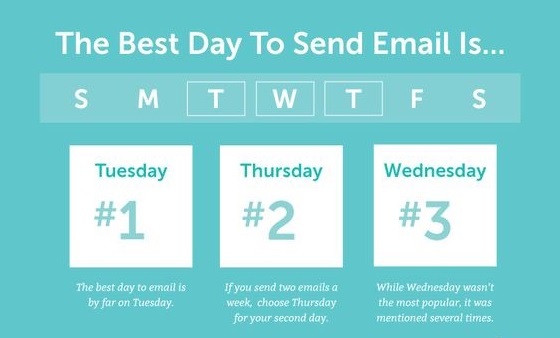
1.Tuesday: This is hands down the #1 best day to send emails according to the majority of the data from these studies.

2.Thursday: If you send two emails a week, choose Thursday for your second day.

3.Wednesday: While no single study showed that Wednesday was the most popular, it came in second place several times

Adapting with changing technology

Lately it’s found that not only are 54 percent of all emails viewed on a mobile device, but this percentage is also on the rise. 

Here are some tips to consider for better open rates and increased interactions:

1.Since mobile click-through rates are lower, you want to be sure your call to action is clear and direct, and that your links are easy to spot and click (no matter what time of day you’re sending).

2.Email open rates also can depend on the device the recipient is using. Tablet users, for example, are more like to open emails outside of business hours (from 5 pm to 8 am), while desktop users are more likely to open during business hours. You can use Email Analytics to track which devices your readers use to open your emails and you’re your campaigns according to how the majority of your subscribers open your messages.

3.Finally, when considering the importance of mobile in your email sends, remember that if your customers can’t read your emails, they’re not likely to continue to interact with them, affecting your future campaigns. Testing a non-responsive versus responsive email design resulted in an increase click-throughs by 130 percent.

Timing isn’t everything

If you notice a dip in your open rates, other factors may be contributing to the decline.

Here are some additional email marketing tips to help with your open and click-through rates:

1.Test your email to make sure it’s rendering properly in multiple browsers and email service providers

2.Review your email list. How old is it? Are there emails that should be removed? Are they the correct decision makers? How can you acquire / grow your email list effectively?

3.Are you effectively rocking your subject line? The subject line is your one brief opportunity to get someone to open your email. Be sure you know the best practices when creating this magic line. Check out how you can use A/B testing to boost the effectiveness of your subject lines.

4.Frequency. Are you sending too often? Be sure to play it cool and segment your lists, so you aren’t bombarding your recipients with unwanted email.

So, when is the best time to send email? As you can see, these are just guidelines to begin with, but one should also test different tactics and see what works with your readers.

B2B Email Marketing Guide

How to make B2B email list building a success?

Where’s the best ROI in online B2B lead generation? Blog posts? Twitter? LinkedIn? Facebook? White papers? Case studies?

Where should you spend lots of your time?

No need to get complex. Think simple. It’s actually your e-mail list.

And absolutely, positively, unequivocally, (say that 3 times fast out loud) no other channel even comes close.

That’s because e-mail has an incredible ROI of $38 for every $1 spent, or 3800%, according to the 2015 DMA National Client Report.

So if you’re not driving prospects to your list, you’re making an embarrassingly bad mistake.

But, the problem becomes, as with anything, knowing what to do to get more prospects on your list.

Don’t sweat! I got you covered. And it’s not super-hard to build your list.

What you need to do:

1. Give Away Freebie Content (Obvious, but what should it be?)

You know you need a “lead magnet” or “free report”…some kind of incentive to get prospects to sign up.

But what would work best?

Ultimately, you never know what could get the max number of sign-ups.

One thing is for sure: your freebie needs to solve a pain for your prospects.

You know what bothers them. So give them the solution.

Try a couple different ones if you obsess with perfection.

2. Strongly Consider “Soft-Gating” Your Content

You know how most B2B, tech, and software companies gate their content, right? Your prospects have to cough up their e-mail addresses just to get at it.

That’s not necessarily wrong.

However, some evidence indicates it may annoy prospects moreso than anything else.

For example, a LinkedIn Business Solutions report suggests 75% of tech pros say they’re less likely to buy from a vendor that gates all content.

That in itself doesn’t mean you shouldn’t gate all your content. After all, tech pros are simply less likely to buy. But it doesn’t say anything about subscribing.

On the other hand, it could show prospects are less likely to subscribe.

The solution? “Soft-gating” your content. That means simply giving your prospects a checkbox option to sign up…or not.

You’ll have to test whether a hard gate, soft gate, or no gate at all entices the most subscribers.

3. Did You Remember “Content Upgrades?”

Do you know what a “content upgrade” is? They’ve caught on a lot for solopreneurs and small B2C or business-to-marketer companies.

But I honestly can only recall one B2B company in the last several months who uses them.

The concept’s simple.

You create a “lead magnet” specific to a blog post. If you write a post about the “Top 9 Benefits of SaaS Recruiting Software,” you could include a free download called “A 20-Question Checklist to Help You Buy the Right SaaS Recruiting Software.”

Helpful tips: You don’t have to create a “content upgrade” for every single blog post. Although you could (and it wouldn’t be a bad idea) if it makes sense.

To understand whether content upgrades would work for you, go to your analytics. Check the following:

Visits (find the blog posts with the most visits)
Time on page (find posts with a good time on page of 1 min 30 seconds or greater)
Bounce rate (look for posts with a bounce rate of 70% or less)
Generally, if your stats fall in good ranges on those, you know those readers like you. So, you have a pretty darn good chance of them signing up.

With the top post, create a content upgrade for it. Content upgrades don’t need to be a huge effort like writing your blog post.

That 20-question checklist from before? That’s all you need – 20 questions. That could take 15-30 mins to write, brand, and save as a PDF.

You’ll want to link to the content upgrade strategically a bit into your blog post. At that point, you know the reader finds the content interesting, and you’re much more likely to get a subscriber out of it (versus placing the upgrade at the end of your post).

After that, all you do is head on down the list of blog posts creating content upgrades until you find it no longer worth your effort.

That’s the gist of content upgrades. Here’s another great resource for further reading and learning on content upgrades.

4. Strategically Use Sign-Up Forms

Do you do what most B2B marketers do and simply slam a sign-up form on your home page and near the bottom of your blog post?

That’s a start. That’s great…but you miss out on floods of sign-ups if you stop there.

Other places to put your sign-up form, and why:

• As an optional embedded form on the right sidebar of your blog (Just look to the right to see this on mine). It works because it gives readers the option to sign up after they’ve found value in you. But it’s not as effective as this next method…

• As a small box that pops up in the bottom right of your screen after a specified time. Again, this gives readers the opportunity to get to know you and like your content first. Then, you ask for the subscribe when they like you more. And finally, the pop-up box captures their attention after getting lost in your content…without being as obnoxious as a pop-up in front of your face in the middle of your screen.

• As a popup in the middle of your screen. This one’s somewhat controversial. All the big-name marketers say it works like a charm. Much better than not-using a pop-up at all.

On the other hand, I have a strong personal grudge against these damn things. They really irritate me. They make me feel like I’m getting scammed out of my e-mail address so the other guy can make some money.

That might not be the truth. But it’s the way I feel. And I wonder if other B2B buyers feel the same way about pop-ups?

If you’re going to use them, as they may be worth a test, I’d again make them a timed release. For example, they only pop up after you’ve been reading for a minute.

If they come the instant you visit the site, you haven’t had any chance to build a relationship. You reader hasn’t gotten any value. And now you ask them for something already.

In my opinion, that’s obnoxious.

But maybe I’m wrong. Anyway, they’re worth a try.

Finally, aside from the discussion of the pop-up, you should have your sign-up form in all those key places.

5. Promote Like a Madman Using Your Existing Relationships (Often forgotten)

Do you promote your e-mail list? Next to no B2B companies do.

Think about all the current ways you interact with customers. A few come to mind:

Your LinkedIn Company Page

Twitter

Facebook (maybe)

Your sales team

Your executive leadership

Conferences

How can you convince buyers to sign up to your email list using each of those?

Some ideas:

Promote the landing page for your lead magnet on social media

Include a link to the landing page on all your e-mail signatures

If leads clearly aren’t ready to close, ask if they’d prefer to sign up to your newsletter instead

Reach out personally to your LinkedIn contacts with a custom message

When you present at a conference, direct everyone to your landing page after you give your presentation

With any close business relationships you have, offer to cross-promote the other company’s newsletter to your list in exchange for the same from them

Now You’re in Prime Position to Build Your List!

For list building, that’s just the start. With the web, you have a nearly infinite number of ways to grow your list.

When you implement those techniques, you’re practically guaranteed solid growth. And your share of that 3800% ROI.

How to Boost Your Sales Campaigns with the Right Database?

The success of the sales campaign greatly depends on the lead information and other sales related data stored in a database. Without access data, you would lose most of the sales opportunities. According to Salesforce consulting companies, there are different ways in which sales campaign can be improved by choosing the right database.

Analyzing old data

The historical sales data is like a goldmine of information. You can get a strategic advantage by using this data and improve sales effort at every sales funnel. For example, you can know which tactics worked best and you can improvise these tactics as per current sales campaigns needs to achieve success.

By using historical data, you can gradually refine your sales approach for different types of customers and achieve an increase in conversion. In order to do this, you need to select the right database that can provide easy access to all your sales data including past leads, sales transactions, opportunities in one place. Historical sales data can prove useful to identify high-value targets and allocate adequate resources to potential opportunities and new leads.

Optimize Pricing

Pricing is an important aspect of a sales campaign. Ask any sales campaign head and he/she will agree the pricing is one of the biggest challenges when introducing a new product. If the pricing is too high, it will drive away customers and if it is low, it will erode your profit margins and sometimes even customer perceptions. Hence, you need to strike the right balance in terms of pricing. In addition to external research, you can scan your database for past transactions and customer base.

The database can be connected to Salesforce CRM. Using the analytical tools in Salesforce CRM, you can segment customers based on different price points and reach an ideal price range based on each customer groups demand, behavior and price tolerance. By combining both external and internal data, you can get the insights needed to determine the right pricing for the product that helps you maximize sales potential.

Visualize Data

Raw data available as records is not useful for analysis. This is because it is time-consuming to sift through huge volumes of data and interpret useful information to boost sales campaign. You need a database that can provide you with a centralized dashboard to view data and perform the analysis. The dashboard should show past data and real-time data in a visual and dynamic manner which makes it simple to reference data to make critical decisions to boost sales campaign.

Salesforce is advanced CRM software that works with wide range of relational databases like NoSQL, Oracle, and PostGRE SQL. According to Salesforce consulting companies, the efficiency of the Salesforce CRM can be greatly enhanced by choosing the right database.

Why Salesforce remains an unbeatable product for business growth?

Customer’s satisfaction is any business entities’ single most important goal. It can be effectively managed over a Customer Relation Management (CRM) system. But, there is a lot to consider when you are choosing first CRM for your organization or migrating from a different platform.

With a plethora of CRMs available in the market offering functionalities aimed at effective customer management to enhance customer satisfaction, Salesforce is the market leader in today’s era and continues to do so since 1999

So what’s about Salesforce CRM that makes it a global industry leader?
It is the way Salesforce CRM suite basically streamlines and automates your business processes across sales, service, marketing and more, that garnered traction of 5Million active users.

Salesforce was the first to launch a CRM on the cloud and offers applications with the key focus on sales and support for small, midsize and big organizations. Technologically it’s designed to bring simplicity, efficiency, integration to take your business to the next level.

Let us check out what is more undercovers:

Salesforce Services:

Salesforce Sales Cloud – It helps to track customer information and all communication at one place and automates complex business processes. It supports both B2B and B2C w.r.t sales, marketing, and customer support by keeping all information up-to-date and integrates social media and real-time customer interaction through Chatter.

Salesforce Service Cloud – It is a service platform for customer service and support. It helps businesses to solve customer problems anytime, anywhere. Only experienced Salesforce Consulting Companies can help you conclude what suits your business needs. Its services include a live agent, helps personalize service, Live Message, Snap-ins and deliver support to customers faster.

Salesforce Marketing Cloud – It is the #1 marketing platform which helps to personalize consumer engagement at scale; integrate every touchpoint across marketing, advertising, sales, service; market smarter with AI; and build a comprehensive view of 1-to-1 customer journey across channels.

Community Cloud – It connects and collaborate with customers, employees, and partners and transforms the way you engage with them. Salesforce has expanded and helps build a community which is critical for your business, from agents to distributors, to partners and, to the customers. It provides a platform for customers to help themselves, enhances customer relationships by allowing customers to interact with each other, allows partners to connect and increase sales, and helps drive employee productivity.

Einstein Analytics – For CRM it’s the first comprehensive artificial intelligence (AI) technology developed to boost business growth and productivity by providing up-to-date views of customers and potential clients. It helps in exploring data from internal and external sources in predefined apps and dashboards, getting AI-powered predictions and stop issues before they arise.

Salesforce Platform – Apps built in within Salesforce platform empowers businesses to build ultimate experiences around the customer. You can customize and extend your CRM solution with myLightning tool. With the AI-powered built-in app for employees, you can automate business processes and provides a consolidated view about customers.

Salesforce IoT – It connects the Internet of Things with the Internet of Customers. It is a platform that turns data generated through various sources – customers, agents, partners into meaningful action. Sales IoT allows users to process massive data, add customer context to it and develop meaningful interactions with customers in real time.

To Summarize

Salesforce platform and technology provides endless possibilities and great potential for business growth. All you have to do is hire the right Salesforce Consulting provider among various Salesforce Consulting Companies offering CRM services as mentioned above. Ultimately collaborating with a Salesforce consulting provider should result in elevating your business to the next level.

Why is marketing automation so important in today’s world?

Marketing automation enables businesses to automate tasks and workflows for the market. Its pronounced benefits are seen in marketing and sales process primarily. “Marketo” is an example of automated marketing business. The process includes prospect and customer profiling, lead scoring, sending automated personalized emails and web recommendations to support the lead nurturing and customer engagement.

This integrated solution enables the companies to identify and nurture prospects using highly personalized, and valuable content based on their online behaviors. This helps to convert these prospects into sales-ready leads. It aids to turn those customers by enhancing the lead nurture process and prospect engagement to deliver a reduced lead cycle and up to 53% increase in the ROI.

Functioning of marketing automation is in a defined way. It attracts prospective base through content and promotions. These customers are converted to regular visitors by contact management and landing page call to action forms. The lead scoring and nurturing turn them into potential customers. The success is finally guaranteed and a report showing the analytics dashboard is framed.

The automation market is growing at a rapid pace and Marketo Customers are able to stay competitive with automation support. In such a scenario, marketing automation is a category of technology that allows companies to streamline, automate and measure marketing tasks. This helps them to increase operational efficiency and grow their revenue faster.

As per the graphs and trends, 92% companies lose their money every month because they ignore automated marketing. A full quarter of companies that adopt marketing automation boost revenue between 30 and 49 percent. According to a new study by RazorSocial’s Ian Cleary, another 20% of companies see a revenue jump between 15- 30 percent.

5 pros and cons of Automated marketing model:

1.Increased qualified leads: businesses that use automated marketing to nurture their prospects see a 451 % increase in highly qualified leads.

2. Too much complexity: one in four marketers still find this method complex and tardy. They find it difficult to operate and work efficiently.

3. Track efforts: companies with marketing automation operations are 36% more likely to track their marketing efforts to multiple touchpoints.

4. Advanced assets: only 38% of marketers that use marketing automation have used advanced assets like progressive profiling.

5.Goals: Marketers use marketing automation to generate higher quality leads and to increase their turn over.

An apt conclusion would be that through marketing automation can be complex, when used correctly, it can be valuable. There is no point making excuses for not using it.

What does it do:

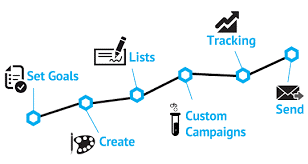
1.Build targeted lists

2.Execute the campaign

3. Measure email/website behavior and activity

4. Segment based activity and score leads

5.The qualified route leads to CRM

6.Moves warm leads to nurture cycle.

7.Analyze marketing/ sales performance.

The dynamic duo of Marketing automation and CRM platforms are complementary to each other. They are like a match made in heaven! While MA helps with reaching out to the right people, CRM aids in handing off from marketing to sales.

A perfect strategized business must invest both in CRM and marketing automation.

“Marketo” is the best marketing automation tool. It is a software company which is based on account-based marketing. It is a SaaS platform for a series of functions like lead tracking, website personalization, Social marketing, Search engine optimization, lead nurturing etc. Be among the prospective customers to enhance your revenue and business. This platforms is mainly used by the MSME companies to speed up their profits. It offers customized products for the industries.