


Your sales team purchased a ‘healthcare contacts’ database containing 50,000 leads. Three months later, conversion rates hover at 1.2% while your team wastes hours calling dental offices when you sell hospital revenue cycle software. The problem? You’re missing vertical industry intelligence. Without vertical industry intelligence, generic databases categorize vastly different organizations under single industry labels. They treat 10-bed urgent care centers the same as 500-bed academic medical centers.
For B2B companies selling into specialized markets, this lack of vertical industry intelligence costs more than wasted calls. Research from Gartner shows 60 to 70 percent of ‘industry-matched’ contacts from generic databases prove poor fits when you need specialty-level precision. The specificity gap between what vertical sellers need and what generic databases provide creates systematic failure and only vertical industry intelligence closes it.
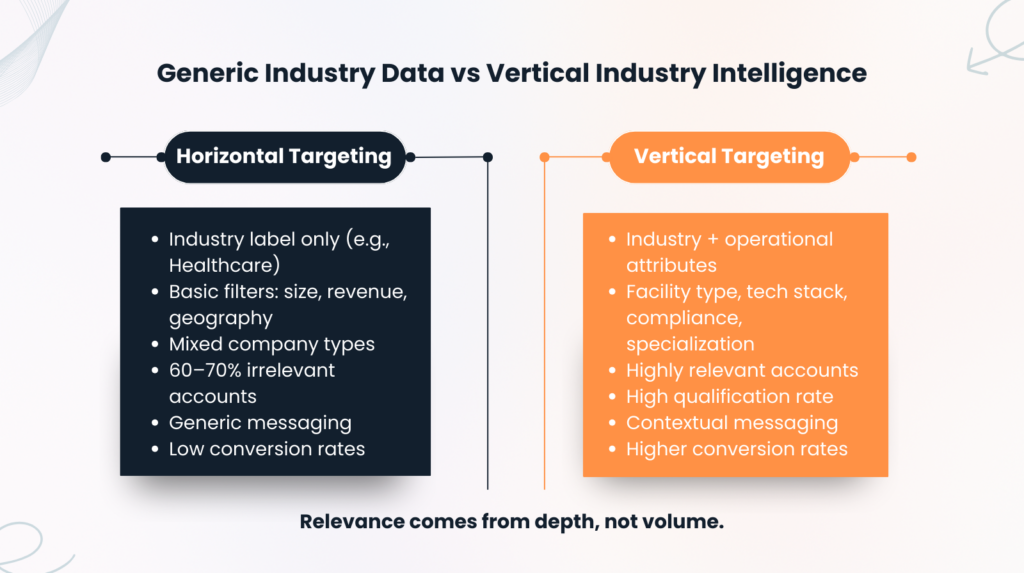
The Generic Database Problem
Traditional B2B databases mainly provide data based on primary firmographic factors such as industry, company size, location, and revenue. However, these characteristics are just the tip of the iceberg in understanding how businesses function within their sectors.
When you search for “healthcare companies with 100-500 employees,” you don’t just get hospitals, you get everything from dental practices and home‑health agencies to urgent care clinics, surgery centers, and even medical device distributors or pharma sales teams. The problem is that all of these organizations operate completely differently. They follow different regulations, use different technology, and make purchasing decisions in totally different ways. Grouping them together might look fine on paper, but in reality, they’re nothing alike.
Selling revenue cycle management software to this undifferentiated list means pitching hospital-focused solutions to dental practices with no claims processing needs, approaching ambulatory surgery centers that outsource billing entirely, and contacting medical device distributors who don’t bill patients at all. The result: 70 percent of contacts waste sales cycles before discovery calls reveal fundamental misalignment.
The expense to the company is obvious. For instance, if buying a “healthcare lead” costs $50, and only 30% of those leads fit your actual target profile, then your real cost per qualified lead will be $167. If you multiply this by the number of contacts in the thousands, the budget will total millions every year.
Packed Data Services suggests that to be successful in vertical sales, one must look beyond SIC codes and dig account intelligence that uncovers a company’s real working profile. Generic databases were made to scale, not to be specific.
Today’s B2B growth is a matter of relevance, not the extent.
Industry-Specific Attributes That Power Vertical Industry Intelligence
Vertical intelligence is essentially constructed using traits that mirror actual world operational and regulatory situations.
Targeting within healthcare is based on several key factors: facility type (hospital, clinic, urgent care, ASC, LTAC), number of beds and patients, clinical specialties (cardiology, oncology, pediatrics) along with EMR/EHR used (Epic, Cerner, Meditech), payer mix regardless of Med/Med, or private insurance; and accreditation status. For example, if you have an Epic powered hospital solution and tried to target a very small clinic using different systems than Epic, you will miss your target completely.
Important Characteristics for Financial Services verticals: Institution Type (Bank vs. Credit Union vs. RIA versus Broker/Dealer), Asset Under Management, Required Regulatory Registration (SEC, FINRA, State), Custodian & Technology Platforms, and Client Segmentation (Retail vs. Institutional vs. UHNW).
If you don’t have a solid understanding of all these attributes, your targeting and segmentation aren’t going to be much more than just an educated guess instead of a plan for how you’re going to go about accomplishing your objective.
Attributes of Manufacturing that make segmentation meaningful include:
Production Type (e.g., Discreet, Process, Batch), Industry Segment (e.g., Automotive, Aerospace, Fast-Moving Consumer Goods (FMCG)), Required Certification(s) (e.g., ISO, AS9100, FDA); the certifications included here typically correspond with each type of production described, Machinery, Equipment types being used, Where you fit within the supply chain (E.g., Original Equipment Manufacturer (OEM), Tier II Supplier). A provider of automation software for the Tier 1 automotive manufacturers should not depend on the general “manufacturing” filters.
The critical attributes of education include the institution’s (K-12, higher education, vocational, charter), the enrollment size (large/small), the public/private status, the profit/non-profit status of institution, if the institution has institutional accreditation or programmatic accreditation from an outside agency and the types of LMS and SIS platforms being used. These attributes along with those above are used to determine the appropriateness of an institution but also have a direct impact on the type of messaging, pricing, and procurement cycle used to sell to the institution.
How Vertical Industry Intelligence Transforms Your Targeting
The transition from horizontal to vertical data is not just an upgrade of your marketing funnel but a complete overhaul of your funnel metrics.
Before vertical intelligence, a normal campaign might aim at “all hospitals in the U.S. ” Total number of organizations: 6,000+. Misalignment rate: About 70%. Conversion rate:1-2%. Messaging: generic and non-resonant.
With vertical intelligence, the target is “200 bed acute care hospitals with Epic EHR in the Midwest having cardiology programs.” Total prospects: around 150. Qualification rate: high. Conversion rate: 8-12%. Messaging: very relevant and contextual.
The math is compelling. Smaller lists with higher relevance consistently outperform large generic lists. Fewer prospects times higher conversion equals better cost per acquisition. Better fit equals shorter sales cycles. Higher relevance equals stronger brand recall.
This is the shift from volume-based targeting to precision-driven growth.
Packed Data Services’ Vertical Market Coverage
Modern B2B teams need more than static firmographics. They need real-time vertical intelligence. Packed Data Services addresses this gap by combining deep industry taxonomy, vertical attribute filtering, and technographic intelligence by vertical.
Instead of 1-2 levels of classification, Packed Data uses multi-layered industry frameworks that reflect real operational structures. Users segment accounts based on industry-specific characteristics such as technology stacks, compliance status, operational scale, and regulatory frameworks.
Packed Data analyzes how different industries adopt technology so teams can see which tools organizations use, identify integration or replacement opportunities, and assess compatibility. In highly regulated sectors such as healthcare, finance, and manufacturing, it also helps eliminate companies that lack the required certifications, licenses, or compliance standards.
Packed Data merges vertical characteristics with buyer intent data, ICP scoring, and AI, powered lead prioritization. The targeting is not only industry, relevant but also purchase, ready because of this. Through enriching the existing CRM records with vertical intelligence, Packed Data facilitates teams in leaving static datasets behind and moving to dynamic account intelligence.
Building a Vertical Sales Playbook with Industry Intelligence
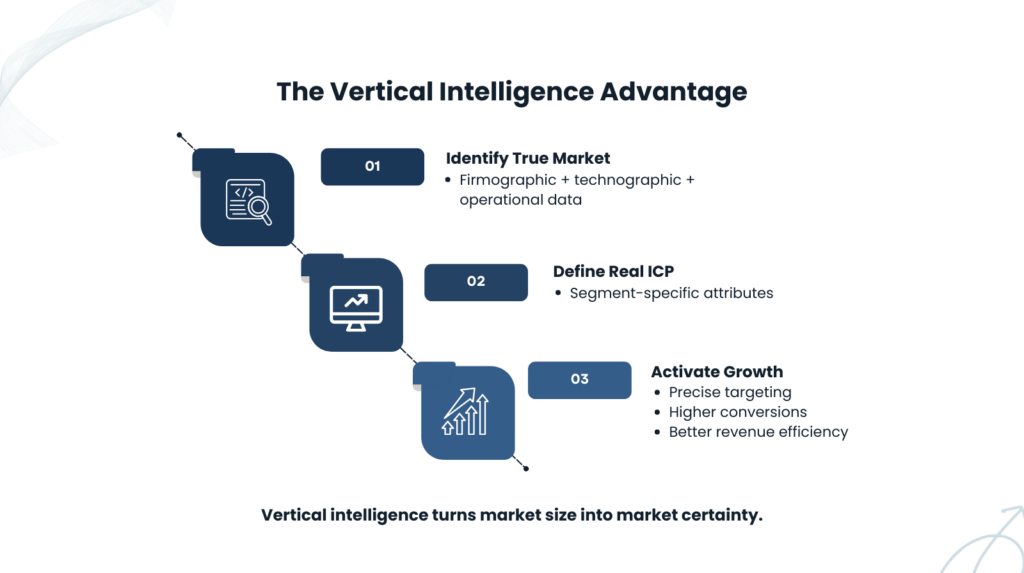
Vertical intelligence is not a data strategy alone. It’s a go-to-market strategy.
Before targeting a vertical, teams must understand regulatory environment, typical buying committees, technology maturity levels, and competitive dynamics. Packed Data’s account intelligence capabilities help organizations map these factors at scale.
Vertical intelligence is what allows sales and marketing teams to communicate with their audience in the same language or vocabulary. For example, they refer to industry, specific terminologies, address role, based pain points and offer contextual value propositions. A hospital CIO would be interested in one set of messaging that a dental practice owner may decide to ignore completely.
Vertical markets communicate through different types of channels: industry associations, trade publications, conferences and events, and specialized online communities. By utilizing data-driven vertical insights, marketers can focus on the most effective channels first. In order to take vertical intelligence from theory to practice, businesses need to provide their sales force with at least industry primers, vertical case studies, competitive intelligence, and compliance awareness. Packed Data’s analytics and enrichment tools help to facilitate this process by converting raw data into actionable sales intelligence.
As industries get more specialized and regulated, top, level industry labels won’t be enough anymore to initiate successful customer engagement. Vertical industry intelligence, which is a combination of firmographics, technographics, intent signals, and regulatory insights, is the next step in B2B data strategy.
If a company wants to improve targeting accuracy, quicken pipeline velocity, and uplift conversion rates, the future of B2B growth is not in broader databases. It is in deeper vertical intelligence.
Packed Data Services make this transition possible by turning fragmented datasets into real, time, vertical, specific insights, thus allowing sales and marketing teams to switch from generic outreach to precision, driven growth.