


Admin Jul 21st, 2026

The sales team claims the pipeline is at $10M. Marketing says $8.5M. Finance has it at $9.2M. Three systems, three numbers: this is cross-system data conflict in action, and by the time management gets involved, the strategy conversation has already been replaced by a fight over which dashboard to trust.
It is neither a reporting issue nor a minor system integration challenge.
According to Gartner, data quality issues cost companies an average of $12.9 million every year. In 2025 research, 95% of decision-makers reported that data conflicts made it “difficult or impossible” for them to meet their digital transformation objectives, and over 50% said that their companies lost money due to it. Data conflicts between systems lead people to distrust any single system, use manual reconciliation and lose decision speed achieved with the help of data investment.
Cross-system data conflict resolution is not just about cleaning up the mess for RevOps leaders. It is a revenue strategy.
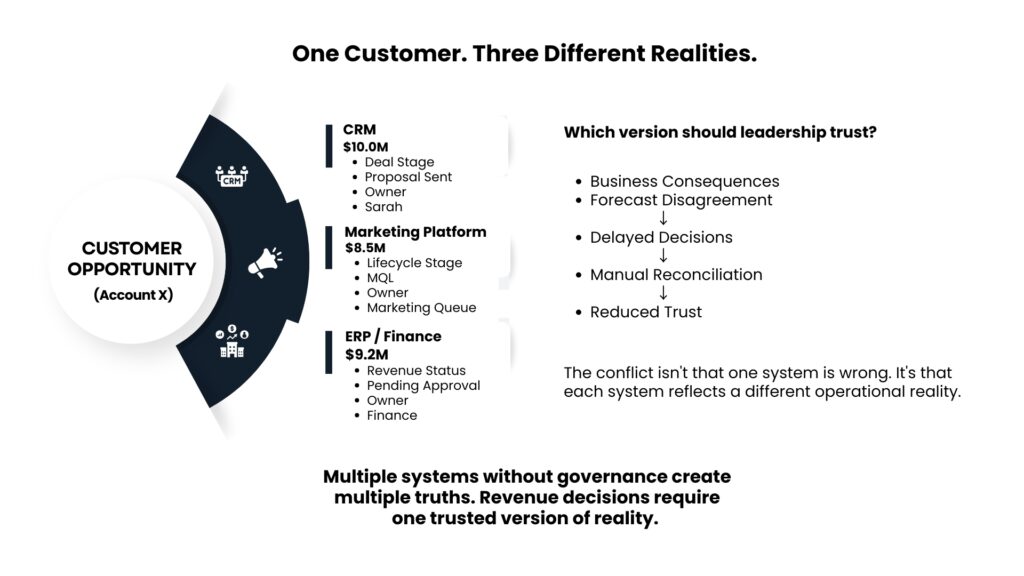
Each element of today’s revenue stack was designed to solve one problem. The CRM system handles opportunities. Marketing automation systems track engagement. The intent platforms watch the purchasing behavior. The ERP systems track financial transactions. All these capture their own valid piece of the customer experience.
The trouble starts when there is an expectation that those pieces should come together into one picture without any intermediate reconciliation step. Marketers see each form submission as a lead. Sales reps see only verified and assigned contacts. The finance department counts the booked revenue. The same customer process gives you three different metrics based on which system you use.
It is not a technology issue. It is a structural hole that becomes wider with the growing stack.
Most cross-system conflicts trace to one of three structural failures.
Systems update at different rates of frequency. The sales rep can update the CRM system in real-time while logging a call, while the system updates marketing automation in batch at night. The team updates the data warehouse weekly. During that period, two systems will display conflicting states of the same record.
In the case of fast-moving pipelines, the delay in synchronization is sufficient to direct the follow up in the wrong direction for a time-sensitive opportunity. A lead that closes at 9 am may still be displayed as unqualified at 2 pm in the marketing automation platform.
In case integration between systems happens using native or middleware approach, field mappings will be set up once and never audited. Field names get renamed, new custom fields are added, and picklists are updated. All of this causes the field mapping to break, although data keeps moving in. An “Offer Sent” deal stage in CRM will map to an “Engaged” status in the analytics layer for months until somebody finds the cause of forecasting problems.
For most companies, no hierarchy defines which system should win in such situations. When the CRM and the enriching platform show different figures on the number of employees in the organization, which figure should we use to calculate the ICP score? Lack of hierarchy makes all further decisions ambiguous, and people pick numbers depending on what they need to do at the moment.
Data inconsistency comes with an associated cost in terms of pipeline, productivity, and forecast accuracy.
According to Validity, the rate of decay for B2B contact data is 30% to 40%. By the time Q3 comes around, the enrichment of data done at the beginning of the year has already gone bad. In case the CRM does not reflect job promotions, company reorganizations, or people leaving companies, sales reps will be contacting the wrong people and giving priorities to the wrong accounts based on ICP criteria.
SiriusDecisions conducted a study which indicated that sales representatives spend up to 27% of their time on non-selling activities. In many cases, this time is spent checking and fixing the inconsistent data before any outreach is made. This amounts to at least one day per week lost because of the problem of data. It would definitely be an inconvenience to lose 5 percent of inbound leads in a $50M pipeline target.
Forecasts face the same problem too. As deal stages update irregularly in both CRM and deal desk software, sales managers adjust forecasts either on the higher side or lower depending on their requirements. This results in biases instead of facts.
To read more about data decay and how to deal with it, click here.
However, all data inconsistencies are not equally risky. By analyzing data inconsistencies based on two metrics: Revenue Proximity and Conflict Frequency, RevOps teams can identify areas that will have the highest impact on the pipeline.
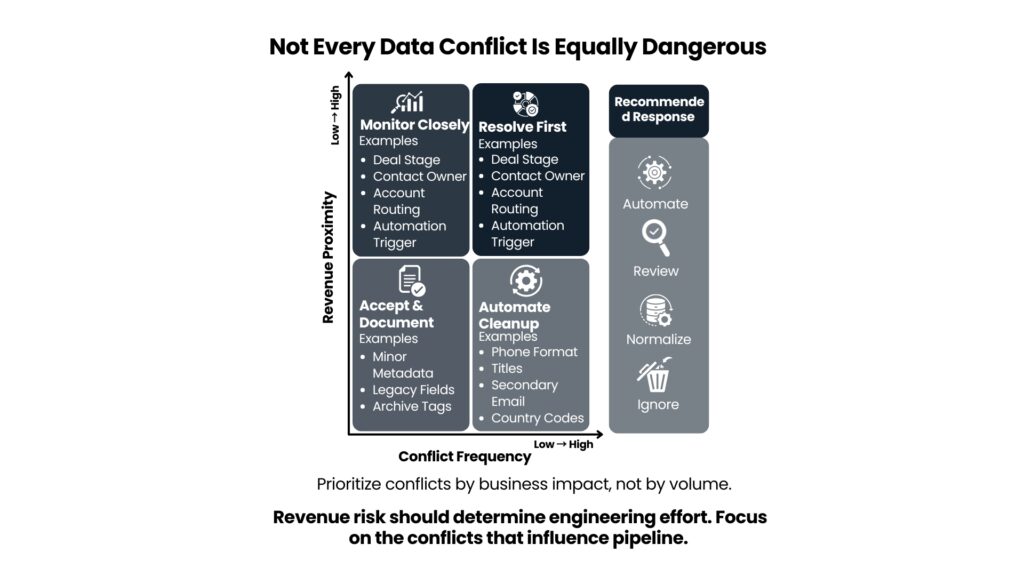
High Revenue Proximity, High Frequency: Deal stage, contact ownership, and account routing are included in this category. They need automated conflict resolution rules as well as designated source of authority. Take care of that first and apply automation to make sure you don’t have to deal with manual resolution at scale.
High Revenue Proximity, Low Frequency: Firmographics on named accounts may rarely be conflicted, but if that happens it may impact ICP scoring or executive routing. Address the conflict as soon as it pops up using conflict detection, refreshing of enrichment, and manual validation.
Low Revenue Proximity, High Frequency: Formatting of titles, phone numbers, secondary emails. Batch reconciliation weekly using normalization. Do not allocate manual review resources for those.
Low Revenue Proximity, Low Frequency: Accept, document, and deprioritize. Not every conflict requires an engineering effort.
This approach prevents RevOps teams from considering all data conflicts to be equally urgent – one of the main reasons why conflict resolution initiatives fail.
For cross-system data conflict resolution to occur, one must make two key decisions:
Which is the authoritative source and how reconciliation takes place in practice.
Pipeline and deal data: CRM is authoritative. No external system overwrites deal stage or close date.
Contact demographics: most recently verified source wins, with enrichment at record creation, re-enrichment at first engagement, and quarterly audits.
Firmographic data: designate a single enrichment provider as primary; flag conflicts from secondary providers above a defined threshold rather than auto-updating.
Intent signals: treat as additive, not substitutive. Layer third-party intent as a separate scored attribute that informs prioritization without overwriting first-party behavioral data.
In terms of which is the authoritative source, two processes can help here.
Event-driven reconciliation checks all other systems through a validation test whenever there is a specific event, like changes in a deal stage or a new MQL, ensuring that bad data does not spread before it does any harm.
The threshold-based conflicts alert system identifies a review request whenever the value for a field differs between systems past a certain point, sending the problem to a data steward of RevOps rather than having automation pick a value.
Very few organizations require a new system. What is actually required is a governance layer that exists above all systems and reconciles conflicting input prior to it reaching operational flows.
There are three architectural styles that can accomplish this at various levels of maturity.
Customer Data Platforms aggregate first party behavioral data and give a single profile that all systems read. It works best when there is a complicated multi-channel engagement in place.
Revenue Operations platforms that have a native two-way sync capability tend to incorporate conflict resolution into their capabilities.
Building a custom data warehouse together with reverse ETL solutions like Census or Hightouch gives you maximum control but you need a mature data team to manage it.
No matter what architecture we use, we have three non-negotiables: field-level data contracts that determine the meaning of every field in every system; change logs that track any change and identify its source, timestamp, and previous value; and periodic conflict audits that see governance as a continuous process rather than a project.
Users tend to view cross-system data conflicts across systems as housekeeping problems, and that’s precisely why the problem won’t go away. Companies invest in better analytics solutions and AI scoring models without sorting out their data infrastructure. The results look great. The data still conflicts.
The companies solving this problem aren’t those with the fanciest stacks. It’s those that decided what sources to prioritize, what logic to use to reconcile them and how to assign responsibility in case of differences. Sales teams trust the priority score because it’s based on clean data. Marketing teams trust the segmentation because accounts mean the same thing everywhere. Executives trust the forecast because there’s only one number in the pipeline.
Making better decisions isn’t about having better dashboards. It’s about having one clear view of reality and that starts by deciding which system each team will trust.