


Admin Jul 7th, 2026

Most B2B firms are not being outcompeted by firms with more data; they are being outcompeted by firms with faster intelligence. Distributed intelligence in RevOps solves this directly: it embeds analytical capability into the tools GTM teams already use, so insights arrive at the moment a decision is being made, not two days after the window has closed. Data pipes already run in real time. Enrichment tools self-activate. Intent signals surface within hours. The bottleneck is never the data; it’s how long it takes to turn that data into a decision.
As shown by a 2025 RevOps benchmark survey of 58 revenue-oriented firms, 72% of GTM teams took between 48 and 72 hours, or even longer, for analytics assistance while working with real-time data pipelines. A separate 2024 survey also revealed that 68% of GTM teams used to submit analysis tickets to centralized analytics teams, receiving responses within two to three days on average.
In addition, according to McKinsey’s research on the B2B buying journey, 73% of opportunities have a “moment of maximum influence” lasting on average 36 to 72 hours. The arithmetic is obvious: centralized analytics inherently misses the opportunity to act.
Distributed intelligence for RevOps solves the problem: an architecture that embeds analytical capabilities directly into business operations and is designed to provide insights at the pace of GTM execution.
Centralized analytics worked when there were few experts in the field of data. Centralized analytics is now irrelevant due to the speed of the contemporary GTM approach.
Let’s look at one example of a flow of requests: RevOps Manager needs cohort-based retention analysis for pricing decisions. They specify it (1-2 days), but they put it on hold because of other priority projects (2-4 days). Eventually, they complete it, but it doesn’t provide the necessary insights and requires some iterations (3-5 days). Total time spent: 7 to 14 days for analysis that should take only 20 minutes with proper infrastructure.
Forrester’s 2024 Analytics ROI study found that organizations with centralized-only models make 3.7x fewer data-informed decisions per week than those with distributed capability. HubSpot’s 2024 State of Revenue Operations report found that analytics teams at high-growth companies receive 4.2x more requests than they can fulfil. A Harvard Business Review Analytic Services study revealed that companies make 61% of revenue decisions using data older than seven days, despite 82% of respondents acknowledging that conditions in their sector change weekly or faster.
Centralized analytics also creates knowledge fragmentation. Analysts understand how to model the data and how to define the metrics. GTM teams do not. They consume static dashboards without understanding the underlying logic, deepening dependency and slowing adaptation.
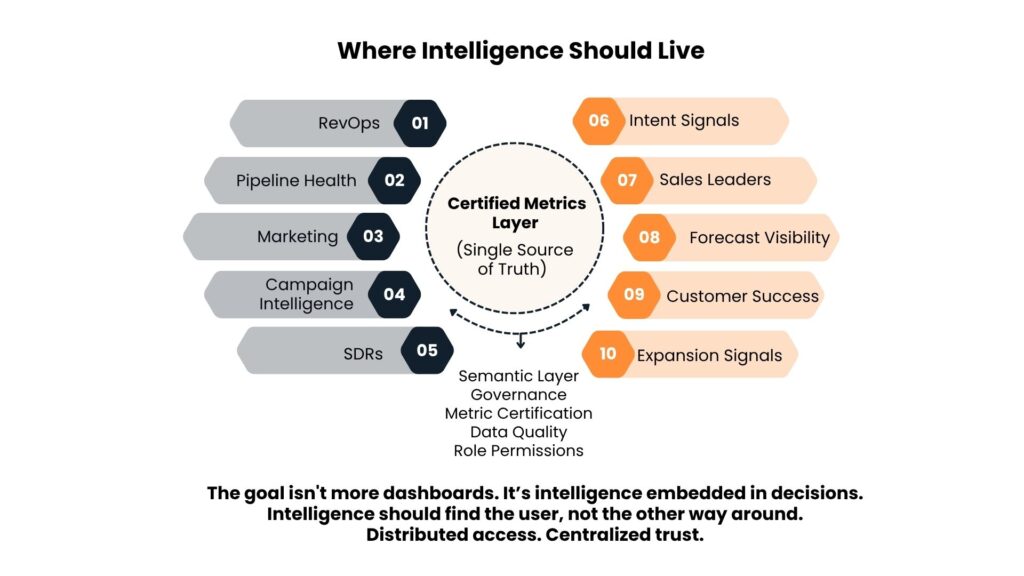
Distributed intelligence for RevOps is not about granting SQL access to all or deploying more dashboards. This architecture concept states that intelligence should be present where decision-makers operate, and governance should be part of the infrastructure, not gatekeeping.
It implies three concepts in practice. Embedded intelligence: analysis embeds in GTM tools, so that routing signals appear in Salesforce, performance metrics display in Outreach and Hubspot, and enrichment/intent signals reach SDRs within sequence. The intelligence finds the user. The user does not need to chase it.
Self-service with governance: GTM squads are able to play around with segments, analyze cohorts and compare performances between different experiments without opening tickets. Role-based access, pre-built metrics logic, and automatic data quality control set the boundaries of the freedom.
Workflow design that aligns with speed: insights coming at the rhythm of decision-making. Dashboards for marketers everyday. Near-real-time signals for SDRs. Pipeline analysis for leaders weekly, not monthly.
It’s not about getting rid of the central analytics function; it’s about shifting the focus of their efforts to modeling and forecasting, while GTM functions take action based on those insights.
Distributed Intelligence needs more than access to an infrastructure. There are three things that enable this system.
The semantic layer serves as the base. This layer sits between the data warehouse and the business users and translates the schema into business language. The metric definitions are also standardized across all consuming applications. No matter who requests a query, the term “churn” will be consistent. According to a 2024 RevOps benchmark study, companies that used self-service BI driven by semantic layers saw a 39% decrease in ad hoc analytics tickets and a 27% increase in GTM experiment volume. Airbnb has reported 64% fewer metric discrepancies when using the semantic layer internally, replacing multiple analyst versions of revenue metrics with a single version.
You can read more about the data interpretation framework here.
It is at the juncture of the semantic layer and governed self-service BI where most companies tend to go wrong. As per a case study of 2025 RevOps, usage of self-service BI without the inclusion of semantic layer led to 52% higher number of queries and 8% rise in GTM experimentation, due to the inconsistency in results. Companies which made use of both observed 48% higher number of queries, 34% higher GTM experiments, and 29% lower disputes regarding metric definitions.
Third component comprises of a metric glossary which consists of GTM-specific definitions for each of the important metrics used, along with the warehouse view and transformation logic behind each of them. As per a benchmark study of 42 RevOps environments done in 2024, it helps in reducing re-explanation by analysts.
This is a valid criticism of distributed intelligence, since, without governance, each team will have its own approach to calculating revenue, and the organization will have no one true source.
A research done in 2025 in RevOps proves this point. Unstructured self-service organizations had 63% more disagreements about metric definitions, 41% more cases of shadow analytics (spreadsheet models conflicting with dashboard metrics), and 22% higher experiment quality churn. Instead of bringing back governance, the fix is to bake it into the system.
Traditional governance has control over what is analyzed through approvals. Distributed governance has encoded standards within the code. Metric definitions have versioning and certification. When a group runs an analysis on the monthly recurring revenue, they invoke a certified method and do not build a formula.
It solves the paradox of governance where centralized and distributed are seen as opposites. Centralize standards and infrastructures. Distribute the executions and explorations. Companies that strike the right balance execute 21% more GTM experiments per quarter, encounter 19% lesser decision latency, and yield 13% greater pipeline to revenue ratio from data-driven activities, according to the 2024 RevOps benchmark.
Readiness assessment must be done systematically. The Distributed Intelligence Maturity Model evaluates four dimensions, rated on a scale from 0 to 5.
The Self-Service Depth dimension assesses whether the GTM teams can do the analysis using semantic models. The Governance Maturity dimension checks whether the metric definitions are followed and also if they include data quality SLAs. The Workflow Integration dimension checks whether the insights integrate into the routing, sequencing, and campaign management applications.
Benchmarking distributed intelligence RevOps maturity requires assessing four dimensions and the DIS score calculates an average of the four dimensions. Businesses that achieve a DIS score of 4.0 or above in 18 months have seen a decrease of 45% in analytics tickets, an increase of 39% in the number of GTM experiments, and have created 19% more pipeline via their analytics projects, according to a RevOps case study from 2025.
Most businesses find themselves in between Stage 1 (reactive ad hoc extractions) and Stage 2 (BI centralized with scheduling). It is the businesses at Stages 3 and 4 that have the advantage.
First, map where GTM teams currently source their intelligence and measure analytics ticket volume and latency. This becomes the baseline for identifying where intelligence latency has the greatest effect on revenue.
Build the semantic layer ahead of scaling intelligence access. Develop pre-built models for pipeline health, conversions, churn, and campaign performance. Enforce these definitions in BI tools before providing access to self-service.
Deploy governed self-service with role-based permissions and enablement. Track usage patterns and retire any shadow models that exist outside the stack.
Integrate insights into current processes as opposed to building out new dashboards. Less decision-making without data is the objective here, not more information sources. The ability to trigger intent alerts and pipeline risk triggers within the processes GTM teams already use is what drives adoption.
Monitor and communicate impact. Measure reductions in ticket volume, experiment cadence, and pipeline contribution from data-driven experiments. Distributed intelligence is an organizational investment. Its value must be tracked and communicated to ensure ongoing commitment.
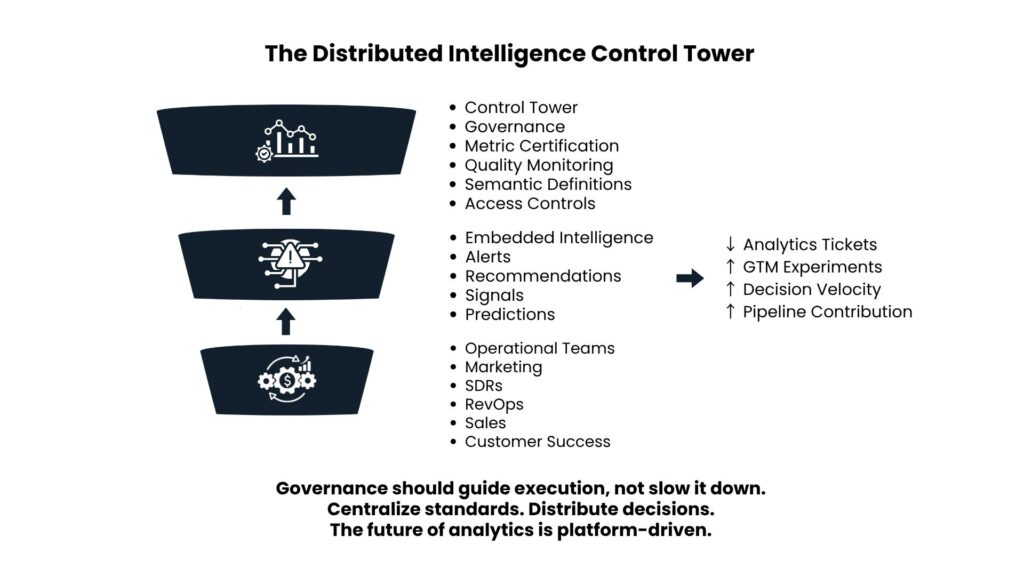
In most B2B companies, the challenge is not a lack of data; it is a lack of access to insights. The speed of data collection through pipelines is quick. The speed of translating it into decisions is not.
Distributed intelligence solves this dilemma by placing analysis power at the decision points, standardizing definitions at the infrastructure layer, and allowing GTM teams to decide without asking for permission. Centralized analytics goes from service delivery to platform creation, providing tools for others to ask and answer questions themselves using clean data.
Companies succeeding in a world driven by data are not the companies that have the most data. They are the ones who move insights fast enough to affect decisions. The best decision today is always better than the perfect decision tomorrow. Distributed intelligence for RevOps is the answer to making today’s decisions with tomorrow’s insights.