


Admin Jul 2nd, 2026

If a B2B company fails to meet its quarterly goal, the post-mortem rarely names the real culprit: the cost of poor data governance. But the evidence is in the data itself; sales worked duplicate accounts, marketing used different lead definitions than sales, and customer success missed churn signals because ‘last contact date’ lived in three different systems. The problem isn’t effort or technology. It’s ownership.
Gartner reports that poor data quality results in losses amounting to $12.9 million annually for firms. According to IBM, global economic damage runs into the trillions of dollars each year as a result of inefficiencies and friction arising from bad data.
A study benchmarked against a sample size of 64 companies adopting a RevOps approach in 2025 discovered that those with low levels of data governance spend 27% more time fixing bad data, are 19% late in launching their GTM strategies, and face 14% higher churn rates among premium clients because of data quality issues. The bottom line does not reflect these losses.
What matters at the root of the problem is structural: data governance in most firms has become a box-ticking compliance issue, rather than a money-saving one.
For most companies, data is considered a communal resource. On paper, this seems collaborative enough. In reality, it leads to diffusion of responsibility, which leaves problems unresolved because nobody has the power and motivation to fix them.
A 2024 survey by RevOps involving 89 organizations revealed that 63% lacked a governance framework, 57% couldn’t determine ownership of various GTM data assets, and 42% had multiple definitions of “pipeline” or “at risk for churn.” Four key questions reveal that there is no clear owner for data within any organization: Who owns the customer data? Who establishes core metrics? Whose responsibility is it to handle data enrichment and data cleansing? Who governs definition and pipeline modifications?
Lack of consensus or answers to such questions is when economic friction starts.
The cost of poor data governance shows up in four predictable ways, most of which never appear on a P&L.
Without a credible source of truth, every team creates its own. Sales creates its own pipeline model, marketing its own logic of attribution, and RevOps its own reconciliation layer. A RevOps use case from 2025 showed how one company was wasting 11,000 analyst hours per year re-running analyses that could have been done just once. With a cost of $150 per hour, this comes to an annual waste of $1.65 million in analytics alone.
With every team owning its respective part of the data, executives receive contradictory information about the same time frame. They request confirmation from another source; teams do the same analysis again to “validate” their findings, and the process continues every cycle. This cycle is a classic symptom of poor data governance; decisions delayed, strategies destabilized.
A benchmark conducted by the same source in 2024 found that organizations suffering from poor data governance practices spend 26% more time finalizing their go-to-market strategy, undergo 18% more midcycle adjustments, and generate 13% less ROI because of decisions made based on unstable data.
TOPO’s 2024 Revenue Operations Benchmark revealed that B2B firms with inconsistent metrics take 23% longer to close deals and incur 31% higher customer acquisition costs than their competitors.
Weak governance is increasingly becoming a liability. Unclear ownership blocks consent monitoring, compliant enrichment use, and audit history demonstration. A 2025 study found 41% without good governance had GDPR/CCPA breaches vs. 17% with solid practices. The average penalty for a GDPR violation stands at six to seven figures.
Poor ownership leads to increased expenses for vendors and engineers in an invisible manner. Poor governance cost 29% more on vendors, 42% wasted enrichments, and 1.5× more pipelines per 2024 benchmark. It is costly to accumulate too much data because organizations acquire a lot of data but never make use of them due to poor ownership of decisions.
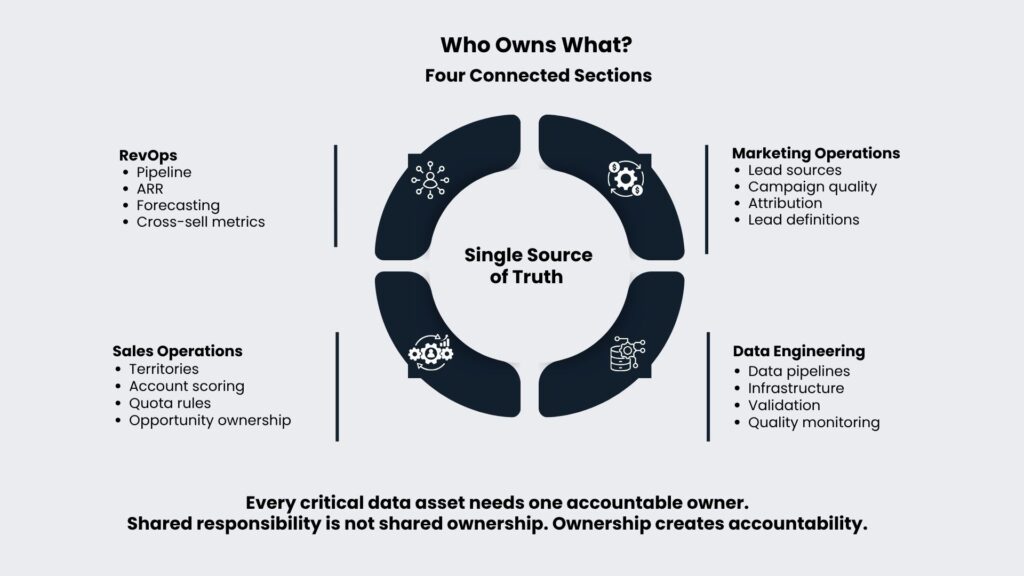
Data ownership is an economic process rather than a bureaucratic one with tangible benefits.
Companies that allocate data stewards for GTM metrics experience 31% shorter data reconciliation time within 12 months, achieve 47% improvement in stability of metrics, and have 12% quicker decision-making process for GTM initiatives. Data stewards are responsible for definition of data, its pipeline management, quality standards, and communication of changes. RevOps owns pipeline/ARR/churn; Marketing Ops leads sources/attribution; Sales Ops handles scoring/territory; Data Engineering manages infrastructure.
The best governance programs do even more than that: They make data quality part of performance measures. If a RevOps VP pay ties to duplicate rates or field completeness, data quality becomes a core capability, not an afterthought.
When the process of identifying poor data quality evolves from being reactive and manually driven to proactive and automated, the difference in cost can be anywhere from tenfold to a hundredfold. The price of the steward is far less than the cost of addressing compliance problems or dealing with high-level reporting crises.
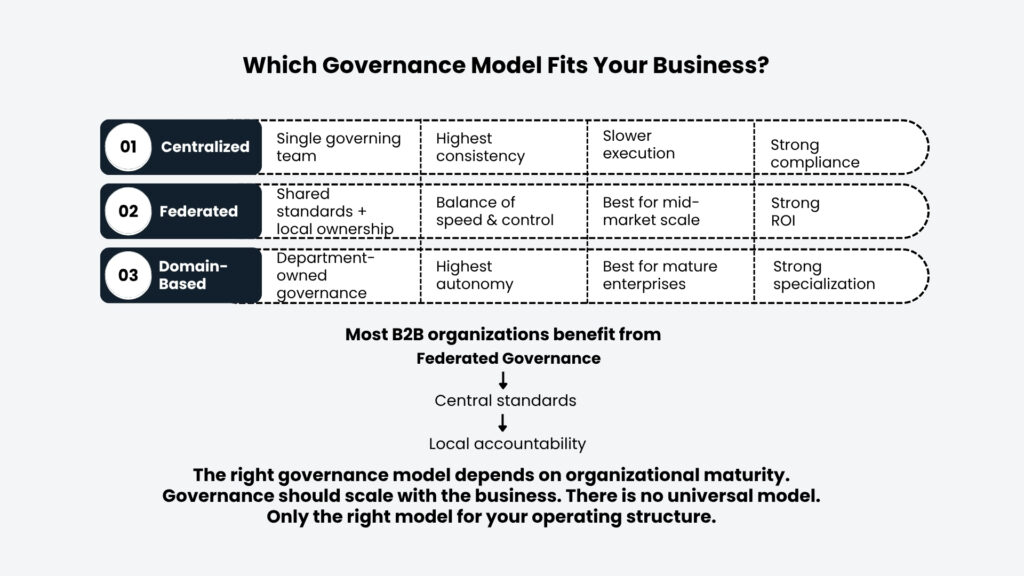
There are three major architectures of the structures managing enterprise data resources, each having its pros and cons.
The centralized governance architecture involves centralized management by the responsible team which is either RevOps or an enterprise data council. The structure guarantees high-level compliance but creates a bottleneck for GTM teams. The approach fits those organizations employing between 200 and 2,000 staff members where strict standardization is needed.
The federated governance architecture involves decentralized management of data among various functional leaders within the company whereas central office ensures cross-departmental standards. The approach combines domain knowledge with velocity but needs strict adherence to standards to avoid fragmentation. According to the findings of SiriusDecisions, federated governance structure brings the highest ROI for companies whose B2B revenue exceeds $50 million but not more than $500 million.
The domain-based governance is characterized by decentralized management of data resources on the department level: RevOps manages pipeline and ARR metrics, Marketing Operations manages lead attribution, Customer Success manages customer health and churn signals.
To translate governance maturity into executive-level ROI, a rigorous measurement approach must be used. The Governance Value Scorecard (GVS) consists of four dimensions measured from 1-5.
Definition Clarity indicates whether GTM metrics’ definitions are clear and consistent among all relevant parties. Definition Clarity eliminates disagreements and work re-doing. Quality and Freshness relates to data accuracy and freshness compared to SLAs. It directly impacts pipeline conversion, revenue reliability, and churn prediction. Decision Speed indicates the speed from having available data to making final GTM decisions. Good scores mean that governance accelerates rather than hinders decision-making. Risk and Compliance measures the quality of data management practices, including auditability and regulatory compliance (GDPR, CCPA, etc.).
A 2025 RevOps study shows GVS rising 2.1 to 4.0 in 18 months, cutting reconciliation 34%, boosting pipeline 17%, and slashing compliance 62%.
Begin with the creation of a data asset inventory. Identify the top 10 to 15 data objects that are important to your business: Account, Contact, Opportunity, Enrichment, Intent, and Churn Signal are common starting points. Track each item’s origin, usage, current informal owner, and top quality pain points.
Appoint your stewards before you build any process. Every important data object needs one person responsible for its definition, freshness, and availability. A committee isn’t an owner; responsibility without ownership doesn’t fix anything.
Automated quality check at time of ingestion. Introduce a staging layer between raw feed data and production CRM field data. Implement automated checks which verify domains, duplicity, and alignment to the ICP prior to loading the records into workflows. Tier the enrichment effort: only route verified leads that fit the model through the expensive enrichment tools.
Introduce dynamic data lifecycle management. Tag all records with the source feed used, status of validation, and date and time stamp of enrichment. Use automated triggers to delete data which is more than 90 days old and hasn’t had any interaction and has not been verified yet.
You can read more here about managing data lifecycle from acquisition to ROI.
ROI from governance should be measured in monetary terms. Metrics such as time to insight, errors, reconciliation, and audit preparation time should be recorded. These metrics need to be communicated to management along with pipeline and conversion figures.
Unowned data is expensive. The cost of poor data governance; in hours, compliance risk, and missed pipeline, compounds every quarter you defer a fix. The companies that are best at leveraging their data aren’t necessarily those with the biggest databases or enrichment platforms. They assign database owners, define each core metric once, and treat governance as investment, not compliance.
Packed Data Services represents a convergence of high-quality data, enrichment, and GTM activation. These examples are not exceptions; these are the common operational models for B2B firms that operate at scale. The problem isn’t whether or not you can afford to govern your data; it’s whether or not you can afford not to.