


Admin Feb 12th, 2026

Last quarter, your sales staff approved 50 new logos. The board was thrilled. After six months, revenue growth has flattened and customer acquisition costs have increased by forty percent. You keep investing heavily to attract new clients while the money-machine; your existing customer base, lies dormant. You need expansion revenue intelligence.
According to HubSpot research, expansion revenue from existing customers is 3 to 5 times more profitable than acquiring new customers. Leading B2B companies deliver 120 to 150 percent net revenue retention (NRR), which means their existing customers become more valuable each year without acquiring a new logo. On average, a mid-market B2B company gets 30 to 40 percent of its revenue from existing customers, missing out on $2 to $3 million of expansion revenue annually.
The blind spot? Most companies track product usage meticulously but miss critical external signals that expansion revenue intelligence uses to predict expansion readiness months before customers ask for more.
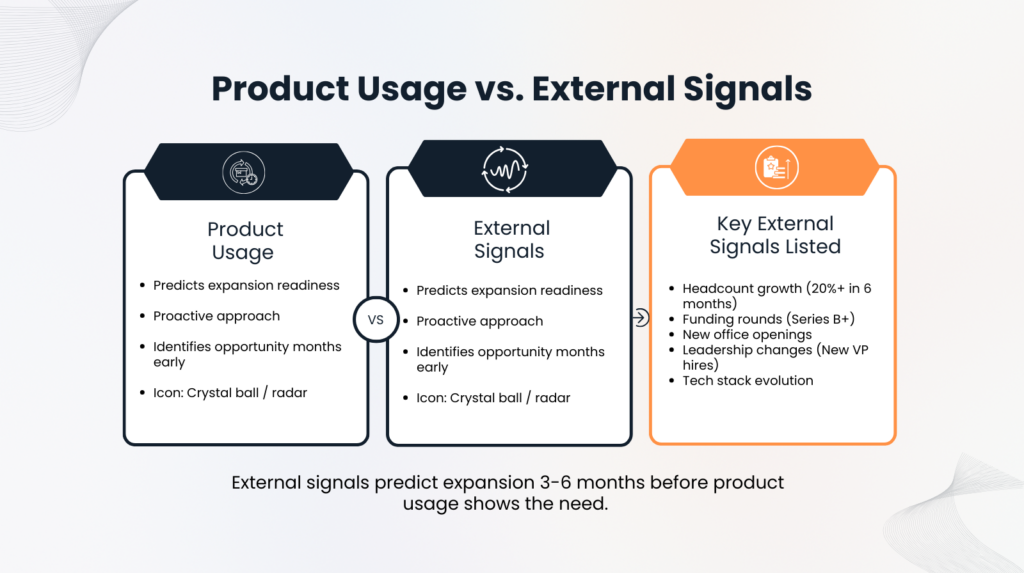
Product usage is the reflection of the way customers interacted with your product yesterday. On the other hand, external signals show you the time when the customers can be ready for the next day expansion.
Your customer has grown from 200 to 350 employees within a year. This is not just a figure of growth. This is actually a direct signal for your Customer Success team sales pitch enterprise, tier licensing. The desire is there even before the usage metrics show the change.
Companies entering development phases generate natural expansion opportunities you need to discover early. Waiting for product adoption to catch up means you’ve already fallen behind.
Growth and Scaling Signals
Rapid scaling is indicated by headcount increase of 20 percent or more in a span of six months. New office openings lead to whitespace opportunities for multi-location licensing. Funding announcements point to the availability of budget and the growth mandate. Series B funding identifies your customer as moving from the scrappy startup phase to a scaling organization with the capital to invest.
Technology Stack Evolution
When your customer adopts Salesforce and you offer CRM integration modules, you have a high-probability cross-sell trigger. Tech stack changes often precede budget reallocation and digital transformation initiatives. Platforms like Packed Data emphasize technographic intelligence because these shifts create immediate integration and capability needs.
Organizational Changes
New VP of Sales hires indicate a bet on sales infrastructure and a desire for sales intelligence tools. Changes in leadership often bring about a different focus and allocation of funds. Such leaders desire to make a difference fast and are more willing to accept new modules or services that fit their new vision.
Business Model Shifts
When a services firm launches a SaaS product, product analytics, customer data platforms, and scalable data infrastructure become very important. When companies change their business models, new expansion opportunities arise even before customers ask for upgrades.
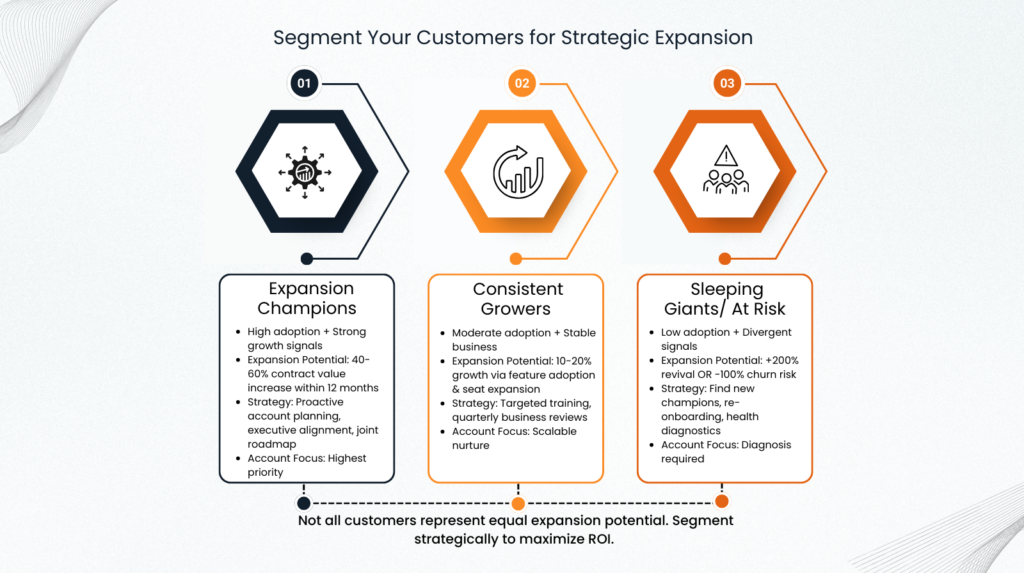
Not all customers represent equal expansion potential. Strategic segmentation transforms expansion from guesswork into strategy.
Expansion Champions (High Adoption + Growth Signals)
These accounts show heavy product usage and strong external growth indicators. They offer 40 to 60 percent contract value increases within 12 months.
Strategy: Proactive account planning with executive alignment and joint roadmap development.
Consistent Growers (Moderate Adoption + Stable Business)
Consistent core feature utilization without large organizational changes generates 10 to 20 percent growth through feature acceptance and seat expansion.
Strategy: Targeted training on untapped competencies and quarterly company reviews.
Giants At Risk or Sleeping (Low Adoption + Divergent Signals)
This category includes both tremendous resurrection potential (positive 200%) and churn risk (negative 100%).
Strategy: Finding new champions or use cases, re-onboarding initiatives, and health diagnostics.
Packed Data’s buyer intent signals and ICP analytics aid in differentiating between accounts that are ready to be revived and those that are headed toward churn.
The Expansion Readiness Score combines multiple inputs: Product usage data, Firmographic intelligence, Technographic signals and Buyer intent data.
This creates a unified predictive indicator. This multi-signal approach powers expansion revenue intelligence at scale.
Systematic expansion requires infrastructure continuously monitoring customer accounts for signals predicting expansion readiness. Manual tracking doesn’t scale.
Packed Data enables automated customer monitoring tracking real-time changes in headcount, tech stack, organizational structure, and market activity. You receive expansion signal alerts the moment key indicators occur, whether a new VP hire or a technographic shift.
Whitespace analysis identifies departments within your current customer accounts not yet using your solution. If you serve marketing but your customer has sales, customer success, and product teams, whitespace analysis quantifies these departmental expansion opportunities.
Parent-subsidiary insights reveal expansion pathways across corporate hierarchies. If you have a foot in the door at a subsidiary, Packed Data shows you the path to the parent company, turning a small deal into a global enterprise contract.
CRM integration for sales intelligence surfaces this customer intelligence directly within Salesforce or HubSpot account records. Sales teams access real-time company insights without leaving their workflow. This transforms your CRM from a static database into a living intelligence system.
Data without action delivers zero value. Structure your expansion approach with standardized playbooks.
Headcount Growth Playbook
Trigger: 20 percent workforce increase in six months.
Outreach: “We’ve seen that your team is expanding rapidly. Let’s discuss how we can support your development.
Offer: Volume pricing, enterprise features, and multi-year plans. Determine the outreach-to-meeting and expansion closure rates.
Tech Implementation Playbook
Trigger: The customer starts using complementary tools.
Outreach: “Great job on going live with Salesforce. Our platform syncs perfectly. “
Offer: Integration modules plus implementation support and training. Measure integration attach rate among customers who adopt additional tools.
New Leadership Playbook
Trigger: Appointment of new executive in department you don’t serve.
Outreach: “Welcome to your new role. Let’s explore how we support your priorities.”
Offer: Customized demos and pilot programs. Monitor response rate from new leaders and departmental expansion rate.
Funding or Acquisition Playbook
Trigger: Funding rounds or acquisitions.
Outreach: “Congratulations on your recent funding. Let’s discuss scaling your data capabilities.”
Offer: Growth packages and enterprise features. Track conversion rate of funded companies to enterprise tier.
Measure expansion rate by signal type, revenue impact per signal, and time from signal detection to closed deal. Best-in-class companies treat expansion metrics as core revenue KPIs.
Organizations relying solely on product usage data react too late. Those combining firmographic insights, technographic intelligence, intent signals, and AI-driven analytics move first.
Establish clear expansion ownership across Customer Success, Account Management, and Sales. Develop signal-specific playbooks with prescribed timing and messaging. Integrate expansion intelligence into daily workflows where teams work. Train teams on expansion identification and commercial conversations.
First, keep an eye on KPIs that are particularly relevant to expansion growth, such as NRR by cohort, expansion pipeline as a proportion of overall pipeline, time from signal to expansion conversation, and expansion rate per customer segment. In addition, make it a point to actively acknowledge and celebrate expansion successes, such as in staff meetings and through the reward system.
With platforms like Packed Data, expansion revenue intelligence becomes predictable, scalable, and measurable. The real growth opportunity isn’t outside your pipeline. It lives inside your existing customer base. The signals are already there. You just need to act on them.